
Contractors and trade professionals frequently battle the frustration of sluggish penetration rates and prematurely burned-out motors when anchoring into high-PSI cured concrete. Selecting between a standard hammer drill and a heavy-duty rotary hammer often leads to costly jobsite delays when the wrong mechanical mechanism is deployed. Historically, teams rely on standard equipment procurement budgets to source versatile, all-purpose tools, hoping a single drill can bridge the gap between light masonry and structural anchoring.
However, investing in a dedicated electro-pneumatic impact tool grants operators unmatched drilling speed and superior vibration reduction, with the crucial stipulation that tool selection must align precisely with your dominant hole-diameter requirements. Relying on specialized SDS-Plus and SDS-Max platforms from industry-leading brands like Bosch and DeWalt provides the necessary torque for demanding masonry applications.
Below, we examine the mechanical distinctions, impact energy ratings, and specific application thresholds of hammer drills versus rotary hammers to help you specify the exact tool required for your next project.
| Factor | Summary |
|---|---|
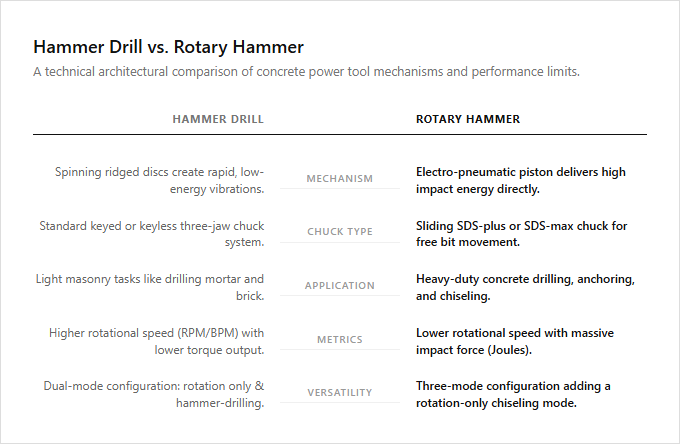
| Impact Mechanism | While a hammer drill relies on two spinning ridged discs to create rapid, low-energy vibrations, a rotary hammer utilizes an electro-pneumatic piston mechanism to deliver much higher impact energy directly to the bit. |
| Chuck Type | Hammer drills typically feature a standard keyed or keyless three-jaw chuck, whereas rotary hammers employ a specialized SDS-plus or SDS-max chuck designed to allow the drill bit to slide back and forth freely. |
| Primary Application | Hammer drills are best suited for light masonry tasks like drilling small-diameter holes in brick or mortar, while rotary hammers excel at heavy-duty concrete drilling, anchoring, and chiseling applications. |
| Performance Metrics | Hammer drills operate at higher RPM and BPM but with lower torque, whereas rotary hammers deliver lower rotational speed but significantly greater impact force measured in Joules. |
| Versatility and Modes | Hammer drills offer dual-mode operation switching between standard drilling and hammer-drilling, while rotary hammers add a third, rotation-only chiseling mode for demolition tasks. |
Electro-pneumatic piston cylinder mechanism versus mechanical ratchet-and-pawl system
Hammer drills employ a mechanical ratchet-and-pawl system, where two ribbed discs slide past each other to create a rapid, shallow hammering action. This high-frequency, low-impact vibration relies heavily on physical user pressure to penetrate material, making the tool highly effective for smaller-diameter holes in masonry or brick.
Rotary hammers utilize an electro-pneumatic piston cylinder mechanism. Within this system, an electric motor drives a piston that compresses air to propel a heavy striker directly into the drill bit, delivering a slower but significantly more powerful impact force that easily fractures dense concrete with minimal operator effort.
Occasional DIYers and residential repair specialists find the versatile hammer drill ideal for light-duty anchoring, while industrial concrete contractors and demolition professionals require the relentless power of a rotary hammer for large-scale drilling and chiseling.
Impact Energy vs. Blows Per Minute
When selecting concrete power tools, understanding the mechanism of action is crucial. Hammer drills rely on a high blows per minute (BPM) frequency generated by two ribbed discs slipping past one another. This rapid, high-frequency percussion delivers low individual impact energy, relying instead on speed and pressure to chip away at lighter masonry materials.
Conversely, rotary hammers utilize a pneumatic piston system to generate much higher impact energy, measured in Joules. Although they operate at a lower BPM frequency than hammer drills, the sheer force of each physical strike allows them to pulverize tough concrete with significantly less user exertion.
Standard hammer drills are best suited for DIY enthusiasts executing light-duty fastening into brick or mortar, whereas heavy-duty rotary hammers are the industry standard for professional contractors performing extensive drilling or chiseling in reinforced concrete.
SDS Quick-Change vs. Standard Keyed Chucks
Standard hammer drills utilize a traditional three-jaw keyed chuck, which relies on friction to hold straight-shank bits. While versatile for light masonry and wood, this design can slip under heavy loads. In contrast, rotary hammers employ specialized SDS-Plus or SDS-Max quick-change chucks. These keyless, slotted drives allow the bit to slide back and forth freely, maximizing impact energy transfer directly to the concrete without rotational slippage.
SDS-Plus chucks accommodate smaller bits for medium-duty anchoring, whereas SDS-Max systems are engineered for heavy-duty demolition. Standard hammer drills with keyed chucks are ideal for DIY enthusiasts performing occasional light fastening, while robust rotary hammers with SDS chucks are essential for professional contractors requiring rapid, high-impact concrete penetration.
Dedicated chiseling mode with rotation-lock function
When selecting concrete power tools, understanding the mechanical differences between a hammer drill and a rotary hammer is essential. The defining distinction lies in the dedicated chiseling mode, which utilizes a rotation-lock function. While hammer drills must always rotate while hammering, rotary hammers allow users to disengage rotation entirely. This lock channels all impact energy into linear striking power, transforming the tool for targeted demolition tasks.
This specialized chiseling capability makes the rotary hammer highly effective for removing tile, scaling concrete, and channeling. Standard hammer drills are ideal for homeowners and DIYers performing light masonry anchoring, whereas rotary hammers are essential for professional contractors who require versatile, heavy-duty drilling and concrete demolition capabilities.
Slip clutch safety mechanism for high-torque bit binding prevention
When drilling into concrete, bit binding poses a significant safety hazard due to sudden high-torque reaction forces. Rotary hammers are engineered with an integrated slip clutch mechanism that disengages the drive shaft when a bit encounters rebar or binds, preventing the tool from violently twisting and injuring the operator. Standard hammer drills, designed for lighter masonry applications, generally lack this heavy-duty safety clutch, meaning any sudden binding transfers the full rotational force directly to the user's wrists.
Choosing between these tools depends heavily on the scale of the application and the required safety margins for high-torque operations. Standard hammer drills are best suited for DIY homeowners performing light-duty fastening in brick or mortar, while rotary hammers are the necessary choice for professional contractors requiring maximum safety and efficiency during heavy-duty structural concrete drilling.
Active vibration control damping systems for operator safety
When selecting concrete power tools, understanding the mechanical distinction between hammer drills and rotary hammers is essential for prioritizing operator safety. Both tools generate significant impact forces to penetrate masonry, exposing users to hand-arm vibration. To mitigate health risks like Hand-Arm Vibration Syndrome (HAVS), modern manufacturers integrate active vibration control damping systems. These systems utilize spring-loaded handles and internal counterweights to decouple the tool's vibration from the operator's grip.
While hammer drills rely on contact discs to create high-frequency vibration, rotary hammers employ a pneumatic piston mechanism that delivers harder, low-frequency blows. Due to the intense impact force of rotary hammers, their vibration damping systems are exceptionally robust, often incorporating tuned mass dampers to absorb kinetic energy. Standard hammer drills are ideal for light-duty renovators and DIY enthusiasts drilling small holes in brick, whereas heavy-duty rotary hammers are the industry standard for professional masonry specialists and structural contractors executing large-scale concrete anchoring.
Pneumatic compression chamber thermal dissipation during extended concrete drilling
During extended concrete drilling, the thermal dissipation capability of a tool's impact mechanism determines its longevity. Rotary hammers utilize a pneumatic compression chamber where a piston compresses air to drive the striker. This rapid pneumatic cycle generates intense localized heat within the chamber, requiring robust magnesium alloy housings and high-grade synthetic lubricants to prevent seal degradation. Standard hammer drills rely on mechanical ridged discs that generate frictional heat rather than pneumatic compression, resulting in lower impact energy but different thermal wear patterns.
Efficient thermal management in rotary hammers ensures consistent impact force during prolonged, high-load applications without risking internal component failure. Standard hammer drills are best suited for homeowners and DIY enthusiasts executing occasional, light-duty masonry tasks, while pneumatic rotary hammers are the industry standard for professional contractors performing continuous, heavy-duty concrete drilling and chiseling.
Leave a comment