
For industrial blasting professionals, managing nozzle wear is a constant, costly challenge. As the nozzle bore expands, system pressure drops, directly degrading abrasive velocity and forcing air compressors to work harder. While many operators accept frequent nozzle replacements as a standard cost of doing business, upgrading to high-performance materials grants your operation dramatically extended service life and sustained pressure consistency.
However, optimizing this investment requires a vital technical stipulation: no single nozzle material is a universal cure-all, as performance is strictly dependent on operating pressure and media selection. For instance, when utilizing highly aggressive abrasives such as aluminum oxide or silicon carbide, the differences in wear resistance between compounds become starkly apparent.
To help you make an informed investment, this article provides a comprehensive comparison between Boron Carbide and Tungsten Carbide nozzles. We will analyze their physical properties, cost-per-hour longevity, and application suitability, offering a clear roadmap to selecting the ideal nozzle for your sandblasting setup.
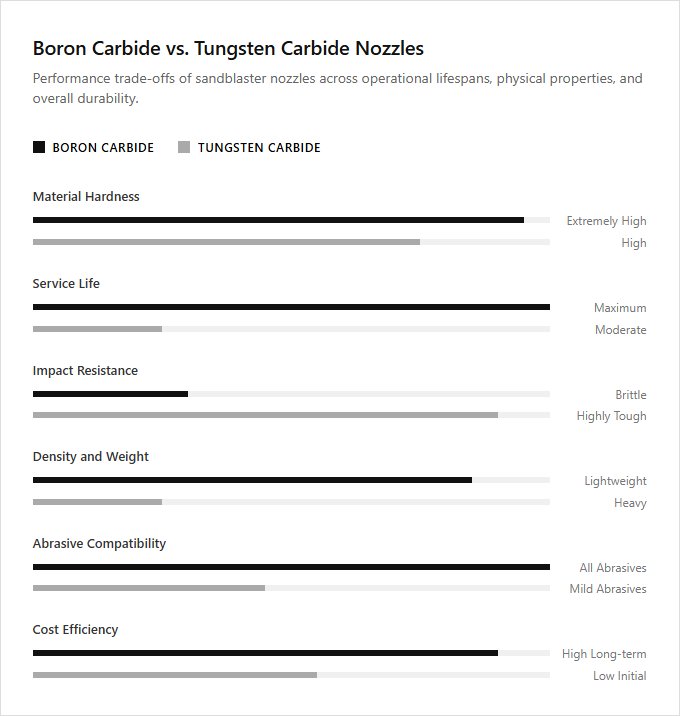
| Factor | Summary |
|---|---|
| Material Hardness | Boron carbide exhibits a much higher Mohs hardness rating than tungsten carbide, making it exceptionally resistant to extreme abrasive wear. |
| Service Life | Boron carbide nozzles offer a significantly longer operational lifespan compared to tungsten carbide when subjected to high-velocity blasting. |
| Impact Resistance | Tungsten carbide possesses superior fracture toughness, making it less brittle and more resistant to mechanical impact if dropped. |
| Density and Weight | Boron carbide has a much lower physical density than tungsten carbide, resulting in a lightweight nozzle that reduces operator fatigue during extended use. |
| Abrasive Compatibility | Tungsten carbide is ideal for softer media like glass beads, whereas boron carbide is required for highly aggressive angular abrasives such as aluminum oxide and silicon carbide. |
| Cost Efficiency | While tungsten carbide has a lower initial purchase price, boron carbide provides better long-term cost efficiency due to reduced downtime and less frequent nozzle replacements. |
Boron Carbide Surpasses Tungsten Carbide in Hardness
When selecting nozzles for industrial sandblasting applications, material composition directly dictates service life and operating efficiency. Boron carbide nozzles represent the premium tier of durability, primarily because boron carbide exhibits a significantly higher Knoop hardness rating than tungsten carbide. This extreme hardness allows boron carbide to withstand highly aggressive media, such as aluminum oxide or silicon carbide, with minimal wear over extended periods.
Tungsten carbide offers superior impact resistance and performs reliably with utility abrasives like glass beads, though it erodes faster under high-velocity compounding. While boron carbide excels in longevity, tungsten carbide provides a cost-effective option for less demanding environments. Industrial operators utilizing aggressive, sharp abrasives require the enduring performance of boron carbide, whereas general contractors performing intermittent, low-pressure blasting are better suited for tungsten carbide.
Tungsten Carbide's Superior Resistance to Mechanical Shock
When selecting nozzle materials for industrial sandblasting, the choice between boron carbide and tungsten carbide depends on the specific demands of your operating environment. Tungsten carbide offers superior fracture toughness, making it significantly less prone to mechanical shock failure. This high resistance to physical impact ensures reliable performance in rugged field conditions where equipment is frequently subjected to rough handling.
Conversely, boron carbide provides extreme hardness and exceptional wear resistance when using aggressive abrasives like aluminum oxide, though it remains highly brittle and susceptible to cracking upon impact. Technicians working in harsh, mobile job sites requiring durable gear benefit most from resilient tungsten carbide, whereas operators in stable, high-volume manufacturing facilities are better suited for the long-lasting wear life of boron carbide.
Lightweight Boron Carbide Reduces Operator Fatigue
When selecting sandblasting nozzles, physical material properties directly impact both operational efficiency and ergonomics. Boron carbide nozzles offer a distinct advantage over tungsten carbide due to their exceptionally low physical density. Because boron carbide is roughly one-third the weight of tungsten carbide, it substantially reduces the weight of the blast hose assembly. This significant weight reduction minimizes operator fatigue, allowing for better tool control during extended shifts.
While tungsten carbide provides excellent shock resistance against physical impact, boron carbide delivers superior wear resistance against aggressive abrasives. Tungsten carbide nozzles are ideal for mobile contractors requiring rugged durability for intermittent field use, whereas boron carbide nozzles are best suited for high-volume, stationary operators performing continuous, manual production.
Aggressive Media Accelerates Tungsten Carbide Nozzle Wear
In industrial sandblasting, nozzle material selection directly impacts operational efficiency and system pressure. While tungsten carbide nozzles offer excellent impact resistance, they experience a significantly faster nozzle orifice diameter wear rate when paired with aggressive media like aluminum oxide or silicon carbide. This rapid degradation leads to premature pressure loss and increased air consumption during operation.
Boron carbide nozzles stand as the superior alternative for resisting extreme abrasive wear, maintaining their inner diameter shape far longer under harsh conditions. Professionals engaged in high-volume, continuous blasting with highly abrasive materials benefit most from boron carbide, whereas utility operators performing intermittent maintenance with milder media find tungsten carbide to be a highly suitable, cost-effective choice.
Durable Boron Carbide for Aluminum Oxide and Silicon Carbide
In industrial sandblasting, nozzle material selection directly impacts operational efficiency and wear life. Boron carbide nozzles represent the pinnacle of wear resistance, delivering optimal durability when paired with highly aggressive abrasive media such as aluminum oxide and silicon carbide. Their extreme hardness minimizes throat expansion, which maintains a consistent blast pattern and pressure over extended periods of heavy-duty use.
By contrast, tungsten carbide nozzles offer excellent impact resistance and perform well with milder abrasives like glass beads or coal slag. While tungsten carbide is more susceptible to rapid wear from aggressive abrasives, its robust structure resists fracturing under rugged job-site conditions. High-volume industrial operators utilizing aggressive media require the longevity of boron carbide, whereas general contractors needing impact-resistant durability for utility blasting are better suited to tungsten carbide.
Boron Carbide Sustains CFM Air Efficiency Longer
When selecting nozzle materials for industrial sandblasting, the choice between boron carbide and tungsten carbide significantly impacts operational cost and efficiency. Boron carbide exhibits extreme hardness, which directly translates to minimal wear at the nozzle orifice over time. Because the internal diameter resists erosion, boron carbide maintains volumetric CFM air consumption efficiency for a longer duration than tungsten carbide, preventing premature pressure drops and reducing compressor strain.
Tungsten carbide remains a durable, impact-resistant option, but its faster wear rate leads to a more rapid increase in air and media consumption. Tungsten carbide is ideal for occasional operators handling less aggressive abrasives in high-impact environments, while boron carbide is best suited for high-volume, professional contractors requiring continuous precision with harsh media like aluminum oxide.
Boron Carbide Lowers Hourly Blasting Costs
When selecting sandblasting nozzles, the choice between boron carbide and tungsten carbide significantly impacts long-term operational expenses. While tungsten carbide offers a lower initial purchase price, boron carbide nozzles deliver exceptional wear resistance under harsh conditions. This extreme durability translates to a vastly superior operational lifespan, offering a significantly lower cost-per-hour blasting efficiency over the life of the nozzle.
Boron carbide withstands aggressive abrasives like aluminum oxide and silicon carbide far better than tungsten carbide, which degrades rapidly under high-impact friction. Maintaining a consistent orifice size over time ensures stable air and media consumption, maximizing compressor efficiency. Tungsten carbide is ideal for occasional DIY enthusiasts blasting with softer media like glass beads, whereas boron carbide is the industry standard for high-volume commercial contractors handling aggressive, highly abrasive materials daily.
Leave a comment