
When executing delicate carving or tight metalworking, utilizing the wrong high-speed tool can easily ruin a workpiece, leaving professionals and hobbyists frustrated by stalled progress. Traditionally, operators rely on standard workshop drills or oversized angle grinders to force their way through highly detailed tasks.
However, upgrading to a specialized high-speed tool grants the operator unmatched precision, allowing for micro-adjustments that standard equipment simply cannot achieve. Yet, a crucial stipulation remains: one must distinguish between the delicate finesse of a compact rotary tool and the raw torque of a pneumatic die grinder to avoid material failure. For instance, engraving intricate glass designs requires a lightweight Dremel-style tool, whereas deburring heavy iron castings demands a robust 1/4-inch die grinder.
To help you make an informed investment, this article compares the mechanics, power sources, and specific applications of both tools, outlining exactly how to choose the optimal instrument for your precision projects.
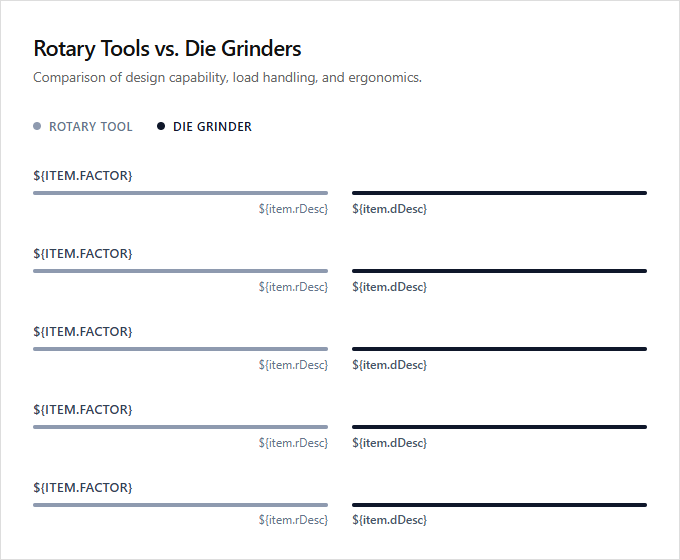
| Factor | Summary |
|---|---|
| Power Output | Die grinders deliver much higher amperage and torque for heavy-duty material removal, whereas rotary tools utilize low-wattage motors designed for delicate tasks. |
| Collet Size | Die grinders typically feature a heavy-duty 1/4-inch collet capacity, while rotary tools utilize smaller 1/8-inch chucks to secure detail-oriented accessories. |
| Speed and Torque | While both maintain high RPM, die grinders leverage pneumatic power to maintain torque under load, preventing motor stalling during heavy grinding. |
| Target Applications | Die grinders are engineered for aggressive abrasive deburring and weld blending, whereas rotary tools are optimized for intricate workpiece detailing. |
| Power Source | Industrial die grinders frequently utilize pneumatic actuation from compressors, whereas commercial rotary tools rely on corded AC currents or lithium-ion battery technology. |
| Tool Ergonomics | Rotary tools feature a lightweight, pencil-grip ergonomic form factor, while die grinders require a robust, two-handed grip to manage gyroscopic forces. |
Rotary Tool vs. Die Grinder Collet Sizes
Rotary tools and die grinders are highly versatile handheld power tools, yet they serve distinct operational scales defined primarily by their collet capacities. Standard rotary tools typically feature a 1/8-inch collet, engineered for high-speed, light-duty applications. This smaller receiver accommodates precision bits, allowing for intricate detailing, engraving, and delicate polishing tasks without overpowering the workpiece.
Die grinders utilize a larger 1/4-inch collet, which accepts heavy-duty shanks capable of handling substantial torque and power. This robust interface supports larger grinding stones, carbide burrs, and cutoff wheels designed for rapid material removal in demanding metalworking environments. Precision-focused hobbyists and crafters benefit most from the delicate control of a rotary tool, while professional mechanics, welders, and heavy fabricators require the high-torque capability of a die grinder.
Rotary Tool Speed Control for Delicate Materials
Rotary tools and die grinders share a similar inline design, but they differ significantly in scale, power, and speed control. While die grinders operate at high torque for heavy-duty material removal, rotary tools excel in precision tasks through advanced speed variance. Utilizing high-RPM variable-speed controls that typically range from 5,000 to 35,000 RPM, rotary tools allow operators to finely tune the velocity. This precise adjustment is crucial when working with delicate materials like thin plastics or softwoods, as lower speeds prevent thermal damage and melting, while higher speeds facilitate clean engraving on glass or metal.
Selecting the appropriate tool depends on the scope of the task and the required precision. Die grinders are suitable for industrial fabricators and automotive mechanics performing heavy grinding, whereas rotary tools are ideal for hobbyists, jewelers, and detail-oriented artisans requiring meticulous control over delicate workpieces.
Spindle runout tolerance levels affecting micro-machining precision and bit deflection
Rotary tools and die grinders differ significantly in spindle runout tolerances, which directly impacts micro-machining precision. High-quality rotary tools often feature tighter spindle tolerances designed to minimize runout, ensuring that miniature carbide burrs and micro-drill bits rotate on a true axis. This precision prevents bit deflection, which can cause erratic cuts, poor surface finishes, or tool breakage during intricate machining tasks.
Die grinders, engineered for heavier-duty material removal, typically tolerate slightly higher runout levels due to their robust bearings and larger collet systems. While this variance is negligible for heavy grinding, it compromises ultra-fine engraving or micro-milling. Rotary tools are ideal for hobbyists and jewelers requiring delicate, high-precision detailing, whereas die grinders suit industrial fabricators and automotive technicians executing high-torque, heavy-duty material removal.
Electric vs. Pneumatic Grinders: Stall Torque Comparison
Electric rotary tools offer exceptional precision but are limited by the stall torque of their compact electric motors. Under heavy loads or excessive pressure, these motors easily bog down or stall to prevent electrical overheating, prioritizing high rotational speeds over raw mechanical force.
Pneumatic die grinders utilize compressed air to deliver high, unrelenting torque that resists stalling under extreme resistance. This industrial capability allows for rapid, heavy-duty material removal without the risk of motor burnout.
Detailed hobbyists requiring intricate engraving or polishing excel with electric rotary tools, while industrial fabricators and automotive mechanics demand the relentless power of pneumatic die grinders.
Versatile Abrasive Compatibility: Diamond to Carbide Burrs
Rotary tools and die grinders serve distinct roles in material removal based on their power profiles and accessory compatibility. Rotary tools excel in high-precision applications, operating at high RPMs with lower torque. They are engineered to accommodate miniature abrasive media, typically utilizing 1/8-inch or 3/32-inch shanks to spin delicate diamond points, small engraving cutters, and miniature polishing wheels without damaging fragile workpieces.
Die grinders utilize high-torque motors to drive larger, heavy-duty abrasive media. These tools accept 1/4-inch or 6mm shanks, making them compatible with aggressive tungsten carbide burrs, large mounted grinding stones, and flap wheels designed for rapid stock removal. Hobbyists and jewelers requiring intricate detail work benefit most from rotary tools, while industrial fabricators and mechanics need the rugged power of die grinders.
Handpiece ergonomics allowing for pencil-grip control during intricate engraving tasks
While rotary tools and die grinders share similar mechanics, their ergonomics dictate their applications. Rotary tools feature a lightweight, slender chassis engineered for precision. This compact design allows for a natural pencil-grip, bringing the fingers close to the accessory for maximum control during intricate engraving tasks. Conversely, die grinders are larger, heavier industrial tools designed for a full-fist grip, prioritizing high-torque power over delicate manipulation.
The handpiece ergonomics directly influence tool selection based on the project's scale. Jewelers, hobbyists, and artists requiring extreme precision for detailed engraving favor the rotary tool, while heavy-duty fabricators, welders, and mechanics requiring rapid material removal rely on the die grinder.
Duty cycle ratings and thermal dissipation capabilities during continuous-use applications
Rotary tools and die grinders differ significantly in their thermal management and duty cycle ratings. Standard rotary tools are engineered for intermittent, precision-oriented tasks; their compact motors generate heat rapidly under sustained loads, requiring frequent cool-down periods to prevent internal damage. In contrast, heavy-duty die grinders feature robust metal gear housings and high-efficiency cooling fans designed specifically for continuous-use applications. These industrial-grade tools dissipate heat rapidly, allowing them to maintain high torque and run continuously without thermal degradation.
Selecting the correct tool depends on your project demands and frequency of use. Rotary tools are ideal for hobbyists and crafters performing detailed, light-duty engraving, while die grinders are suited for professional metalworkers and fabricators requiring sustained power for heavy-duty material removal.
Leave a comment