
Achieving flawless finishes without compromising workpiece integrity remains a persistent challenge for precision craftsmen and industrial technicians. Too often, improper rotational speed selection results in scorched hardwoods, melted polymers, or prematurely fractured accessories. While standard equipment funding sources typically prioritize heavy-duty, stationary machinery, allocating budget to specialized hand-held tooling is equally critical for operational efficiency.
Investing in a platform that grants operators exact RPM control directly mitigates these costly material failures. However, achieving this level of operational versatility stipulates that users thoroughly understand the mechanical limits of their drivetrain. From heavy-duty industrial deburring to delicate jewelry engraving, matching motor velocity to material density is paramount for professional-grade results.
This article analyzes the core distinctions between fixed and variable speed rotary tools, evaluates their performance across diverse applications, and provides a clear decision framework to help you optimize RPM control in your workshop.
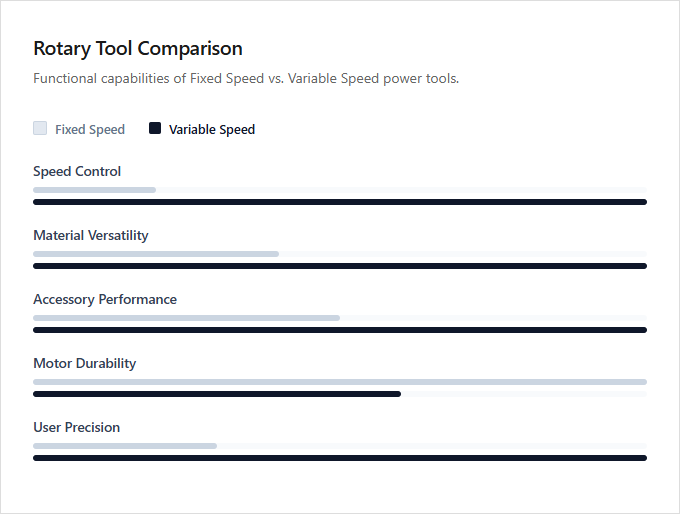
| Factor | Summary |
|---|---|
| Speed Control | Fixed speed tools operate at a single high rate of revolutions per minute (RPM), whereas variable speed models allow the operator to adjust the velocity to match specific application requirements. |
| Material Versatility | Variable speed units prevent thermal deformation when working on delicate substrates like plastic, while fixed speed units are restricted to harder materials like metal and glass. |
| Accessory Performance | Adjusting the speed optimizes the centrifugal force and cutting efficiency of different attachments, preventing premature abrasive wear of grinding stones and cutting wheels. |
| Motor Durability | Fixed speed rotary tools feature a simpler motor armature configuration with fewer electronic speed control components, reducing potential failure points in the circuitry. |
| User Precision | Variable speed tools utilize a potentiometer dial to deliver consistent torque at lower speeds, ensuring meticulous control during intricate deburring and engraving tasks. |
Material-specific SFPM optimization
Rotary tool performance relies heavily on maintaining the correct Surface Feet Per Minute (SFPM) for the target material. Variable speed rotary tools excel in this area, allowing operators to dial in precise rotations per minute (RPM) to match workpiece density. This optimization prevents heat buildup in delicate plastics and avoids tool degradation when cutting hardened metals, ensuring clean finishes and prolonged accessory life.
Fixed speed tools operate at a single, high RPM. While this simplicity ensures maximum torque for demanding tasks, it lacks the versatility required for materials susceptible to melting or burning. Fixed speed models are ideal for dedicated, single-task operators performing heavy grinding, whereas variable speed models are best suited for detailed craftspeople and technicians working with diverse material types.
Electronic feedback circuitry for constant torque
Fixed-speed rotary tools operate at a single, maximum RPM, whereas variable-speed models offer adjustable velocity to match specific materials. A critical advancement in premium variable-speed tools is electronic feedback circuitry. This technology monitors the load on the motor and automatically adjusts power to maintain constant torque and speed under resistance, preventing stalling during demanding applications.
While fixed-speed tools deliver reliable, high-speed power, they lack the adaptability required for heat-sensitive materials. In contrast, variable-speed models equipped with feedback circuitry provide the exact precision and power needed for intricate carving, polishing, and heavy grinding alike. Fixed-speed models are best suited for production line workers performing repetitive, high-speed cutting tasks, while variable-speed tools with feedback control are ideal for versatile trade professionals and hobbyists working with a wide range of materials.
Resonant frequency and vibration harmonics mitigation
When operating rotary tools, managing vibration is critical for maintaining precision and reducing hand fatigue. Fixed-speed models operate at a constant, high RPM, which can frequently trigger resonant frequencies if the tool's rotational speed matches the natural frequency of the workpiece or accessory. This alignment generates constructive harmonic interference, resulting in intense vibration. Variable-speed rotary tools mitigate this issue by allowing operators to adjust the RPM, effectively shifting the excitation frequency away from these resonant peaks to dampen harmful harmonics.
By altering the speed, users can bypass specific vibration nodes that cause material chatter or tool instability. Fixed-speed tools are best suited for production-line operators performing repetitive, single-material tasks such as high-volume cutting, whereas variable-speed tools are ideal for multi-disciplinary craftspeople and technicians who require precise harmonic control across diverse materials.
Thermal dissipation and motor duty cycle efficiency
Fixed-speed rotary tools are engineered to run at a single, high RPM, allowing the internal cooling fan to operate at constant maximum efficiency. This continuous airflow provides superior thermal dissipation, maintaining a stable motor temperature and enabling longer duty cycles under sustained loads.
Variable-speed models offer versatility but experience reduced cooling efficiency at lower speed settings. Because the internal fan spins slower at reduced RPMs, heat dissipates less effectively, requiring shorter duty cycles to prevent motor degradation during demanding tasks. Fixed-speed models are ideal for industrial operators performing repetitive, high-speed cutting, whereas variable-speed units suit detail-oriented artisans working with diverse materials.
Accessory maximum rated RPM safety thresholds
When choosing a rotary tool, accessory safety thresholds must dictate your decision. Fixed-speed models operate at a single high velocity, typically 35,000 RPM. This constant speed poses a safety hazard if you attach accessories like wire brushes or polishing wheels, which have lower maximum rated RPMs and can disintegrate under excessive force.
Variable-speed tools provide critical control, allowing operators to match the tool's output to the safety limits stamped on each attachment. Keeping the RPM below these thresholds prevents accessory failure and material damage. Fixed-speed models suit production workers performing repetitive, high-speed cutting, whereas variable-speed units are ideal for hobbyists and restorers working with diverse materials.
Material removal rate optimization
Optimizing the material removal rate with a rotary tool depends heavily on matching spindle speed to the specific workpiece. Fixed-speed rotary tools run constantly at maximum velocity, typically around 35,000 RPM. This high speed maximizes material removal rates on dense materials like steel, glass, or stone, where maintaining top RPM prevents stalling and ensures rapid, efficient cutting action.
Variable-speed models allow precise RPM adjustments, which is critical for optimizing material removal across diverse material densities. Lowering the speed prevents melting on plastics and burning on softwoods, ensuring steady debris clearing without damaging the substrate or clogging the accessory. Fixed-speed tools suit production line operators requiring rapid, repetitive cutting of uniform hard materials, while variable-speed models are ideal for restoration specialists and hobbyists working with a broad range of sensitive and robust media.
Pulse-width modulation speed regulation
Rotary tools are primarily categorized into fixed-speed and variable-speed models. Fixed-speed tools operate at a single, high RPM, delivering consistent power for straightforward applications. Modern variable-speed rotary tools achieve greater adaptability through Pulse-width modulation (PWM) speed regulation. This advanced electronic method controls power by rapidly switching the motor's voltage on and off, which maintains high torque even at lower rotational speeds.
By using PWM, the tool avoids the power loss and overheating common in older voltage-reduction methods. Fixed-speed models are suited for industrial operators performing repetitive, single-purpose cutting or grinding, while variable-speed PWM tools are ideal for detail-oriented craftspeople and restorers working with diverse materials.
Leave a comment