
Executing precision detail work with a handheld rotary tool often introduces a frustrating compromise: achieving the necessary spindle angle frequently results in acute hand fatigue and severely obstructed visibility. While standard workshop funding sources and equipment budgets typically prioritize upgrading the primary power units themselves, optimizing the physical interface between the operator and the workpiece yields far greater immediate efficiency. Investing in specialized ergonomic attachments grants operators unprecedented control, effectively transforming a bulky motor housing into a highly maneuverable, pen-like instrument.
However, we must stipulate that achieving maximum utility requires matching the specific mechanical interface to the task; a misapplied tool can compromise torque. For example, deploying the flexible Dremel 225-01 Flex Shaft offers pen-grip delicacy for engraving, whereas the rigid Dremel 575 Right Angle Attachment is engineered for high-torque, perpendicular clearance.
This comparative guide evaluates both configurations, analyzing their torque transmission efficiency, ergonomic benefits, and spatial accessibility to help you optimize your workshop's handheld operations.
| Factor | Summary |
|---|---|
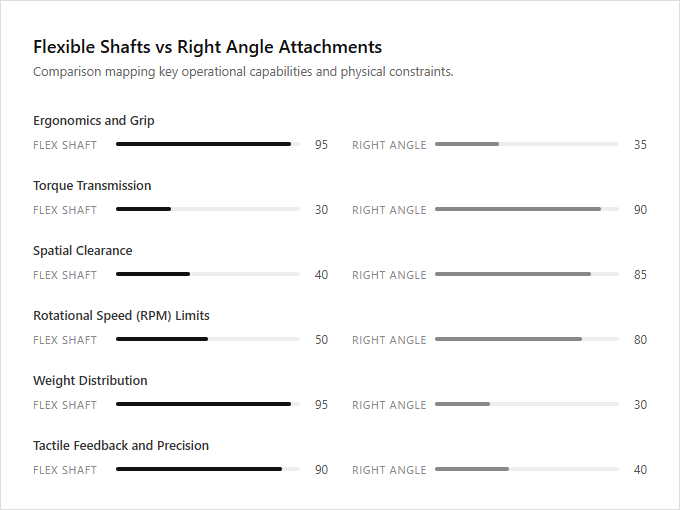
| Ergonomics and Grip | Flexible shafts utilize a lightweight, pencil-grip handpiece to maximize dexterity and reduce user fatigue, whereas right-angle attachments retain a bulkier profile that requires a pistol or palm grip. |
| Torque Transmission | Flexible shafts transfer rotational energy through a flexible inner steel core subject to torsional deflection under load, while right-angle attachments employ rigid bevel gears for direct, high-torque power transfer. |
| Spatial Clearance | Right-angle attachments excel in tight, perpendicular recesses with minimal vertical clearance, whereas flexible shafts require a continuous bend radius to prevent kinetic binding and overheating. |
| Rotational Speed (RPM) Limits | Flexible shafts are constrained by friction-induced heat generation that limits their maximum safe RPM, whereas gear-driven right-angle attachments can handle higher rotational velocities. |
| Weight Distribution | Flexible shafts isolate the heavy motor housing of the rotary tool on a hanger stand, while right-angle attachments add cantilevered weight directly to the operator's wrist. |
| Tactile Feedback and Precision | Flexible shafts provide superior tactile sensitivity for delicate tasks like micro-abrasion and engraving, while right-angle attachments offer the structural rigidity needed for aggressive milling and sanding. |
Flexible Shafts vs. Bevel Gears: Backlash and Wind-Up
Flexible shafts offer maneuverability by transmitting power through a rotating internal cable. This design introduces torsional backlash and core wind-up, where the inner cable twists under resistance. This elasticity causes minor rotational lag and sudden speed surges when load conditions change, affecting precision during delicate applications.
Right-angle attachments employ a rigid bevel gear drive to redirect rotational force. This solid mechanical coupling eliminates torsional wind-up, delivering instantaneous torque and maintaining stable spindle speeds under heavy pressure.
Flexible shafts are ideal for detailed crafters requiring lightweight, pen-like control for intricate engraving, while right-angle attachments suit industrial technicians executing heavy-duty cutting or grinding in restricted structural spaces.
Flexible Core Bend Radius vs. Right-Angle Gearbox Clearance
Flexible shafts and right-angle attachments solve distinct spatial challenges in rotary tool applications. Flexible shafts rely on an internal rotating core that requires a minimum bend radius-typically several inches-to prevent binding, friction, and premature cable failure. Conversely, right-angle attachments utilize a fixed, rigid gearbox to deliver a constant ninety-degree direction change. This mechanical configuration provides a highly compact, low-profile clearance that easily accesses tight, linear recesses where a looping flexible shaft cannot physically fit.
While the flexible shaft reduces hand fatigue by transferring the tool's weight, the right-angle attachment provides stable, perpendicular leverage. Fine-scale modelers and engravers seeking maximum dexterity prefer the lightweight flexible shaft, while automotive mechanics and cabinet makers navigating obstructed joints rely on the rigid right-angle attachment.
Balancing Motor Housing to Reduce Operator Strain
Flexible shafts significantly reduce musculoskeletal load by completely divorcing the heavy motor housing from the operator's hand. By suspending the motor overhead or placing it on a bench, the handpiece weight is minimized to mere ounces. This configuration eliminates static muscle fatigue in the forearm and shoulder during extended operational periods.
Right-angle attachments redistribute mass by shifting the tool's center of gravity closer to the work surface. While the operator still supports the motor's weight, the perpendicular orientation allows for a more natural, ergonomic wrist alignment in confined spaces, mitigating repetitive strain.
Flexible shafts are ideal for detail-oriented artisans requiring maximum dexterity for intricate engraving, whereas right-angle attachments best serve automotive technicians or remodelers navigating tight, structural recesses.
RPM Limits: Sheath Friction vs. Gear Thermal Constraints
Flexible shafts transmit rotational power through a spinning internal core. At high speeds, typically exceeding 20,000 RPM, continuous friction between this core and the outer protective sheath generates substantial heat. This thermal buildup degrades internal lubricants and compromises structural integrity, establishing a strict upper RPM threshold for safe operation.
In contrast, right-angle attachments redirect rotational force using internal bevel gears. Their speed limits are dictated by gear-mesh thermal limitations, where high-velocity friction and tooth impact generate localized heat. Without active cooling, exceeding these mechanical RPM thresholds leads to rapid gear wear or thermal expansion lockup.
Flexible shafts are ideal for jewelers and hobbyists requiring maximum manual dexterity for prolonged detail work, whereas right-angle attachments are best suited for industrial technicians performing heavy-duty, intermittent cutting in confined structural spaces.
Spindle runout and dynamic balancing differences affecting precision grinding tolerances
Flexible shafts rely on a rotating inner cable that inherently introduces torsional flex and minor dynamic imbalance. This cable whip increases spindle runout under high-speed grinding, slightly compromising strict concentricity. While excellent for maneuverability, the variable tension limits its effectiveness for micro-tolerance applications requiring absolute axial stability.
Right angle attachments employ rigid bevel gears to redirect power. This fixed mechanical linkage drastically reduces radial play and maintains a stable rotational axis, resulting in superior spindle runout control and tighter grinding tolerances. Flexible shafts are ideal for artisans requiring maximum hand dexterity and intricate detailing, whereas right angle attachments are suited for industrial machinists executing precise, perpendicular deburring in confined spaces.
Multi-Axis Maneuverability vs. Fixed Spindle Orientation
Flexible shafts provide exceptional multi-axial degrees of freedom by transmitting rotational power through a pliable, decoupled cable. This architecture relieves the user of motor weight, enabling fluid, pen-like maneuverability to navigate intricate three-dimensional geometries and organic contours with high precision.
Conversely, right-angle attachments utilize a rigid gear system to establish a fixed, ninety-degree orthogonal spindle orientation. This configuration excels in delivering stable, perpendicular torque within confined parallel clearances where straight access is restricted. Flexible shafts are ideally suited for fine-detail artisans and woodcarvers requiring fluid artistic dexterity, while right-angle attachments are best for trade professionals and mechanics performing heavy-duty, perpendicular fastening in structural recesses.
Torque Loss: Core Friction vs. Gear Drag
Flexible shafts transmit rotational power through a coiled steel inner core spinning within a protective sheath. This configuration introduces continuous internal core friction, which escalates when the shaft is bent during operation. This surface-to-surface contact converts valuable torque into heat, diminishing power transmission efficiency under heavy workloads.
Right-angle attachments employ a mechanical bevel gear train to redirect rotational force. Efficiency losses in these units arise from gear mesh drag, bearing resistance, and backlash rather than continuous sleeve friction. While gear mechanisms maintain a more rigid torque transfer under load, they introduce mechanical inertia and require routine lubrication to mitigate heat and wear.
Flexible shafts suit jewelers and detail carvers requiring maximum fingertip dexterity, while right-angle attachments are ideal for cabinetmakers and tradespeople needing high-torque power in tight, structural corners.
Leave a comment