
Achieving a flawless, mirror-like finish is a constant battle for detailing professionals and enthusiasts alike. Many struggle with persistent micro-marring, or worse, the frustrating stalling of a polishing pad just when they need cutting power the most. Traditionally, detailers rely on entry-level, standard orbital polishers as their primary path to correction. However, understanding the mechanical distinction between forced rotation and free-spinning dual action systems grants operators absolute control over correction efficiency and paint safety.
Of course, maximizing these tools carries the stipulation that your choice must align with paint clear-coat hardness and user technique. Renowned industry standards like the gear-driven Flex XC 3401 and the free-spinning Rupes LHR 21 demonstrate how these distinct actions perform under professional pressure.
In this guide, we will dissect the mechanical differences of both drive systems, evaluate their efficiency on various clear coats, and help you determine which motion best elevates your paint correction workflow.
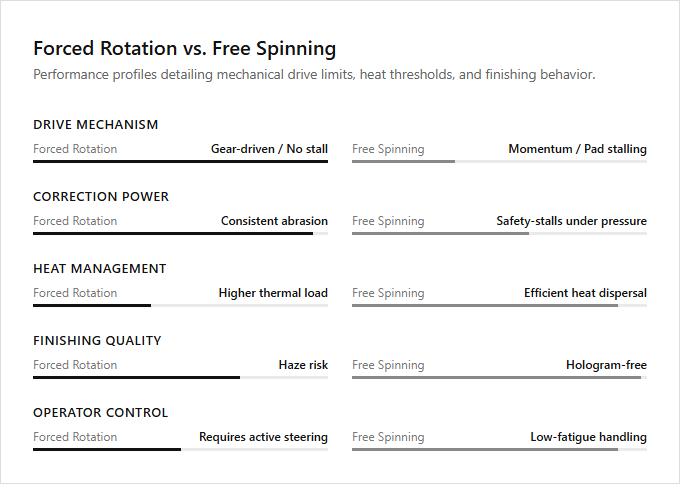
| Factor | Summary |
|---|---|
| Drive Mechanism | Forced rotation utilizes a gear-driven orbital mechanism to prevent pad stalling, while free spinning relies on a momentum-driven spindle assembly. |
| Correction Power | Forced rotation provides consistent rotational abrasion for rapid defect removal, whereas free spinning safety-stalls under high pressure to prevent burn-through. |
| Heat Management | Forced rotation generates a higher thermal load on the clear coat, whereas free spinning disperses heat more efficiently via random orbital motion. |
| Finishing Quality | Free spinning polishers excel at removing compounding haze to produce a hologram-free finish due to their irregular orbital path. |
| Operator Control | Forced rotation demands active steering due to the walking effect of the gears, whereas free spinning offers smoother, low-fatigue handling. |
Prevention of pad stalling through gear-driven forced rotation
Dual-action polishers are divided into free-spinning and gear-driven forced rotation designs. Free-spinning models rely on centrifugal force, making them susceptible to pad stalling when pressure is applied or when navigating curved vehicle panels. In contrast, forced-rotation polishers utilize a direct gear drive that prevents pad stalling entirely. This mechanical connection ensures the pad continues rotating and oscillating regardless of downward pressure or surface contours.
By maintaining consistent movement, gear-driven tools deliver uniform cutting power and predictable heat generation across all areas of the paintwork. Free-spinning polishers are ideal for enthusiasts seeking risk-free finishing, whereas forced-rotation models suit experienced professionals requiring rapid, consistent correction on complex surfaces.
Utilization of random orbital oscillation to minimize paint safety risks
Both forced-rotation and free-spinning dual-action polishers leverage random orbital oscillation to safeguard automotive clear coats. By combining a rotational movement with a secondary orbital path, these machines distribute friction across a wider surface area. This orbital deviation prevents the intense, localized heat buildup common with traditional rotary polishers, significantly reducing the risks of paint burn-through and holograms.
The primary distinction lies in how they manage resistance. Free-spinning models allow the rotation to stop under heavy pressure, acting as a built-in safety mechanism against over-polishing. Forced-rotation units utilize a gear-driven mechanism to maintain constant rotation regardless of downward force, providing faster defect correction while retaining the safety benefits of oscillation. Free-spinning polishers are ideal for enthusiasts and beginners prioritizing maximum safety, whereas forced-rotation machines are best suited for seasoned detailers requiring predictable cutting power on rigid body lines.
Consistent torque delivery on complex body panel curves
When detailing intricate automotive body panels, the choice between forced rotation and free-spinning dual-action polishers centers on torque management. Free-spinning polishers rely on centrifugal force, meaning the backing plate can stall when encountering deep concaves, sharp swage lines, or increased operator pressure. While this mechanism prevents paint burn-through, it requires precise technique to maintain pad rotation over complex curves.
Forced rotation polishers utilize a gear-driven mechanism that dictates both orbital and rotational movements. This design ensures uninterrupted torque delivery, preventing pad stall regardless of surface contours or downward pressure. Gear-driven tools are highly favored by collision repair professionals needing rapid, predictable defect removal on complex panels, whereas free-spinning models are best suited for enthusiasts seeking a safer, more forgiving correction process on flat or gently curved surfaces.
Control of heat dissipation on delicate clear coats
Forced rotation dual-action polishers utilize a gear-driven mechanism that maintains constant pad rotation regardless of downward pressure. While this delivers consistent cutting power, the continuous friction generates significant localized heat, requiring precise technique and constant movement to prevent damage on delicate clear coats.
Free-spinning polishers rely on a momentum-driven system that stalls when excessive force is applied. This inherent safety feature prevents dangerous friction spikes, allowing thermal energy to dissipate naturally and making it highly effective for managing temperatures on sensitive paintwork.
Forced rotation units are best suited for high-volume collision professionals requiring rapid correction times, whereas free-spinning models are ideal for detailing enthusiasts and risk-averse operators seeking maximum safety on thin finishes.
Variations in orbit throw size affecting defect removal speed
Dual-action polishers utilize either forced rotation or free-spinning mechanisms, where orbit throw size plays a critical role in defect removal speed. In free-spinning machines, a larger orbit throw increases the pad's surface coverage and velocity, accelerating correction times on flat areas. However, excess downward pressure or complex curves can stall the rotation, which reduces efficiency.
Forced-rotation polishers maintain a constant, gear-driven spin regardless of the load applied. When paired with smaller, concentrated orbit throws, they deliver relentless cutting power over ridges and contoured panels without stalling. Free-spinning models with large throws are ideal for production detailers seeking rapid coverage on flat panels, while forced-rotation units are best suited for precision-focused technicians managing intricate body lines and severe paint defects.
Reduction of hologram creation compared to rotary action
Rotary polishers often introduce unsightly holograms and buffer trails due to their single, continuous axis of rotation. In contrast, dual-action polishers utilizing either forced rotation or free-spinning mechanisms significantly reduce this risk. By combining rotation with an orbital oscillation, both systems disperse friction and prevent the concentrated heat buildup that causes holograms, resulting in a safer, more consistent finish.
While both designs mitigate paint damage, they behave differently under load; forced rotation maintains a gear-driven spin under pressure, whereas free-spinning pads stall to prevent over-correcting. High-volume detailing professionals seeking rapid defect correction with absolute control choose forced rotation, whereas enthusiasts and beginners prioritizing maximum safety against paint burn-through prefer free-spinning polishers.
Impact of backing plate mass on counterweight balance
Free-spinning dual-action polishers rely on a precise equilibrium between the internal counterweight and the rotating assembly. The mass of the backing plate directly dictates this balance. Altering the factory-specified plate mass disrupts this calibration, generating severe vibration that dampens the free-spinning rotation and accelerates tool wear.
Forced rotation polishers utilize a gear-driven mechanism that maintains rotation regardless of downward pressure. While backing plate weight still influences overall tool harmonics, the positive drive system absorbs these mass imbalances far more effectively than free-spinning alternatives. Free-spinning models are ideal for enthusiasts seeking safe, hologram-free finishing, while forced-rotation units suit high-volume professionals requiring consistent, aggressive defect removal.
Leave a comment