

Achieving flawless, tear-out-free bevels and highly repeatable depth adjustments remains a persistent challenge for woodworkers, often resulting in ruined hardwood stock due to base instability. While standard workshop equipment budgets typically prioritize a traditional fixed-base model as the default routing solution, limiting yourself to standard acquisitions restricts your technical capabilities.
Investing in specialized machinery-specifically comparing tilt bases to plunge bases-grants operators the precise mechanical leverage required to eliminate manual templates. This transition carries the stipulation that users must align workpiece geometry with the specific torque profiles and weight distributions of each base. For example, executing a complex chamfer on a white oak tabletop or milling a blind mortise requires distinct stabilization methods.
Below, we examine the mechanical differences between tilt and plunge designs, evaluating their efficiency in bevel milling and micro-depth adjustment to help you select the ideal router for your workflow.
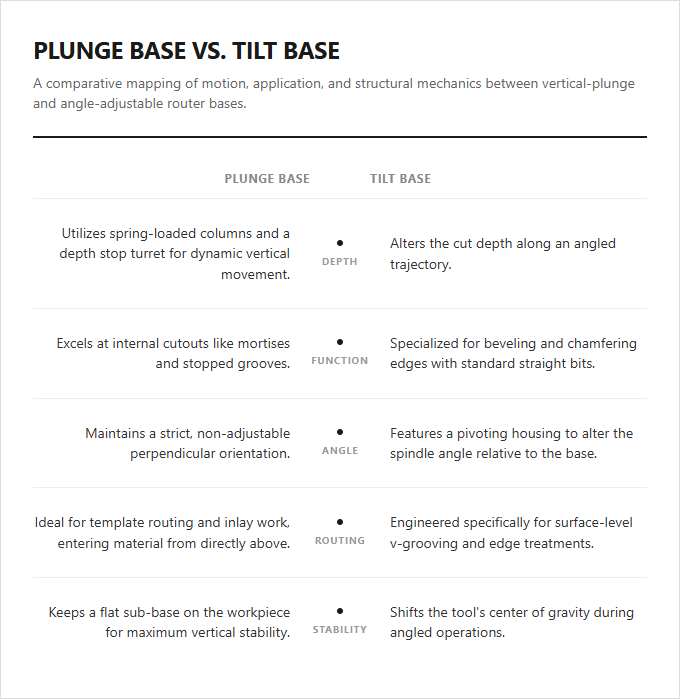
| Factor | Summary |
|---|---|
| Depth Adjustment | While the plunge base utilizes spring-loaded columns and a depth stop turret for dynamic vertical movement, the tilt base alters the cut depth along an angled trajectory. |
| Primary Function | Plunge bases excel at internal cutouts like mortises and stopped grooves, whereas tilt bases are specialized for beveling and chamfering edges with standard straight bits. |
| Angled Cutting | The tilt base features a pivoting housing to change the spindle angle relative to the base, while a plunge base maintains a strict perpendicular orientation. |
| Specialized Routing | Plunge bases are ideal for template routing and inlay work because they allow the bit to enter the material from above, whereas tilt bases are designed for surface-level v-grooving. |
| Stability and Control | A plunge base maintains a flat sub-base on the workpiece for superior stability during vertical plunge strokes, whereas a tilt base shifts the tool's center of gravity during angled operations. |
Tilt base angular adjustment range for bevel milling and chamfering
When selecting a router base, the choice between a tilt base and a plunge base depends on the required axis of operation. A tilt base offers specialized angular adjustment, typically ranging from -30 to 45 degrees, which enables precise bevel milling and chamfering using standard straight bits. This adjustable orientation provides highly accurate, repeatable angled cuts along workpiece edges without requiring specialized chamfering tooling.
Conversely, a plunge base operates strictly on a vertical axis, allowing the operator to lower the cutter directly into the workpiece face for internal cuts such as mortises and templates. While the plunge base excels at controlled vertical depth transitions, it lacks the angular versatility inherent to the tilt design. Detailed edge-profilers and installers requiring custom bevel angles benefit most from the specialized tilt base, whereas general cabinetmakers and furniture builders executing internal joinery find the plunge base more suitable for their operations.
Plunge depth capacity controlled by spring-loaded guide columns
When selecting a router base, understanding the mechanical differences in depth control is essential. A plunge base utilizes spring-loaded guide columns to govern plunge depth capacity, allowing the operator to smoothly lower the spinning cutter vertically into the workpiece. This design provides precise control over multi-stage depth adjustments and safe, controlled entries into the wood. In contrast, a tilt base sacrifices vertical plunging mechanics in favor of angular adjustments, pivoting the motor housing to cut precise bevels and chamfers at a fixed depth setting.
The spring-loaded columns on the plunge base offer a safety advantage by automatically retracting the bit when downward pressure is released. Meanwhile, the tilt base excels at creating consistent angled profiles along workpiece edges without the need for specialized bevel bits. Woodworkers executing intricate interior cuts like mortises and inlays will find the plunge base indispensable, while craftspeople performing frequent edge-shaping and custom joinery are best served by the tilt base.
Turret depth stop with micro-fine adjustment dials for incremental passes
When selecting a router base, depth control mechanisms dictate project precision. The plunge base excels in vertical repeatability, incorporating a multi-position turret depth stop with micro-fine adjustment dials. This configuration enables craftsmen to execute precise, incremental passes by stepping down the cut depth systematically, protecting both the workpiece and the router motor. Tilt bases, by comparison, focus on angular orientation, allowing the spindle to pivot while relying on standard locking collars rather than stepped turret systems for depth regulation.
The choice between these systems depends on your specific workshop requirements. Plunge bases are suited for furniture makers performing repetitive, deep vertical cuts like mortises, while tilt bases are ideal for specialty trim carpenters and luthiers requiring precise beveling and custom chamfered edges.
Rack-and-pinion gear mechanism for precise tilt angle calibration
Choosing between a tilt base and a plunge base depends on the specific demands of your woodworking projects. The tilt base is engineered for specialized beveling and joinery, utilizing a sophisticated rack-and-pinion gear mechanism. This gearing system allows craftsmen to make precise micro-adjustments for exact tilt angle calibration, ensuring perfectly matched compound angles on complex trim work and chamfered edges.
In contrast, the plunge base excels at vertical depth control, allowing the router bit to descend directly into the center of a workpiece for interior cuts. While it lacks the angular calibration of the rack-and-pinion tilt system, its spring-loaded columns provide unmatched stability for mortises and routing templates. The plunge base is ideal for cabinetmakers performing frequent interior cutouts, whereas the tilt base is best suited for finish carpenters executing precise beveling and custom molding alignment.
Plunge lock lever mechanics for stabilizing the depth of cut
A tilt base router offers specialized angular precision, allowing woodworkers to make beveled cuts at set degrees. This base relies on a mechanical lock to secure both the angle and the depth of cut, providing rigid stability during edge-routing operations.
The plunge base utilizes spring-loaded columns governed by a plunge lock lever. This lever is critical for stabilizing the depth of cut; engaging it clamps the motor housing securely onto the vertical guide posts to eliminate play or drift. This allows the operator to lower the spinning bit smoothly into the wood and lock it firmly at a precise depth.
Tilt bases are suited for specialists performing repetitive beveling and chamfering, whereas plunge bases are ideal for craftsmen executing detailed interior cuts like mortises and inlays.
Template guide bushing compatibility on plunge base sub-plates
When selecting between a tilt base and a plunge base router, accessory integration is a critical factor for precision woodworking. Plunge bases excel in template routing because their sub-plates are standardly engineered to accept Porter-Cable style guide bushings. This direct compatibility allows the router to follow jigs and templates with high accuracy, utilizing the plunge mechanism to descend vertically into the workpiece while keeping the bit perfectly centered within the guide.
Conversely, tilt bases are designed for angled edge profiling and rarely accommodate template bushings without aftermarket modifications. A plunge base is ideal for furniture makers and cabinetry professionals executing intricate joinery or template-guided patterns, while a tilt base is best suited for trim carpenters and installers who frequently perform custom beveling and specialized off-angle edge treatments.
Collet chuck accessibility during height or angle configurations
When selecting a router base, collet chuck accessibility directly impacts setup efficiency. In a tilt base configuration, angling the motor housing often opens up direct physical access to the collet, allowing for straightforward bit adjustments even at complex angles. In contrast, a plunge base contains the motor within vertical guide posts; adjusting the height pushes the collet deep inside the base casting, often requiring the operator to fully compress the springs to secure the collet nut.
While the plunge base provides superior control for incremental depth cuts, its restricted collet access requires more patience during setup compared to the open design of the tilt base. Cabinetmakers requiring frequent, deep pocket cuts prefer the plunge base, whereas trim carpenters focusing on specialized beveling and edge profiling find the tilt base ideal.
Leave a comment