
Every abrasive blasting operator knows the frustration of a sputtering nozzle. Moisture in compressed air lines quickly turns dry blasting media into a damp, clumpy paste, leading to immediate clogs, uneven finishes, and costly downtime. To combat this, facilities typically allocate standard funding sources-such as annual maintenance budgets or capital equipment reserves-toward basic pneumatic upgrades.
However, selecting the precise filtration technology grants operators uninterrupted system reliability and flawless surface profiles. This optimization is highly effective, with the stipulation that the chosen device is correctly sized for your compressor's CFM output and operating temperature. Industrial powder coaters and automotive restoration shops, for instance, rely on this tailored approach to maintain high-volume production without line contamination.
Below, we examine the critical differences between moisture separators and coalescing filters, detailing how they function, their distinct performance limits, and how integrating both systems can permanently eliminate media clogs.
| Factor | Summary |
|---|---|
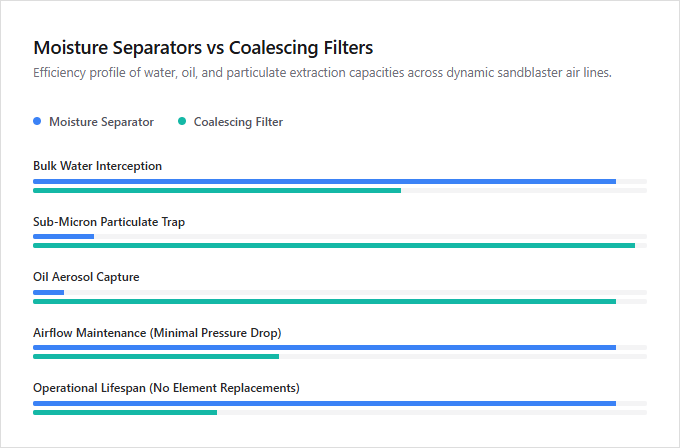
| Operating Principle | Moisture separators utilize centrifugal force to mechanically spin out bulk liquid water, whereas coalescing filters employ a dense fiber matrix to merge microscopic aerosol droplets into drainable liquids. |
| Filtration Efficiency | Moisture separators target large liquid droplets and bulk water contaminants, while coalescing filters capture sub-micron particulate matter and ultra-fine oil aerosols down to 0.01 micrometers. |
| Oil Removal | Moisture separators are ineffective at removing vaporized compressor oil from the air stream, whereas coalescing filters are specifically designed to trap oil aerosols to prevent blast media clumping. |
| System Placement | Moisture separators are installed upstream near the air compressor to catch bulk condensation, while coalescing filters are placed downstream near the sandblaster nozzle to ensure final purification. |
| Pressure Drop | Moisture separators cause minimal pressure drop due to their baffling design, whereas the dense media of coalescing filters creates a higher differential pressure that increases as the element loads. |
| Maintenance Requirements | Moisture separators only require manual or automatic draining of the accumulated liquid, whereas coalescing filter elements must be periodically replaced to prevent particulate saturation. |
How Cyclonic Moisture Separators Protect Abrasive Media
In sandblasting operations, managing compressed air moisture is critical to prevent abrasive media from clumping and clogging the equipment. Moisture separators utilize cyclonic separation to remove bulk liquid water before it reaches the abrasive media. By spinning the incoming air, centrifugal force flings heavy water droplets against the outer wall, where they collect and drain away safely, providing highly efficient initial filtration.
Coalescing filters offer a different approach, targeting microscopic oil aerosols and fine water vapor by merging tiny droplets into larger ones within a specialized fiber matrix. Standard moisture separators are ideal for high-volume industrial operators working in humid outdoor environments, whereas coalescing filters are best suited for precision technicians requiring ultra-clean, dry air for delicate surface preparation.
How Coalescing Filters Capture Sub-Micron Aerosols
Moisture management is critical in abrasive blasting to prevent media clumping and equipment clogging. Standard moisture separators utilize centrifugal force or mechanical baffling to remove bulk liquid water and large droplets from the compressed air stream. While highly effective for heavy water extraction, these devices often let microscopic contaminants pass through the system.
Coalescing filters provide a more advanced purification process. These systems employ diffusional interception to capture sub-micron oil and water aerosols that cause media clumping. By merging these tiny, suspended droplets into larger drops that drain away, the coalescing filter ensures an ultra-dry air supply necessary for consistent abrasive flow and optimal surface preparation.
Basic moisture separators are ideal for hobbyists performing occasional outdoor blasting with coarse grit, while high-efficiency coalescing filters are designed for industrial professionals who require continuous, precision performance with ultra-fine media.
Why Moisture Separators Need Desiccant Dryers
In sand blasting operations, managing compressed air quality is critical to prevent abrasive media clogs and equipment corrosion. Moisture separators utilize centrifugal force to extract bulk liquid water and heavy contaminants from the air stream, but they are ineffective against water vapor. To successfully lower the pressure dew point and eliminate vapor before it reaches the blast nozzle, a moisture separator must be paired with a downstream desiccant dryer.
Coalescing filters offer an alternative mechanism by merging sub-micron liquid droplets and oil aerosols into larger droplets for continuous drainage. High-volume industrial operators requiring ultra-dry air for continuous, high-precision blasting benefit most from integrated coalescing and desiccant systems, while casual DIY hobbyists typically find standard moisture separators sufficient for intermittent, low-humidity utility tasks.
Borosilicate Microfiber Coalescing Filter Media
Effective moisture management is critical in sandblasting to prevent abrasive clumping and equipment clogging. Standard moisture separators utilize centrifugal force to remove bulk liquid water and large debris from the compressed air stream. Coalescing filters provide a much higher level of purification by targeting sub-micron water aerosols and oil mists that standard separators miss.
The superior efficiency of a coalescing filter relies on specialized media made of borosilicate microfibers. As contaminated air passes through this dense matrix, the fibers merge microscopic droplets into larger drops for gravity draining. This continuous process removes ultra-fine liquid contaminants before they can reach the blast nozzle.
Standard moisture separators suit occasional DIY hobbyists performing basic restoration work, while coalescing filters are essential for professional refinishers who require ultra-dry air for precision, industrial-grade blasting.
Unfiltered Compressor Oil Clogs Blast Pot Metering Valves
Moisture separators effectively remove bulk liquid water from compressed air lines, but they fail to capture fine oil aerosols. When unfiltered compressor oil aerosols enter the system, they mix with hygroscopic abrasive media. This contamination causes the media to agglomerate, leading to frequent clogs in the blast pot metering valve and disrupting the blasting process.
Coalescing filters address this specific issue by merging microscopic oil droplets into larger drops that can be easily drained. Eliminating these oil aerosols prevents media clumping and ensures a consistent flow of abrasive. Standard moisture separators are ideal for casual DIY users operating in dry environments, while coalescing filters are essential for industrial operators requiring continuous, clog-free performance.
How Moisture Separators Protect Coalescing Elements
In dry abrasive blasting, managing compressed air quality is critical to prevent media clogging and equipment damage. Moisture separators and coalescing filters serve complementary roles within this purification process. Moisture separators act as bulk liquid pre-filters to prevent premature particulate loading of the coalescing element. By removing the majority of liquid water and large droplets first, these separators protect the downstream coalescing filters, which are designed to capture much finer oil aerosols and sub-micron droplets.
Using both technologies in tandem ensures a reliable, continuous flow of dry air for optimal blasting performance. Standard moisture separators are ideal for casual DIYers and general workshop operators who require basic water removal, while advanced coalescing filters are essential for professional automotive restorers and industrial blasters demanding ultra-clean, oil-free air for sensitive coating applications.
Saturated Filters Reduce Blast Velocity and Abrasive Flow
Effective moisture management is critical in abrasive blasting to prevent media clumping and equipment clogging. While standard moisture separators use centrifugal force to remove bulk liquid water, coalescing filters target much finer oil aerosols and sub-micron droplets. However, coalescing elements require strict maintenance. Saturated coalescing filters create a high differential pressure drop that reduces blast nozzle velocity and abrasive flow consistency, which directly degrades productivity and surface profile uniformity.
Standard moisture separators are suited for high-volume, outdoor mobile operators using coarse media where basic liquid removal is sufficient, whereas coalescing filters are necessary for precision industrial technicians requiring ultra-clean, dry air for delicate coating preparation.
Leave a comment