
Woodworkers often struggle with the tedious bottleneck of surface preparation-specifically, choosing a sander that balances aggressive material removal with a flawless finish without exhausting their hands or budget. While standard workshop funding sources and tool capital budgets typically prioritize large machinery like cabinet saws, selecting the right hand-held finishing tool is where project quality is truly realized.
Investing in the correct pad diameter grants artisans the precision to slash labor times while elevating surface quality. This efficiency, however, comes with the stipulation that tool performance must align strictly with project scale; for instance, utilizing a heavy-duty Bosch GET75-6N on delicate cabinetry requires a vastly different technique than using a compact 5-inch DeWalt DWE6423 for tight face frames.
To clarify this crucial workshop investment, this article compares 5-inch and 6-inch random orbital sanders across key operational metrics: material removal rates, ergonomics, dust extraction efficiency, and overall cost-effectiveness.
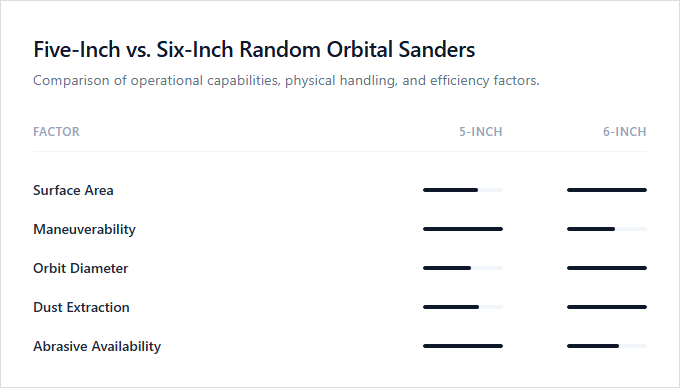
| Factor | Summary |
|---|---|
| Surface Area | The six-inch model offers a larger surface area that yields approximately forty-four percent more abrasive contact, significantly increasing the material removal rate. |
| Maneuverability | Five-inch sanders provide superior maneuverability and control on vertical surfaces due to their lighter weight and more compact footprint. |
| Orbit Diameter | Six-inch sanders often feature a larger orbit diameter to facilitate aggressive stock removal, whereas five-inch models utilize smaller orbits for fine finish sanding. |
| Dust Extraction | The larger shroud and vacuum plenum of a six-inch sander generally provide more efficient dust extraction during heavy-duty operations. |
| Abrasive Availability | Five-inch hook-and-loop sanding discs are highly ubiquitous in the market, offering greater grit variety and lower consumable costs than six-inch discs. |
6-Inch Platforms for Faster Material Removal
When selecting between a five-inch and a six-inch random orbital sander, the primary differentiator lies in efficiency and surface coverage. A six-inch platform offers approximately forty-five percent more abrasive surface area than its five-inch counterpart. This increased footprint translates directly into a faster material removal rate, making the larger model highly effective for flattening expansive panels and rapidly stripping old finishes.
The five-inch sander excels in maneuverability and control, particularly on vertical surfaces or intricate assemblies where a larger tool proves unwieldy. Professional cabinetmakers tackling expansive installations benefit most from the rapid material removal of the six-inch model, while DIY hobbyists and detail-oriented refinishers will find the lighter five-inch sander ideal for detailed furniture restoration and vertical sanding.
5-Inch Small-Orbit Platforms for Fine Wood Finishing
Selecting the right random orbital sander depends on your specific project requirements. Five-inch platforms typically feature a smaller orbit diameter, which is engineered for finer wood finishing and detailed surface preparation. This tighter sanding pattern minimizes visible swirl marks, ensuring a highly polished, professional finish on delicate wood surfaces.
Six-inch sanders provide a larger surface area and a wider orbit diameter, making them highly efficient for rapid material removal on expansive, flat planes. Cabinetmakers and detail-oriented woodworkers will benefit most from the precision and control of the five-inch sander, whereas deck builders and general contractors require the high-productivity output of the six-inch model to manage large-scale resurfacing tasks.
High-Amperage 6-Inch Models Prevent Stalling
When selecting between a five-inch and a six-inch random orbital sander, the primary distinctions lie in surface coverage and motor capability. Six-inch models are engineered with higher motor amperage, providing the necessary torque to maintain consistent rotation under heavy downward pressure. This increased power effectively prevents stalling under load, allowing for rapid material removal on expansive workpieces.
Five-inch sanders utilize smaller motors and smaller sanding discs, making them highly maneuverable in tight spaces and on vertical surfaces. While they offer less surface coverage, their lighter weight reduces operator fatigue during detailed tasks. Five-inch models are ideal for DIY enthusiasts and cabinetmakers focusing on intricate casework, whereas six-inch sanders are best suited for professional woodworkers and refinishers managing large-scale, flat surface preparation.
5-inch models have reduced gyroscopic effect for easier vertical maneuvering
When choosing between a five-inch and a six-inch random orbital sander, the decision involves balancing surface coverage against maneuverability. Five-inch models offer a distinct advantage during vertical or overhead tasks. Due to their smaller disc size and lighter build, these sanders experience a reduced gyroscopic effect, allowing operators to maintain precise control and reduce muscle fatigue when working on upright surfaces.
Six-inch sanders provide a larger contact area that accelerates material removal on expansive, flat workspaces. While the larger pad offers high efficiency, it demands more effort to guide on vertical planes. The five-inch model is ideal for cabinetmakers and DIY enthusiasts who require precision on vertical installations, while the six-inch model is best suited for professional refinishers and installers managing large-scale, flat timber surfaces.
Abrasive availability is higher for the 5-inch 8-hole hook-and-loop configuration
When selecting between a five-inch and a six-inch random orbital sander, sourcing replacement sandpaper is a critical operational factor. The five-inch model utilizes the highly standardized eight-hole hook-and-loop configuration. This specific format dominates the market, ensuring that compatible abrasive discs in various grits are readily available at virtually any local hardware store or online retailer.
Six-inch sanders offer a larger surface area for faster material removal, yet their diverse multi-hole patterns can make sourcing specific abrasive discs more difficult. The five-inch sander is ideal for DIY enthusiasts and general woodworkers requiring maximum convenience and versatility, while the larger six-inch unit is best suited for professional cabinetmakers and refinishers prioritizing speed on broad, flat surfaces.
6-inch sanders demand higher CFM dust extraction capabilities
Choosing between a five-inch and a six-inch random orbital sander involves evaluating both project scale and workshop infrastructure. While the six-inch model provides greater surface coverage for faster material removal, it also generates a substantially larger volume of debris. Because of this increased waste output, six-inch sanders demand higher CFM dust extraction capabilities to maintain a clean workspace and prevent premature abrasive clogging, whereas five-inch models operate efficiently with standard workshop vacuums.
Five-inch sanders are ideal for DIY enthusiasts and furniture makers who prioritize maneuverability on detailed workpieces, whereas six-inch sanders are best suited for professional contractors and cabinet makers who regularly process large, flat surfaces.
Adjustable Speed for Different Wood Densities
Selecting between a five-inch and a six-inch random orbital sander depends largely on the scale of your projects and the materials involved. Both options frequently feature variable speed dials that allow operators to adjust the orbits per minute (OPM). This precise speed regulation is crucial when transitioning between different wood densities, as denser hardwoods require lower speeds to prevent surface burning, while softer woods benefit from higher speeds for rapid material removal.
The five-inch model offers superior control and maneuverability on vertical surfaces, whereas the six-inch alternative provides a larger contact area to complete expansive, flat projects more efficiently. The compact five-inch sander is ideal for DIY enthusiasts and furniture makers focusing on detailed cabinetry, while the high-capacity six-inch sander is best suited for professional carpenters and refinishers handling large-scale installations.
Leave a comment