
Achieving flawless, splinter-free cuts with a circular saw is a persistent challenge for operators, particularly when working with costly finish materials where a single millimeter of tear-out ruins an entire workpiece. To bypass this frustration, many craftsmen initially rely on standard, factory-included steel blades as their primary cutting source. However, upgrading to specialized tooling grants operators pristine, glue-line-ready edges and drastically reduces saw motor strain-under the strict stipulation that the blade's feed rate and tooth geometry are precisely matched to the wood's density. For example, professional cabinetmakers routinely deploy thin-kerf carbide blades to secure seamless joints in delicate maple veneers. Below, we will analyze the metallurgical differences between Carbide-Tipped and High-Speed Steel (HSS) blades, evaluate the physics of kerf width optimization, and establish a clear framework for selecting the ideal blade for your high-precision applications.
| Factor | Summary |
|---|---|
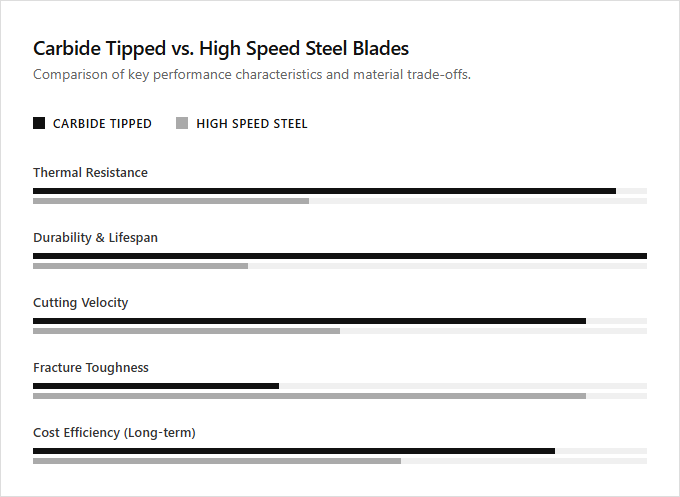
| Material Composition | Carbide-tipped blades feature tungsten carbide teeth brazed to a high-tensile steel alloy plate, whereas High-Speed Steel blades are made from a homogenous steel alloy containing carbon, tungsten, molybdenum, and chromium. |
| Thermal Resistance | Carbide tips maintain their structural integrity at extreme operating temperatures, whereas High-Speed Steel blades exhibit lower red-hardness and are prone to thermal degradation under intense friction. |
| Durability and Lifespan | Due to superior abrasive wear resistance, carbide-tipped blades retain their sharp cutting edges significantly longer than High-Speed Steel alternatives, reducing tool-change frequency. |
| Cutting Velocity | Carbide-tipped blades support much higher surface feet per minute (SFM) and aggressive feed rates compared to High-Speed Steel blades, increasing overall machining productivity. |
| Fracture Toughness | High-Speed Steel blades offer high elasticity and impact resistance, making them less susceptible to tooth chipping and catastrophic failure when cutting inhomogeneous materials than brittle carbide tips. |
| Cost Efficiency | While High-Speed Steel blades require a lower initial capital expenditure, carbide-tipped blades yield a better long-term return on investment due to their extended operational longevity. |
Carbide-Tipped Teeth Outperform High-Speed Steel
When selecting power saw blades, the metallurgical differences between carbide-tipped and high-speed steel (HSS) options are critical. Carbide-tipped teeth exhibit superior metallurgical hardness and thermal stability compared to high-speed steel. This allows carbide blades to maintain sharp cutting edges even at extreme operating temperatures, resisting the thermal degradation that quickly dulls standard steel.
While high-speed steel blades offer excellent flexibility and are easily resharpened, they wear down rapidly under demanding conditions. Carbide blades provide an extended service life and cleaner cuts in dense materials, though they require a higher initial investment. High-volume construction professionals requiring maximum durability benefit most from carbide-tipped blades, whereas DIY hobbyists performing occasional light woodworking find high-speed steel to be a highly cost-effective choice.
Thin-Kerf Configurations: Efficiency Versus Deflection
When selecting power saw blades, the choice between carbide-tipped and high-speed steel (HSS) options directly impacts cutting efficiency and tool longevity. Carbide-tipped blades offer superior hardness and thermal resistance, maintaining a sharp edge significantly longer than traditional HSS. In both material categories, thin-kerf configurations are highly favored because they minimize material waste and decrease motor strain during operation.
The reduced thickness of thin-kerf plates makes them highly susceptible to plate deflection under heavy lateral loads, which can compromise the accuracy of the cut. While HSS blades offer greater flexibility and lower upfront costs, carbide-tipped alternatives provide the rigidity and durability needed for dense hardwoods and abrasive materials. High-speed steel is ideal for budget-conscious DIYers undertaking occasional light utility cuts, whereas carbide-tipped options are best suited for professional contractors requiring long-term precision and high-volume output.
Precision Benefits of Thicker Standard-Kerf Blades
When selecting power tool saw blades, understanding the structural differences between carbide-tipped and high-speed steel (HSS) options is essential for optimal performance. Standard-kerf blades in both categories utilize thicker plate dimensions to minimize radial runout and ensure high-precision dimensional tolerances under heavy loads. This additional plate thickness delivers superior stability, reducing vibration and ensuring straight, dependable cuts in challenging materials.
While HSS blades offer excellent flexibility and straightforward maintenance, carbide-tipped alternatives provide exceptional hardness and thermal resistance. High-speed steel blades are ideal for budget-conscious hobbyists performing general-purpose cutting, whereas carbide-tipped blades are suitable for industrial professionals requiring maximum durability and long-term accuracy in high-production environments.
Laser-Cut Expansion Slots Prevent Blade Warping
When selecting saw power tool blades, the choice between Carbide-Tipped and High-Speed Steel (HSS) dictates performance limits. A critical engineering advancement in these blades is the integration of laser-cut expansion slots. During high-RPM operations, intense friction generates extreme heat. These precision-engineered slots manage this thermal expansion, preventing the blade from warping and ensuring consistent cutting accuracy.
While HSS blades offer excellent flexibility and are easily resharpened, carbide-tipped blades excel in longevity and heat resistance. High-Speed Steel blades are best suited for budget-conscious DIY hobbyists performing occasional light woodworking, whereas carbide-tipped blades are the ideal choice for professional contractors requiring maximum durability and precision during heavy-duty, continuous operations.
How ATB Tooth Geometry Prevents Tear-Out
When selecting saw blades for power tools, the choice between carbide-tipped and high-speed steel (HSS) options directly impacts cutting performance and longevity. Carbide-tipped blades feature exceptional hardness, maintaining their sharp edges significantly longer than standard HSS blades. To maximize these material advantages, specialized tooth geometry is often employed. For instance, an Alternating Top Bevel (ATB) configuration features teeth that angle in opposite directions, creating a highly efficient shearing action that cleanly slices wood fibers to prevent tear-out.
While high-speed steel blades offer a more economical alternative for general-purpose tasks, they wear down faster under heavy workloads. High-speed steel blades are ideal for budget-conscious hobbyists tackling occasional light woodworking, whereas carbide-tipped blades are suitable for professional craftsmen who demand long-term durability and flawless finishes.
Optimizing Chip Load to Prevent Tool Wear
Selecting between carbide-tipped and high-speed steel (HSS) blades requires a precise understanding of cutting physics, particularly chip load. Chip load-the thickness of material removed by each tooth-directly impacts tool longevity. For carbide-tipped blades, calculating the optimal chip load prevents premature abrasive wear on the brittle carbide inserts by ensuring the teeth actively cut rather than rub. For HSS blades, precise chip load calculations facilitate proper heat dissipation, preventing the tool from overheating and losing its temper.
Maintaining the correct feed rate and RPM preserves the structural integrity of both blade types under heavy workloads. Carbide-tipped blades are ideal for high-production industrial operators requiring long-lasting sharpness on tough materials, while high-speed steel blades best suit general contractors and workshop hobbyists seeking a resilient, easily resharpened option for versatile, everyday cutting.
Anti-Vibration Slots Enhance Cutting Precision and Finish
When selecting saw blades for power tools, the choice between carbide-tipped and high-speed steel (HSS) dictates both cut quality and tool longevity. Carbide-tipped blades frequently incorporate advanced engineering, such as laser-cut anti-vibration slots. These specialized slots damp harmonic vibration during high-speed rotation, stabilizing the blade to improve the overall surface finish and maintain a highly precise kerf path. Standard HSS blades generally lack these dampening features, making them more susceptible to vibration-induced deflection.
While HSS blades offer immense initial sharpness and can be easily resharpened, carbide-tipped alternatives excel in heat resistance and structural rigidity under heavy loads. High-speed steel blades are ideal for budget-conscious DIY hobbyists performing occasional light woodworking, whereas carbide-tipped blades are best suited for professional contractors requiring daily, high-volume precision in dense materials.
Leave a comment