
Woodworkers and fabrication professionals often struggle to achieve clean, burn-free cuts, frequently battling frustrating motor bog-downs and excessive tool vibration. While buyers typically attempt to resolve these performance issues by auditing standard workshop budget allocations or upgrading to premium blades, the root limitation often lies deeper than basic capital investment.
Selecting the correct drive configuration is the pivotal decision that ultimately grants your workshop the precise torque, noise reduction, and long-term durability required for demanding projects. However, maximizing this operational efficiency comes with the stipulation that operators must balance upfront acquisition costs against scheduled maintenance realities-such as the belt tensioning required when routinely ripping heavy 8/4 maple stock.
To guide your next machinery acquisition, this article delivers a comparative analysis of direct drive versus belt drive table saw motor systems, evaluating their mechanical designs, power transmission efficiency, and long-term utility.
| Factor | Summary |
|---|---|
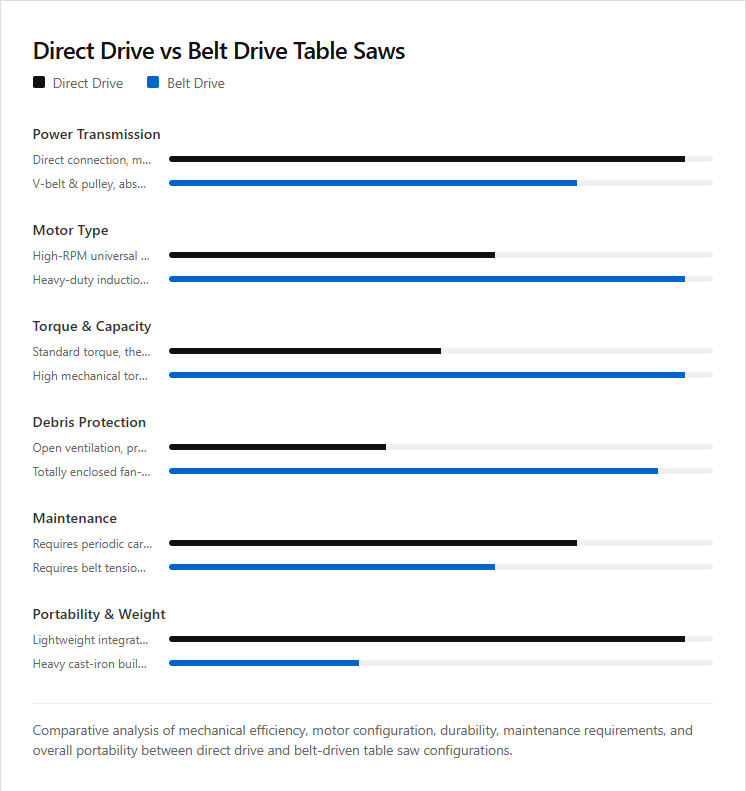
| Power Transmission | Direct drive saws connect the motor shaft directly to the arbor to minimize energy loss, whereas belt drive systems use pulleys and a V-belt to isolate the motor from vibration. |
| Motor Type | Direct drive table saws typically utilize high-RPM universal motors, while belt drive configurations employ heavy-duty induction motors built for continuous duty cycles. |
| Torque and Capacity | Belt drive saws leverage pulley ratios to generate higher mechanical torque for thick lumber, whereas direct drive saws may experience thermal overload when cutting dense hardwoods. |
| Debris Protection | Belt drive systems often feature totally enclosed fan-cooled (TEFC) motors to prevent sawdust contamination, unlike the open-ventilation housings of direct drive motors. |
| Maintenance Requirements | Direct drive units require periodic carbon brush replacement, whereas belt drive saws require routine drive belt tensioning and alignment to prevent power loss. |
| Portability and Weight | Direct drive saws offer a lightweight, integrated chassis ideal for jobsite transport, whereas the cast-iron trunnions and external motors of belt drive saws add substantial mass. |
How Direct Drive Systems Transfer Power
Table saw drive systems primarily fall into two categories: direct drive and belt drive. Direct drive systems transfer power directly from the armature shaft to the blade arbor. This configuration minimizes energy loss, resulting in a compact, lightweight, and virtually maintenance-free tool. These motors are typically louder and experience greater stress during heavy-duty cuts.
Belt drive saws utilize a pulley system, which dampens vibration and increases torque by positioning the motor away from the arbor. Direct drive models are ideal for mobile contractors and DIY hobbyists prioritizing portability, whereas belt drive systems are best suited for professional woodworkers requiring high precision and continuous workshop use.
Vibration-Dampening Poly-V Belt Drives
When selecting a table saw, the drive configuration significantly impacts cutting performance and machine longevity. Direct drive table saws connect the motor shaft directly to the blade, resulting in a compact, lightweight footprint. Belt drive configurations instead utilize a system of pulleys and poly-V belts to transfer power. This design isolates the motor from the blade arbor, which absorbs operational shock and provides exceptional harmonic vibration dampening for cleaner, more precise cuts.
This mechanical isolation also minimizes noise and reduces wear on critical internal components. Direct drive models are best suited for mobile contractors requiring highly portable, low-maintenance machines for job site framing, whereas belt-driven saws are ideal for dedicated woodworkers and furniture makers who demand maximum precision, torque, and quiet operation in a stationary workshop.
Optimizing Belt Drive Torque and Spindle RPM
Direct drive table saws couple the motor directly to the blade arbor, yielding a compact, lightweight system with minimal power loss during operation. This configuration is highly efficient for standard tasks but lacks the mechanical adaptability found in larger workshop machinery.
In comparison, belt drive systems leverage pulley ratios to optimize torque transfer and spindle RPM. By separating the motor from the arbor, these systems absorb vibration and allow for fine-tuned speed adjustments to handle dense hardwoods. Direct drive saws are ideal for mobile contractors requiring portability on the jobsite, whereas belt drive models are best suited for stationary craftsmen demanding high precision and continuous torque.
Carbon Brush Wear in Direct Drive Table Saws
When selecting a table saw, the drive system represents a critical engineering distinction. Direct drive table saws connect the motor directly to the blade arbor, typically utilizing high-RPM universal motors that contain wear-prone carbon brushes. While these systems offer a compact and lightweight design, the friction on the brushes requires periodic maintenance and replacement to prevent power loss and motor failure.
Belt drive table saws position the motor away from the arbor, using a pulley system and induction motor that runs quieter and minimizes vibration. This physical separation protects the motor from dust accumulation, ensuring a longer operational lifespan. Direct drive models are ideal for DIY hobbyists and mobile contractors needing portability, whereas belt drive units suit professional woodworkers seeking maximum precision and durability in a permanent workshop.
Belt Drive Saws with Sealed Induction Motors
Direct drive table saws connect the motor directly to the blade, offering a compact, lightweight design optimized for easy transport. These models typically utilize universal motors, which operate at higher decibels and feature open ventilation systems susceptible to dust accumulation.
In contrast, belt drive table saws position the motor away from the arbor, transferring power through a pulley system. Belt drive saws utilize heavy-duty induction motors that are sealed against sawdust ingress. This enclosed configuration protects vital internal components, reduces operating noise, and minimizes vibration during demanding cuts.
Direct drive models suit DIY enthusiasts and mobile contractors requiring high portability, while belt drive units are ideal for professional woodworkers seeking precision, quiet operation, and longevity in a permanent workshop.
Belt Slippage as a Blade Stall Overload Buffer
When evaluating table saw configurations, the drive mechanism plays a critical role in tool longevity and operator safety. Direct drive systems connect the motor shaft directly to the blade arbor, whereas belt drive systems utilize a pulley arrangement. This belt configuration serves as a physical overload buffer; during a severe blade stall or kickback event, the belt will slip on the pulleys. This mechanical slippage absorbs the sudden kinetic shock, preventing the extreme rotational force from transferring to the motor and protecting the internal components from catastrophic failure.
Direct drive units lack this mechanical buffer, meaning sudden stops subject the motor to immediate electrical and physical strain. Lightweight direct drive models suit DIY hobbyists seeking portable, budget-friendly tools for light-duty tasks, while robust belt drive saws are ideal for professional craftsmen requiring continuous power, quieter operation, and built-in mechanical protection during heavy-duty woodworking.
Offset Motors Boost Bevel Capacity and Clearance
When evaluating table saw configurations, the distinction between direct drive and belt drive systems significantly impacts cutting versatility. Direct drive saws mount the motor directly to the arbor, resulting in a compact but occasionally obstructive design. In contrast, belt drive systems utilize a pulley mechanism that offsets the motor placement. This offset positioning provides crucial physical clearance beneath the table top, allowing the blade to tilt to its maximum bevel capacity without the motor housing interfering with the cabinet frame.
In addition to superior bevel clearance, belt drive systems absorb motor vibration, leading to cleaner cuts and quieter operation. Direct drive models, though louder, offer unmatched portability and require virtually no belt maintenance. Compact direct drive saws are highly suitable for mobile jobsite contractors requiring lightweight equipment, while heavy-duty belt drive systems are preferred by stationary woodworkers who demand maximum precision, torque, and beveling flexibility.
Leave a comment