
Moisture in compressed air lines is a persistent threat to industrial efficiency, frequently causing corroded pneumatic tools, ruined finishes, and costly operational downtime. To resolve this, operators typically rely on standard baseline investments, such as simple point-of-use water traps, to manage bulk liquid. However, elevating your air treatment strategy to target optimal dew points grants unmatched system reliability, ensuring flawless downstream performance and extended tool longevity.
Stipulation: While mechanical filtration is highly effective for bulk liquid removal, achieving sub-zero pressure dew points requires active chemical adsorption.
In high-stakes environments like automotive refinishing and CNC plasma cutting, failing to make this distinction leads to catastrophic finish defects and premature equipment failure. Below, we compare moisture separators and desiccant dryers, evaluating their distinct mechanics, dew point capabilities, and operational costs to help you select the ideal configuration for your facility.
| Factor | Summary |
|---|---|
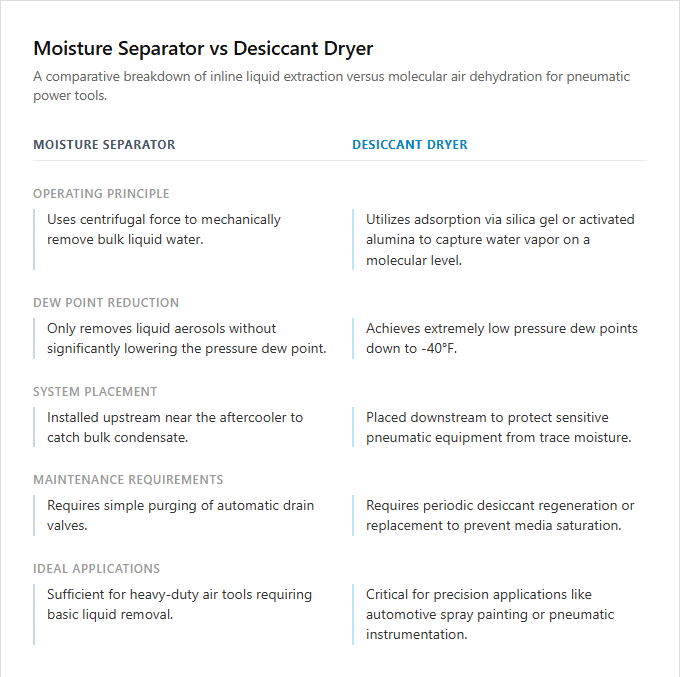
| Operating Principle | A moisture separator uses centrifugal force to mechanically remove bulk liquid water, whereas a desiccant dryer utilizes adsorption via silica gel or activated alumina to capture water vapor on a molecular level. |
| Dew Point Reduction | Moisture separators only remove liquid aerosols without significantly lowering the pressure dew point, while desiccant dryers can achieve extremely low pressure dew points down to -40°F. |
| System Placement | The moisture separator is installed upstream near the aftercooler to catch bulk condensate, while the desiccant dryer is placed downstream to protect sensitive pneumatic equipment from trace moisture. |
| Maintenance Requirements | Moisture separators require simple purging of automatic drain valves, whereas desiccant dryers require periodic desiccant regeneration or replacement to prevent media saturation. |
| Ideal Applications | Moisture separators are sufficient for heavy-duty air tools requiring basic liquid removal, while desiccant dryers are critical for precision applications like automotive spray painting or pneumatic instrumentation. |
Moisture separators utilize centrifugal separation to remove bulk liquid condensate
Moisture separators serve as the primary defense against water in compressed air systems. These devices utilize centrifugal separation, spinning the incoming air stream to force bulk liquid condensate and heavy debris outward against the chamber walls for easy drainage. This mechanical process is highly effective at removing bulk water, though it does not eliminate vaporized humidity.
Desiccant dryers utilize chemical agents like silica gel to adsorb vaporized moisture at a microscopic level, achieving extremely low dew points. Moisture separators suit general workshop operators running pneumatic impact tools, whereas desiccant dryers are essential for precision technicians performing automotive spray painting or electronics manufacturing.
Activated Alumina Adsorption in Desiccant Dryers
Moisture separators and desiccant dryers serve distinct roles in optimizing compressed air systems. Moisture separators utilize mechanical filtration or centrifugal force to remove bulk liquid water and heavy condensation from the air stream. While highly effective at managing liquid accumulation, they cannot eliminate water vapor, leaving some humidity in gaseous form.
Desiccant dryers employ chemical adsorption with activated alumina to capture water vapor at a molecular level. As compressed air passes through the desiccant bed, the porous alumina beads attract and retain moisture, achieving extremely low dew points and preventing downstream system corrosion.
Moisture separators are ideal for general workshop operators running standard pneumatic tools, whereas desiccant dryers are suitable for automotive painters and laboratory technicians requiring ultra-dry, instrument-grade air.
Moisture Separators Cannot Lower Dew Point Below Ambient
Moisture separators utilize mechanical action, such as centrifugal force, to remove bulk liquid water from compressed air. While highly efficient at capturing liquid droplets, moisture separators are physically incapable of lowering the pressure dew point below ambient temperature. As the compressed air cools further downstream in the system, water vapor will inevitably condense into new liquid moisture, making these devices insufficient for applications requiring strictly dry air.
In contrast, desiccant dryers utilize chemical adsorption to attract and bind water vapor directly from the airstream. This process achieves extremely low pressure dew points, often down to -40°F, preventing condensation even in freezing conditions. Standard moisture separators are ideal for general workshop operators running basic pneumatic tools, whereas desiccant dryers are essential for precision professionals in automotive painting or laboratories who require ultra-dry air.
Desiccant Dryers Achieve Ultra-Low -40° Dew Point
Moisture separators and desiccant dryers serve distinct roles in optimizing compressed air quality. Moisture separators utilize mechanical separation, such as centrifugal force, to remove bulk liquid water and large particles from the airstream. In contrast, desiccant dryers use chemical adsorption to extract water vapor, achieving an ultra-low pressure dew point of minus forty degrees. This extreme dryness prevents condensation and freezing in downstream piping, protecting sensitive pneumatic equipment from internal corrosion and failure.
Selecting the appropriate technology depends entirely on the specific requirements of your application. Moisture separators are ideal for general workshop tasks where liquid water is the primary concern, while desiccant dryers are necessary for high-precision environments. Standard mechanical separators suit general utility operators using air tools, whereas desiccant systems are essential for critical professionals in spray painting, electronics, or sub-zero environments who demand completely moisture-free air.
Moisture Separators Prevent Desiccant Bed Liquid Slugging
Moisture separators and desiccant dryers perform distinct, complementary roles in managing compressed air quality. Moisture separators utilize mechanical separation to remove bulk liquid water and heavy aerosols directly from the air stream. This process serves as a critical pre-filtration stage, protecting downstream drying equipment by preventing liquid slugging from overwhelming and ruining the sensitive desiccant bed.
Desiccant dryers then adsorb the remaining microscopic water vapor to achieve extremely low dew points. Without the preliminary separation of liquid water, desiccant beads degrade rapidly and lose their chemical drying efficiency. General workshop operators running standard pneumatic tools benefit from cost-effective moisture separators, whereas precision automotive painters and laboratory technicians require desiccant dryers to ensure ultra-dry, contaminant-free air.
Desiccant Dryers for ISO Class 1 & 2
Moisture control is critical in compressed air systems to prevent tool damage and product contamination. Moisture separators utilize centrifugal force to remove bulk liquid water and large droplets from the air stream. While highly efficient at removing liquid aerosols, these mechanical devices cannot eliminate water vapor, leaving the compressed air saturated.
To achieve ultra-dry air, a desiccant dryer is required. These systems use chemical adsorbents to extract water vapor, achieving extremely low pressure dew points. This process is necessary to meet the stringent ISO 8573-1 Class 1 or Class 2 moisture purity standards required for sensitive applications.
Moisture separators are ideal for general workshop operators using basic pneumatic tools, whereas desiccant dryers are essential for precision professionals in pharmaceutical, electronics, or automotive painting industries requiring contaminant-free air.
Purge Air Requirements for Regenerative Desiccant Dryers
Moisture separators and desiccant dryers serve distinct roles in compressed air treatment. Moisture separators employ mechanical action to remove bulk liquid water from the air stream. Desiccant dryers utilize chemical beads to adsorb water vapor, achieving much lower dew points. Regenerative desiccant dryers offer continuous operation by using twin towers, where one actively dries the air while the other regenerates. These systems require a specific percentage of the compressed air, typically ten to fifteen percent, as purge air to regenerate the saturated desiccant media.
This purge air requirement reduces the net volume of usable air, demanding precise system capacity planning. Moisture separators are ideal for general automotive hobbyists needing basic liquid removal for air tools, while desiccant dryers are essential for professional painters and electronics manufacturers requiring ultra-dry, moisture-free air.
Leave a comment