
Selecting the wrong high-pressure inflation tool often leads to costly downtime and premature mechanical failure-a frustrating bottleneck for fleet managers and industrial operators struggling to maintain optimal uptime.
When allocating capital from standard equipment procurement budgets, organizations typically default to auxiliary shop compressors. However, integrating a dedicated cordless power inflator grants operators unparalleled onsite autonomy and rapid deployment during critical tasks, provided that we stipulate that high pressure must not sacrifice volumetric flow rate.
For instance, inflating high-volume commercial truck tires or servicing heavy-duty pneumatic systems requires sustained pressure levels that standard DIY tools simply cannot deliver.
To guide your next procurement cycle, this article evaluates the core differences between single-stage and dual-stage power inflators, comparing their mechanical efficiency, pressure limits, and duty cycles so you can select the optimal tool for your high-pressure output needs.
| Factor | Summary |
|---|---|
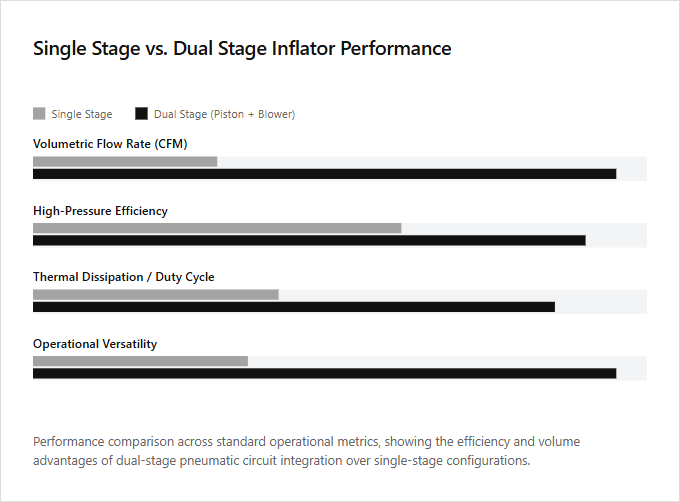
| Compression Mechanism | Single-stage inflators rely solely on a reciprocating piston for pressure, whereas dual-stage units integrate both a high-pressure piston and a high-volume centrifugal blower. |
| Volumetric Flow Rate | Dual-stage inflators achieve a significantly higher cubic feet per minute (CFM) rating at low pressures compared to single-stage models, which are limited by their fixed-displacement design. |
| Maximum Pressure Capability | While both designs can achieve high pounds per square inch (PSI) outputs, dual-stage tools utilize dedicated pneumatic circuits to optimize efficiency at different pressure thresholds. |
| Duty Cycle and Heat Dissipation | Single-stage inflators often suffer from a shorter duty cycle due to rapid thermal buildup when attempting large-volume tasks without a dedicated low-pressure bypass. |
| Operational Versatility | Dual-stage inflators offer superior versatility by utilizing a dual-function mode selector to transition between high-pressure tire inflation and high-volume mattress deflation. |
Dual-Stage Configurations Achieve Higher Discharge Pressure
When selecting an inflator power tool, understanding the mechanical distinction between single-stage and dual-stage configurations is essential for optimal performance. Single-stage inflators draw air directly into the cylinder and compress it in a single stroke, making them highly efficient for standard operations. In contrast, dual-stage configurations utilize a consecutive two-step compression process, which allows them to achieve significantly higher maximum discharge pressure measured in PSI.
This multi-phase compression reduces the workload on each stage while maximizing output efficiency for demanding tasks. Single-stage units are ideal for casual DIY hobbyists performing routine household and automotive maintenance, whereas dual-stage models are best suited for professional technicians and commercial operators requiring high-pressure inflation for heavy-duty equipment.
Intercooler Technology in Dual-Stage Compression
Selecting the right inflator power tool depends on understanding the engineering differences between single-stage and dual-stage systems. Single-stage inflators compress air directly to the target pressure in one stroke. In contrast, dual-stage systems utilize a two-phase process featuring advanced intercooler technology. This intercooler cools the compressed air as it travels between the first and second compression phases, lowering the air temperature, increasing air density, and protecting the tool from thermal stress during prolonged operation.
Operating temperature and duty cycles differ significantly between these configurations. Single-stage inflators are ideal for homeowners requiring quick tire top-offs and occasional recreational use, whereas dual-stage systems are best suited for commercial technicians who demand continuous, high-volume performance for heavy-duty applications.
High Compression Ratios Limit Single-Stage Volumetric Efficiency
When selecting an inflator power tool, understanding the mechanical distinction between single-stage and dual-stage systems is essential for operational efficiency. Single-stage inflators compress air to its final pressure within a single cylinder stroke. This design results in a higher compression ratio per cylinder, which reduces overall volumetric efficiency because heat generation and clearance volume limit the intake of fresh air.
In contrast, dual-stage systems divide the compression workload across two distinct chambers, cooling the air between stages. This staged process allows the tool to maintain high volumetric efficiency and deliver consistent output during high-pressure applications without excessive thermal stress.
Single-stage units are ideal for casual DIY homeowners requiring quick, low-pressure tire inflation, whereas dual-stage models are best suited for commercial automotive technicians demanding continuous high-pressure performance.
Dual-stage inflators maintain higher delivered CFM at elevated operating pressures.
When selecting an inflator power tool, understanding the mechanical distinction between single-stage and dual-stage systems is essential for optimal performance. Single-stage models compress air directly in one motion, making them highly efficient for standard tasks but prone to reduced airflow under resistance. Conversely, dual-stage inflators utilize a successive compression process, which allows them to maintain a significantly higher delivered CFM at elevated operating pressures.
This mechanical divergence dictates the efficiency and speed of your inflation tasks. Single-stage units are best suited for everyday homeowners and recreational users needing to inflate sports balls or passenger car tires, whereas dual-stage inflators are designed for heavy-duty professionals who regularly service high-pressure commercial tires and large pneumatic equipment.
Dual-Stage Models for Continuous High-Pressure Applications
When selecting an inflator power tool, understanding the distinction between single-stage and dual-stage engineering is essential for matching the tool to your operational needs. Single-stage inflators compress air in a single motion, offering a lightweight and highly portable solution for standard, intermittent tasks such as inflating passenger vehicle tires or sports equipment.
In contrast, dual-stage models utilize a two-step compression process that minimizes heat buildup. This advanced design allows dual-stage units to deliver a continuous duty cycle, making them uniquely suited for demanding, high-pressure applications that require sustained operation without overheating.
Single-stage units best serve casual homeowners and DIYers seeking quick convenience for everyday tasks, while dual-stage systems are tailored for commercial mechanics and off-road enthusiasts who require relentless, heavy-duty performance.
Inefficient Single-Stage Inflators Generate More Heat
When selecting between single-stage and dual-stage inflator power tools, understanding thermal efficiency is critical. Single-stage inflators compress air to the target pressure in a single stroke, which significantly lowers their thermal efficiency during high-pressure cycles. This limitation causes rapid heat buildup within the tool, necessitating frequent cooling intervals to prevent internal component wear and potential system failure.
Dual-stage inflators utilize a two-step compression process that effectively distributes the thermal load, resulting in cooler operating temperatures and reliable, sustained output. Single-stage models are ideal for homeowners seeking a lightweight tool for occasional, low-pressure tasks like inflating sports balls and bicycle tires, whereas dual-stage units are suited for automotive professionals and heavy-duty users requiring continuous, high-pressure operation for truck tires and large equipment.
Force Multiplication in Sequential Cylinders
Single-stage inflators utilize a direct piston mechanism to move air, making them highly efficient for standard, high-volume applications at lower pressures. In contrast, dual-stage inflators employ a sequential cylinder design that relies on unequal piston displacement to multiply output force. This configuration allows the tool to seamlessly transition from rapid, low-pressure filling to high-pressure compression by routing air through a progressively smaller secondary chamber.
These mechanical differences dictate both the operational speed and the maximum pressure capacity of the tool. Single-stage models are ideal for everyday inflatables, while dual-stage units provide the versatile force required for high-pressure vehicle tires and heavy-duty equipment. Single-stage inflators suit casual DIY homeowners needing quick tire top-offs, whereas dual-stage models serve mobile mechanics and off-road enthusiasts requiring adaptable, high-performance pressure delivery.
Leave a comment