
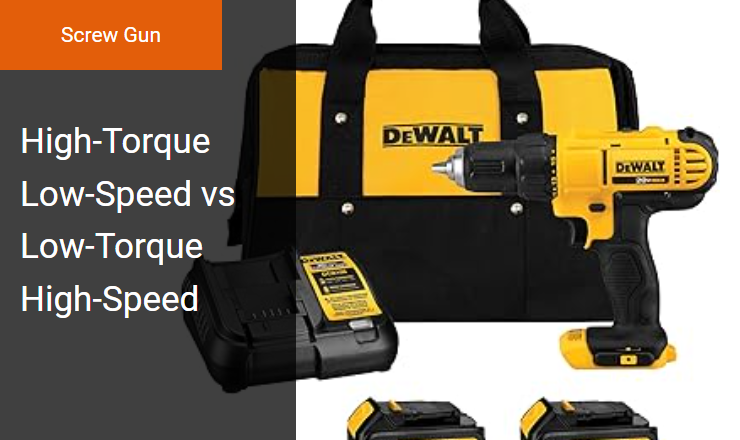
For commercial contractors and installers, achieving consistent fastening depth without stripping screw heads or damaging delicate substrates remains a persistent, costly struggle on the jobsite. While standard equipment procurement budgets typically account for baseline tool allocations, relying solely on out-of-the-box configurations often overlooks the critical mechanics of torque-to-speed ratios.
Optimizing the depth-sensitive clutch grants operators precise micro-adjustability, dramatically reducing material wastage and boosting throughput. However, maximizing this efficiency stipulates that operators align their tool's speed settings with the specific yield strength of the workpiece. For example, in high-volume applications like securing heavy-gauge steel framing or dense subflooring, choosing the wrong threshold leads to systemic fastening failures.
This article examines the operational trade-offs between high-torque, low-speed and low-torque, high-speed configurations. We will analyze clutch mechanics, material dynamics, and calibration strategies to help you optimize your fastening workflow.
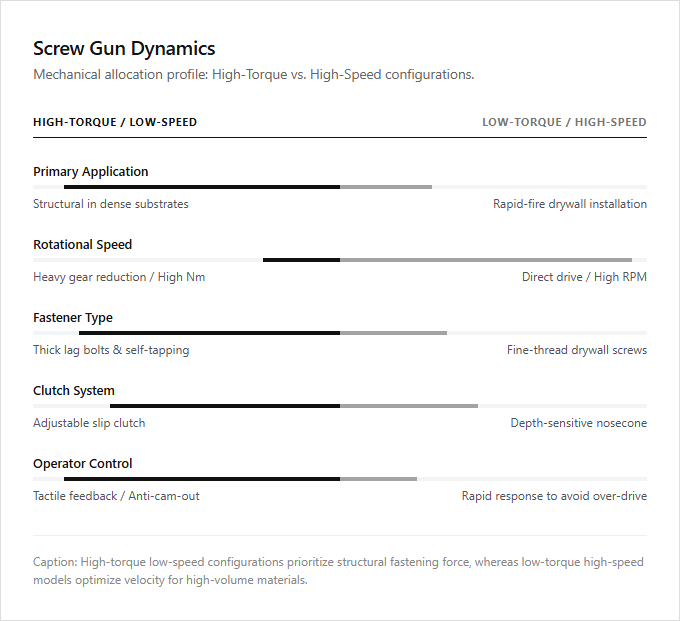
| Factor | Summary |
|---|---|
| Primary Application | High-torque low-speed configurations are utilized for structural fastening in dense substrates, whereas low-torque high-speed models are ideal for rapid-fire drywall installation. |
| Rotational Speed | High-speed units operate at higher revolutions per minute (RPM) to maximize efficiency, while high-torque units feature heavy gear reduction to output greater Newton-meters (Nm) of torque. |
| Fastener Type | Thick lag bolts and self-tapping screws require the high rotational force of a low-speed gun, whereas fine-thread drywall screws are best driven by high-velocity, low-torque motors to prevent strip-out. |
| Clutch System | Low-torque high-speed screw guns often utilize a depth-sensitive nosecone clutch for consistent flush depth, whereas high-torque models rely on adjustable slip clutches to prevent motor stalling. |
| Operator Control | Low-speed high-torque settings provide the operator with superior tactile feedback to prevent fastener cam-out, while high-speed settings demand rapid reaction times to avoid over-driving. |
Preventing Thread Stripping in High-Density Substrates
Selecting the correct speed and torque configuration on a professional screw gun is critical for preserving joint integrity. High-torque, low-speed settings are engineered specifically for demanding applications in dense materials. By delivering maximum rotational force at lower revolutions, this configuration maintains a high drive-to-strip ratio. This mechanical advantage ensures that the fastener fully seats without stripping the receiving threads in high-density substrates like hardwoods or heavy-gauge metals.
In contrast, low-torque, high-speed settings prioritize rapid installation in softer mediums where resistance is minimal. High-torque configurations are ideal for structural framing carpenters and metal fabricators who require controlled precision under high resistance, whereas high-speed settings are suited for drywall installers and high-volume assemblers prioritizing rapid production.
High-Speed Configurations Maximize Gypsum Board Throughput
Selecting the optimal screw gun configuration depends heavily on the resistance of the target material. High-torque, low-speed models deliver the mechanical leverage necessary to drive heavy fasteners into dense substrates like hardwoods or structural steel without stalling the motor. This prevents fastener breakage and ensures precise depth control under high-load conditions.
Conversely, low-torque, high-speed configurations are engineered to maximize duty cycle and throughput in low-resistance materials like gypsum board. By prioritizing rotational speed over sheer force, these tools allow operators to sink drywall screws rapidly and repeatedly, drastically reducing installation time.
Heavy-duty structural builders and metal fabricators require the control of high-torque units, whereas high-volume drywall contractors and ceiling installers benefit most from the rapid efficiency of high-speed systems.
Automatic Depth-Disengaging Positive Jaw Clutch
Screw guns utilize a specialized positive jaw clutch system to control fastener depth. This mechanism requires the operator to apply constant axial thrust force to engage the drive clutch. Once the adjustable nosepiece contacts the work surface and reaches the preset countersink depth, the clutch automatically disengages, stopping rotation and preventing over-driving. High-torque, low-speed models leverage this mechanism to handle dense materials and heavy-gauge steel studs where control and driving power are paramount.
Low-torque, high-speed configurations optimize this depth-sensitive clutch for rapid installation in lighter materials, such as standard drywall to wood or light-gauge metal framing. These high-speed units maximize productivity through swift cycle times while maintaining precise depth consistency. High-torque, low-speed models are suited for heavy-duty commercial framing and subflooring installers, while low-torque, high-speed units are ideal for high-volume drywall contractors demanding rapid, repetitive fastening.
Precise Nosepiece Calibration Prevents High-RPM Cam-Out
Selecting between high-torque, low-speed and low-torque, high-speed screw guns depends heavily on the specific fastening application. High-speed models offer rapid installation but introduce distinct mechanical challenges. Specifically, the significant rotational inertia generated at high RPM increases the risk of cam-out, where the driver bit slips and damages the fastener.
To mitigate this risk, high-speed units require precise micro-adjustable nosepiece calibration to disengage the clutch at the exact depth before head damage occurs. High-torque, low-speed configurations bypass these inertial challenges, providing sustained driving power for dense materials. High-torque low-speed models suit structural contractors working with heavy timber and steel, while low-torque high-speed units are ideal for drywall installers requiring rapid, repetitive fastening.
Low RPM Protects Drive Dogs Under High Torque
When selecting a screw gun, the choice between high-torque, low-speed and low-torque, high-speed configurations depends heavily on the resistance of the fastening material. High-torque applications require low motor RPM to prevent thermal overload and preserve the mechanical integrity of the drive dog. Operating at lower speeds under heavy loads reduces heat buildup in the motor windings and prevents premature wear on the internal clutch engagement components.
Low-torque, high-speed models maximize productivity in softer substrates where rapid fastening is required and resistance is minimal. High-torque, low-speed units are ideal for structural framers and deck builders working with dense hardwoods or heavy-gauge steel, whereas low-torque, high-speed models are best suited for drywall installers and high-volume interior trim specialists.
Optimizing Depth-Sensitive Clutches for Hard and Soft Joints
Selecting between high-torque, low-speed and low-torque, high-speed screw guns depends heavily on the fastening material. Optimizing the depth-sensitive clutch is critical when transitioning between hard-joint and soft-joint applications. For hard-joint fastening, such as metal-to-metal, a high-torque, low-speed setting prevents rapid strip-out and structural deformation by allowing the clutch to disengage precisely at the target depth. Soft-joint fastening, like drywall or wood, benefits from a low-torque, high-speed configuration, where rapid seating is paired with a sensitive clutch calibration to prevent over-driving through delicate substrates.
Properly balancing these speed, torque, and clutch parameters ensures clean, structurally sound installations without damaging the workpiece. Heavy-duty steel framers and commercial deck builders require the high-torque, low-speed variant for dense materials, whereas residential drywall installers and cabinet makers benefit most from the high-speed, low-torque model to maximize efficiency during rapid, repetitive tasks.
Dynamic BLDC Torque Control for Consistent Clutch Engagement
In industrial fastening, selecting between high-torque low-speed and low-torque high-speed screw guns depends on the specific material resistance. Modern versions of both configurations utilize brushless DC (BLDC) motors integrated with closed-loop feedback systems. These sensors continuously monitor spindle speed and current draw, dynamically adjusting the motor's power output to maintain consistent clutch engagement under varying load profiles. This real-time calibration prevents fastener damage and ensures precise depth control during operation.
High-torque low-speed models excel in dense materials requiring sustained driving force. In contrast, high-speed low-torque variants maximize efficiency in high-volume, low-resistance tasks. High-torque low-speed units are ideal for structural carpenters and deck builders driving heavy lag screws, while high-speed low-torque models are best suited for drywall installers and cabinet makers requiring rapid, repetitive fastening.
Leave a comment