
Selecting the wrong drive interface for your screw gun often leads to stripped fastener heads, ruined materials, and costly job site delays. While standard equipment procurement budgets typically prioritize multi-purpose drills as foundational assets, maximizing specialized fastening efficiency requires a more targeted technical approach.
Investing in the correct interface grants operators unmatched torque transfer and rapid deployment capabilities that standard tools cannot replicate. However, an important technical stipulation to manage expectations is that quick-release systems are strictly limited to specific shank geometries, meaning aftermarket adapters rarely deliver the stability of a native fit. For example, high-volume drywalling with fine-thread screws demands a vastly different spindle interface than driving heavy-duty lag bolts into timber.
This article provides a comprehensive comparison of the 1/4-inch hex quick-release collet and the 3/8-inch chuck, analyzing torque capacity, accessory compatibility, and task-specific efficiency to guide your next tooling investment.
| Factor | Summary |
|---|---|
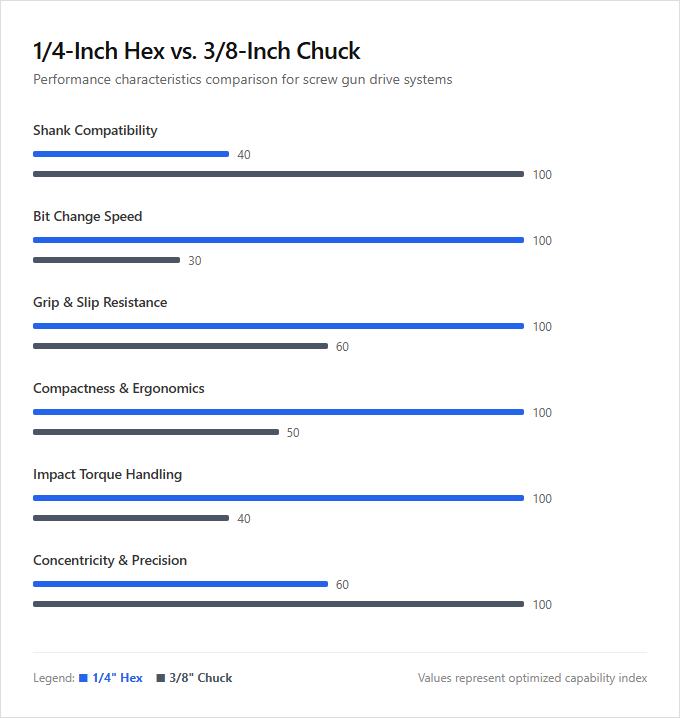
| Shank Compatibility | While the 1/4-inch hex collet is strictly limited to hexagonal-shank bits, the 3/8-inch chuck offers greater versatility by accepting both round and hex-shank drill bits. |
| Bit Change Mechanism | The 1/4-inch hex utilizes a quick-release sleeve for rapid, tool-free bit changes, whereas the 3/8-inch chuck requires manual or keyed tightening to secure the accessory. |
| Grip and Slippage | The locked positive engagement of the 1/4-inch hex prevents rotational slippage under load, unlike the 3/8-inch chuck which relies solely on frictional force and can slip during high-torque tasks. |
| Tool Weight and Ergonomics | Screw guns with a 1/4-inch hex drive have a significantly shorter head length and lower mass, maximizing efficiency in tight spaces compared to the heavier 3/8-inch chuck assembly. |
| Torque Application | The 1/4-inch hex is designed to handle the rapid concussive force of an impact driver mechanism, while the 3/8-inch chuck is optimized for continuous rotational torque. |
| Concentricity and Runout | A 3/8-inch chuck generally provides superior concentricity for precise drilling, whereas the 1/4-inch hex connection allows for slight radial play that is acceptable for driving fasteners. |
1/4-Inch Hex Collets Eliminate High-Torque Slip
When selecting a professional screw gun, the choice between drive systems dictates both efficiency and application scope. Notably, one-quarter inch hex collets utilize hexagonal shank geometry to eliminate rotational slip under high torque. This locked-in design enables seamless power transfer and rapid, one-handed bit changes during repetitive, high-speed fastening tasks.
Conversely, the three-eighths inch chuck offers broader compatibility, accommodating various round and triangular shank bits for diverse drilling operations. The quick-change hex system is highly suited for high-production tradespeople like drywallers and cabinet installers, while the versatile three-eighths inch chuck is ideal for general contractors and utility technicians who require a single tool for multi-material drilling and driving.
Precision 3/8-Inch Keyless Chucks
When selecting a driving tool, the choice between a one-quarter inch hex drive and a three-eighths inch chuck depends on your precision requirements. Three-eighths inch keyless chucks deliver superior concentricity and minimal radial runout for precision drilling operations. By securing round-shank bits firmly along three contact points, this chuck style minimizes wobble and ensures perfectly straight, clean holes.
In contrast, the one-quarter inch hex connection excels in high-speed fastening, utilizing a quick-release mechanism that prioritizes rapid bit changes over absolute axial alignment. High-volume drywall and framing contractors benefit most from the fast, repetitive output of the hex drive, while precision cabinetmakers and detailed installers require the superior accuracy of the three-eighths inch chuck.
How Quick-Release Collets Secure Insert Bits
The one-quarter inch hex drive is engineered for high-efficiency fastening, utilizing quick-release collets that rely on a ball-detent mechanism to secure the power grooves of insert bits. When a compatible hex bit is inserted, a spring-loaded steel ball drops into the bit's groove, establishing a secure lock that prevents slipping while allowing rapid, one-handed changes. This system maximizes productivity during repetitive driving applications.
Conversely, the three-eighths inch chuck employs adjustable jaws to grip a wide variety of round or hex shanks, prioritizing torque and versatility over speed. High-volume drywall installers and production woodworkers favor the rapid-change efficiency of the hex drive, while general carpenters and maintenance technicians benefit more from the adaptable, multi-material capabilities of the three-eighths inch chuck.
Three-Jaw Chuck with Universal Shank Capacity
The quarter-inch hex drive is engineered for rapid bit changes and high-efficiency driving. This system utilizes a quick-release collar that accepts standard hex-shank bits, making it highly effective for repetitive fastening tasks where speed and compact tool design are prioritized.
The three-eighths inch chuck offers superior versatility. The three-jaw chuck system provides universal shank capacity for round, triangular, and hexagonal bits. This design eliminates accessory compatibility limitations, allowing the operation of specialty drill bits alongside standard driving attachments.
The quarter-inch hex configuration is ideal for production assemblers and drywall installers requiring rapid-fire driving, whereas the three-eighths inch chuck is best suited for general contractors and maintenance technicians who demand multi-material drilling flexibility.
1/4-Inch Hex Interfaces: Built for High Torsion
When selecting a screw gun interface, the choice between a one-quarter inch hex drive and a three-eighths inch chuck depends on the mechanical demands of the task. The one-quarter inch hex interface is specifically engineered to withstand high torsional impact forces, making it the industry standard for rapid, high-torque fastening. Its locking design prevents bit slippage under extreme rotational stress, ensuring efficient power transfer during demanding driving applications.
The three-eighths inch chuck offers broader versatility, accommodating various round and hex-shank bits for general-purpose drilling. While it lacks the specialized impact tolerance of the hex interface, its adjustable jaws provide secure tension for diverse accessory sizes. Heavy-duty tradespeople requiring rapid, repetitive fastening excel with the quarter-inch hex, while maintenance technicians and homeowners seeking maximum utility find the three-eighths inch chuck indispensable.
3/8-Inch Drill/Drivers with Adjustable Torque Clutches
When selecting a fastening tool, the choice between a one-quarter inch hex drive and a three-eighths inch chuck depends on the required precision and application. One-quarter inch hex systems, typical of impact drivers, offer rapid bit changes and high rotational force for driving large fasteners quickly.
Three-eighths inch drill/drivers incorporate an adjustable mechanical clutch for precise torque limitation. This mechanism allows operators to select specific torque thresholds, which prevents over-driving screws and protects delicate materials from splitting or stripping.
The quick-change hex system is ideal for high-volume framing contractors requiring speed and power, whereas the versatile three-eighths inch chuck is best suited for cabinetmakers and technicians who demand meticulous depth and torque control.
Quick-change sleeves minimize downtime by allowing rapid one-handed bit ejection.
When selecting a screw gun, the choice between a one-quarter inch hex drive and a three-eighths inch chuck impacts operational efficiency. The one-quarter inch hex collet excels in high-speed applications. Its integrated quick-change sleeve minimizes downtime by allowing rapid, one-handed bit ejection, enabling operators to swap driver bits instantly without interrupting their workflow.
The three-eighths inch chuck accommodates a broader range of round and hex-shank bits, prioritizing versatility over speed. High-volume drywall installers and assemblers benefit most from the rapid efficiency of the hex drive, whereas general contractors and remodelers require the multi-material adaptability of the three-eighths inch chuck.
Leave a comment