
Achieving the perfect countersink depth is a persistent challenge for tradespeople, often resulting in stripped fasteners, fractured drywall, or marred workpieces. While standard drill-drivers with basic mechanical slip clutches offer a familiar fallback, they lack the speed and micron-level precision required for high-volume, professional-grade production.
Specialized screw guns overcome this limitation, granting operators the ability to achieve flawless, repeatable flush seating that virtually eliminates surface damage. However, capitalizing on this benefit requires a key stipulation: depth-sensitive and torque-control clutches operate on entirely different physical principles, and selecting the wrong mechanism can compromise your workpiece.
For example, high-speed drywall installation relies heavily on the instant disengagement of a depth-sensitive clutch, whereas dense cabinetry assembly demands the precise resistance-matching of a torque-control system. This article analyzes the mechanical differences between these two clutch designs, evaluates their performance across key applications, and provides a definitive guide to selecting the right tool for your workflow.
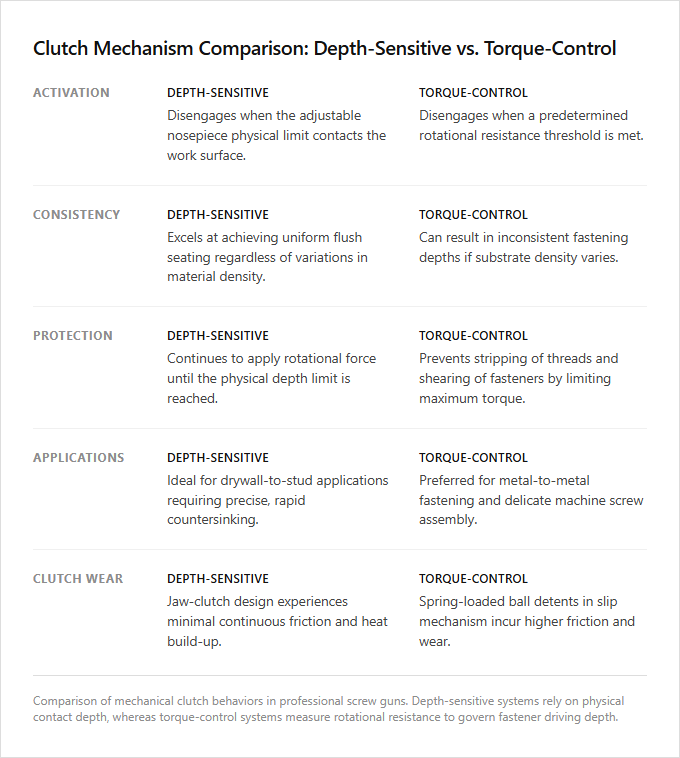
| Factor | Summary |
|---|---|
| Activation Mechanism | The depth-sensitive clutch disengages when the adjustable nosepiece contacts the work surface, while the torque-control clutch disengages when a predetermined rotational resistance threshold is met. |
| Depth Consistency | Depth-sensitive clutches excel at achieving uniform flush seating regardless of material density, whereas torque-control clutches can result in inconsistent depths if substrate density varies. |
| Fastener Protection | Torque-control clutches prevent stripping of threads and shearing of fasteners by limiting maximum torque, whereas depth-sensitive clutches continue to apply rotational force until the physical depth limit is reached. |
| Material Applications | Depth-sensitive clutches are ideal for drywall-to-stud applications requiring precise countersinking, while torque-control clutches are preferred for metal-to-metal fastening and machine screw assembly. |
| Clutch Wear | The jaw-clutch design of depth-sensitive mechanisms experiences less continuous friction and heat build-up compared to the spring-loaded ball detents in torque-control slip clutches. |
Precision Disengagement of Depth-Sensitive Clutches
Screw guns utilize specialized clutching mechanisms to prevent over-driving fasteners, primarily categorized into depth-sensitive and torque-control designs. Depth-sensitive clutches utilize an adjustable mechanical nosepiece as a physical stop to disengage the jaw-clutch at a precise distance. When the nosepiece contacts the work surface, the drive clutch disengages automatically, ensuring screws are driven perfectly flush regardless of material density variations.
Torque-control clutches disengage based on rotational resistance, slipping when a pre-selected force threshold is reached. This alternative design responds to the material's resistance rather than physical depth. Drywall installers and high-volume carpenters rely on depth-sensitive models for rapid, flush fastening, while precision assemblers and technicians prefer torque-control models to protect delicate components from over-tightening.
Torque-Control Clutch Mechanism
In professional fastening applications, selecting the appropriate clutch mechanism on a screw gun dictates both efficiency and finish quality. A depth-sensitive clutch operates by disengaging the drive spindle once the screw head reaches a pre-set depth relative to the nosepiece. This mechanical bypass ensures consistent flush-seating regardless of variations in the density of the underlying substrate.
Torque-control clutches employ a spring-loaded slip clutch that disengages the drive spindle when rotational resistance exceeds the torque threshold. This system prevents over-tightening by stopping the drive action at a calibrated rotational force rather than a physical depth measurement.
Depth-sensitive tools are preferred by drywall installers needing rapid, repetitive flush finishes, while torque-control models are best suited for cabinetmakers and assembly technicians requiring precise fastening force to protect delicate materials.
Depth-Sensitive vs. Torque Clutches for Consistent Flushness
When fastening into materials with varying densities, torque-control clutches often deliver inconsistent screw depths. Because a torque-control mechanism disengages based on rotational resistance, denser grain structures cause the tool to stop prematurely, leaving screw heads proud, while softer zones lead to overdriven fasteners.
Depth-sensitive clutches rely on physical contact with the work surface to disengage. This mechanical design ensures consistent countersink flushness regardless of material density fluctuations, as the drive stops only when the preset physical depth is reached.
Drywall installers and high-volume deck builders benefit most from depth-sensitive clutches for rapid, flush finishes, while assembly technicians and precision woodworkers require torque-control clutches to prevent over-tightening in uniform materials.
Axial Pressure Clutch with Automatic Contact Disengagement
In professional fastening, selecting the appropriate clutch mechanism is vital for material integrity. A depth-sensitive clutch relies on continuous axial pressure from the operator to maintain positive clutch engagement during the driving process. Once the nosepiece contacts the work surface at the preset depth, the clutch automatically disengages to prevent over-driving.
A torque-control clutch operates based on rotational resistance rather than operator force, slipping when a predetermined torque threshold is reached. This design protects delicate substrates from excess rotational force without relying on physical depth stops. Drywall installers and high-volume framing contractors benefit most from the rapid depth-sensitive design, while precision product assemblers and woodworkers require torque-control models to prevent stripping threaded fasteners.
Torque-Control Clutches Prevent Fastener Damage
Selecting the appropriate clutch mechanism on a screw gun optimizes both efficiency and material integrity. A depth-sensitive clutch disengages the drive when the fastener reaches a predetermined depth relative to the work surface. This mechanism relies on physical contact, making it highly effective for consistent, flush-mount fastening in high-volume installations.
A torque-control clutch prevents thread stripping and fastener head shear by limiting the maximum transmissible torque. Once the pre-selected rotational resistance is reached, the clutch slips to protect sensitive components and ensure structural joint integrity. Drywall installers and high-production framers benefit most from the rapid, surface-level consistency of depth-sensitive clutches, whereas precision mechanics and woodworkers require the damage-preventing control of torque-sensitive systems.
Calibrating Countersink Depth with Threaded Lock-Collars
Depth-sensitive clutches disengage the drive mechanism once the screw head reaches a predetermined depth relative to the work surface. To achieve precise countersink depth, these specialized guns utilize a threaded lock-collar for micro-adjustments. Manually rotating this collar fine-tunes the nosepiece position with high precision, ensuring consistent, flush fastening regardless of slight variances in material density.
In contrast, torque-control clutches disengage when a pre-set rotational resistance is met, regardless of how deep the fastener has penetrated. Depth-sensitive models are ideal for drywall installers and carpenters who require perfectly flush finishes, while torque-control units are best suited for mechanical assemblers and metalworkers who must prevent over-tightening and stripped threads.
Depth-Sensitive vs. Torque-Control Clutches in Fastening
Depth-sensitive clutches disengage the drive mechanism once the screw head reaches a predetermined depth relative to the work surface. This precise depth control is essential when fastening compressible substrates like drywall and softwoods, preventing the fastener from sinking too deep and damaging the material face.
Torque-control clutches utilize a slip mechanism that disengages when a specific rotational force is reached. This mechanism is required for machine-screw assembly in metal or hard plastics, where over-tightening can easily strip threads or fracture the host components.
Drywall installers and carpenters require depth-sensitive tools for rapid, flush fastening, while assembly-line technicians and precision mechanics rely on torque-control models to maintain strict engineering tolerances.
Leave a comment