
In high-precision assembly, technicians frequently struggle with stripped fasteners and damaged workpieces caused by the imprecise speed modulation of traditional drive systems. While standard tool-acquisition funding sources typically prioritize conventional variable-speed trigger mechanisms to address these issues, newer technology offers a more refined path forward.
Integrating gyroscopic activation grants operators fluid, real-time control over rotational speed simply by tilting their wrist. Implementing this technology, however, comes with the stipulation that users must undergo a brief learning curve to master spatial calibration. Industry-leading examples, such as the DeWalt 8V MAX Gyroscopic Screwdriver, highlight how this intuitive interface excels in delicate applications.
The following sections will compare gyroscopic sensors against traditional trigger switches, analyzing their mechanical reliability, ergonomic benefits, and overall impact on assembly-line efficiency.
| Factor | Summary |
|---|---|
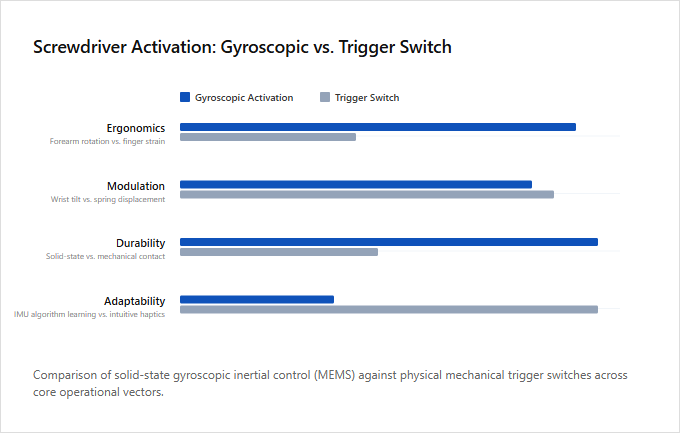
| Control Mechanism | Gyroscopic activation utilizes an internal micro-electromechanical systems (MEMS) gyroscope to sense wrist motion, whereas a trigger switch relies on a physical potentiometer to modulate motor speed. |
| Ergonomics and Strain | Trigger switches can induce repetitive strain injury (RSI) during prolonged tasks, whereas gyroscopic tools leverage forearm rotational kinetics to reduce localized finger fatigue. |
| Speed Modulation | Gyroscopic drivers offer variable velocity proportional to the angle of wrist inclination, while trigger switches regulate rotational speed through tactile spring-loaded displacement. |
| Component Durability | Mechanical trigger switches are susceptible to contact degradation from particulate ingress, whereas solid-state gyroscopic sensors experience minimal mechanical wear over time. |
| Operator Adaptation | Users must adapt to the proprietary inertial measurement unit (IMU) algorithms governing gyroscopic tools, unlike the universally intuitive haptic feedback of trigger switches. |
MEMS Sensors: Contactless Motion Detection in Gyroscopic Tools
Traditional power screwdrivers rely on mechanical trigger switches to regulate motor speed and rotation. Modern gyroscopic tools utilize micro-electromechanical systems (MEMS) sensors to detect physical motion instead of mechanical contact. These internal sensors continuously measure the user's hand gestures, translating subtle wrist tilts into variable speed and directional control, which reduces physical strain during repetitive tasks.
This technology eliminates wear-prone mechanical components, whereas traditional trigger switches offer familiar, robust reliability for high-torque demands. Traditional trigger-drive models are best suited for heavy-duty contractors needing consistent power, while gyroscopic screwdrivers are perfect for electronics technicians requiring delicate, one-handed precision.
How Traditional Trigger Switches Use Potentiometers
Traditional screwdriver power tools employ a standard trigger switch mechanism to regulate motor speed. This system relies on a potentiometer to translate physical finger compression into electrical signals, varying the tool's power based on the depth of the trigger pull. While highly reliable, this mechanical approach requires continuous finger exertion, which can cause hand fatigue during repetitive tasks.
In contrast, gyroscopic activation utilizes internal sensors to control speed and rotation based on the directional tilt of the user's wrist. This motion-sensing technology eliminates manual triggers, offering a fluid, gesture-based control dynamic. Trigger-switch models are suited for high-volume manufacturing workers who require predictable, tactile feedback, whereas gyroscopic screwdrivers are ideal for field technicians and electricians performing rapid fastening in confined or overhead spaces.
Gyroscopic Speed Modulation via Hand Movement
Modern power screwdrivers utilize distinct control mechanisms to regulate speed, primarily categorized into gyroscopic activation and traditional trigger switches. Gyroscopic speed modulation is directly governed by the user's hand angular velocity and spatial orientation. By sensing the tilt and rotation of the wrist, internal sensors translate physical movement into proportional drive speed, offering intuitive, single-handed control without manual pressure adjustments.
Traditional trigger-switched models rely on physical depression depth to control motor output, providing a familiar, mechanically restricted interface. Gyroscopic tools are ideal for electronics technicians requiring meticulous, variable control in tight spaces, while trigger-activated models best serve production-line assemblers who demand consistent, highly repetitive fastening speeds.
Trigger-Based Speed Control via PWM Duty Cycles
Traditional electric screwdrivers utilize a trigger switch to regulate motor speed through variable pulse-width modulation (PWM) duty cycles. By altering the ratio of on-to-off time in the electrical signal, PWM allows operators to precisely control rotational velocity based on finger pressure. This established technology provides predictable power delivery and highly consistent torque management for standard fastening tasks.
In contrast, gyroscopic activation employs internal sensors to detect the physical twist of the user's wrist, translating angular momentum into proportional motor speed and direction. Trigger-based models are ideal for assembly line workers requiring repetitive, high-volume depth control, while gyroscopic screwdrivers suit field technicians and electricians who frequently operate in awkward angles with restricted hand clearance.
IMU-Enabled Dynamic Bi-Directional Rotation Control
Traditional power screwdrivers rely on manual trigger switches and separate directional sliders to control operation. In contrast, gyroscopic activation integrates an Inertial Measurement Unit (IMU) to dynamically manage bi-directional rotation. By sensing the user's wrist movements, the internal IMU translates the direction and angular velocity of a physical turn into corresponding drive rotation and speed, offering seamless fluid control without manual button switching.
This technological divergence alters the ergonomic experience and operational efficiency of fastening tasks. Standard trigger-switch drivers are ideal for high-volume production workers requiring repetitive, consistent torque, whereas gyroscopic screwdrivers are best suited for precision technicians and field electricians who need intuitive, single-handed control in cramped or awkward angles.
Closed-Loop Gyroscopic Wrist Stabilization
Modern power screwdrivers utilize distinct activation mechanisms to regulate motor output: traditional manual trigger switches and advanced gyroscopic sensors. Gyroscopic systems employ closed-loop feedback algorithms to continuously match motor output with wrist deflection. By sensing the angular velocity and direction of the user's wrist, the internal microprocessor modulates speed and torque in real-time, delivering highly responsive, proportional control.
Traditional trigger switches rely on physical finger depression, offering a familiar, stable control scheme that operates independently of tool orientation. Gyroscopic screwdrivers are highly suitable for precision electronics technicians requiring delicate, intuitive control in confined spaces, whereas trigger-switch models are ideal for high-volume assembly workers who prioritize predictable, repetitive power delivery.
Mechanical Wear Limits of Trigger Switches
When selecting professional screwdriver power tools, the choice between traditional trigger switches and modern gyroscopic activation impacts both tool longevity and user control. Standard trigger switches rely on variable-resistance mechanical contacts to modulate motor speed. Over time, these physical components suffer from friction, dust infiltration, and electrical arcing, which inevitably degrade the contacts and lead to inconsistent speed control or eventual switch failure.
Gyroscopic activation bypasses these mechanical limitations by utilizing internal motion sensors to detect wrist rotation, translating the angle of movement into precise directional speed without physical wear points. This digital sensing mechanism eliminates the vulnerability of traditional contacts, ensuring consistent performance throughout the tool's lifespan. Trigger-switch models are best suited for assembly line workers who require repetitive, predictable actuation, whereas gyroscopic screwdrivers are ideal for precision technicians and electricians who need highly intuitive, variable-speed control in confined spaces.
Leave a comment