
On high-throughput assembly lines, selecting the wrong activation mechanism for electric torque screwdrivers often leads to chronic operator fatigue, repetitive strain injuries, and inconsistent torque delivery. Manufacturing managers frequently struggle to balance ergonomic safety with demanding production quotas.
While standard capital equipment budgets or operational tooling grants are typically leveraged to acquire these high-precision instruments, the true return on investment depends entirely on the tool's interface. Selecting the correct activation method-whether push-to-start or lever-actuated-grants assembly lines an immediate boost in cycle-time efficiency and a reduction in hand-arm vibration exposure.
A crucial stipulation remains, however: neither method is a universal cure-all, as mechanical efficacy is highly dependent on the specific fastening angle. For instance, in precision electronics assembly, using a lever-start configuration for horizontal applications has proven to optimize tactile feedback and maintain strict quality standards.
This article will compare push-to-start and lever-start mechanisms, analyze their ergonomic advantages, and outline the key selection criteria to guide your next tooling procurement.
| Factor | Summary |
|---|---|
| Activation Trigger | Push-to-start tools initiate spindle rotation through axial pressure applied to the fastener, whereas lever-start tools utilize a manual throttle lever depressed by the operator's grip. |
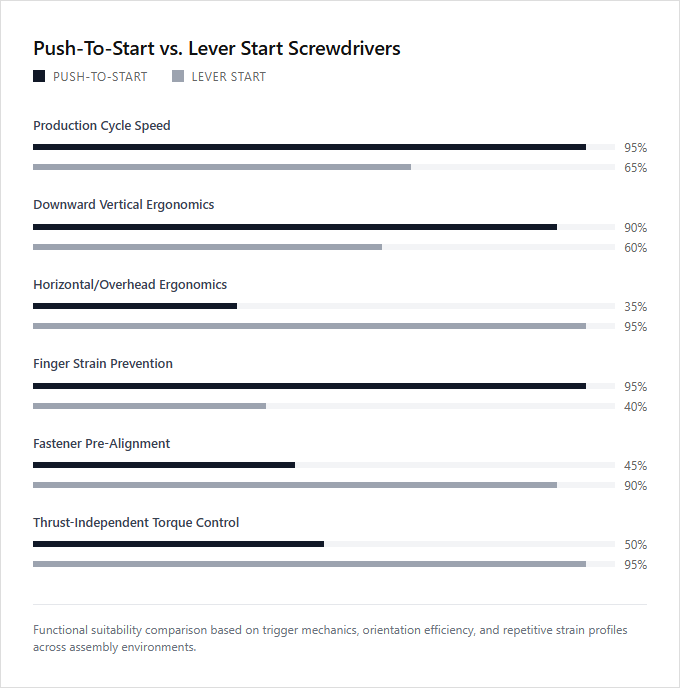
| Tool Orientation | Push-to-start drivers are optimized for vertical downward fastening, while lever-start drivers are preferred for horizontal or overhead applications where applying constant axial force is challenging. |
| Operator Ergonomics | Lever-start mechanisms can cause repetitive strain injury in the fingers, whereas push-to-start designs transfer physical stress to the arm and shoulder by eliminating trigger-pulling motions. |
| Fastener Alignment | Lever-start tools allow precise tool-to-fastener engagement prior to throttle activation, reducing the risk of screw-head cam-out compared to push-to-start variants. |
| Torque Repeatability | Both configurations utilize automatic shut-off clutches to control torque, but push-to-start systems require constant downward thrust to prevent premature clutch disengagement. |
| Production Cycle Time | Push-to-start tools decrease assembly cycle times in high-volume manufacturing by eliminating the manual step of depressing a mechanical lever for each fastening cycle. |
Push-to-Start vs. Lever Start Activation
When selecting industrial electric screwdrivers, the activation mechanism significantly impacts assembly line efficiency. A push-to-start screwdriver operates by requiring a deliberate downward axial force from the operator to initiate clutch engagement and activate the motor. This design ensures that the tool runs only when properly aligned and pressed against the fastener, reducing the risk of screw stripping or workpiece damage.
The lever-start screwdriver relies on manual microswitch depression to activate the tool. The operator depresses a physical lever to run the motor, allowing for rotation independently of the downward pressure applied to the workpiece. Push-to-start models are ideal for operators performing high-volume, vertical assembly tasks where rapid downward alignment is natural, while lever-start models suit technicians conducting delicate, low-torque operations or working at horizontal angles where maintaining constant axial pressure is difficult.
Push vs. Lever Start by Assembly Orientation
In industrial assembly, selecting the appropriate activation mechanism for power screwdrivers directly impacts process efficiency and ergonomics. Vertical assembly applications highly favor push-to-start models. By initiating tool rotation through downward axial pressure alone, these systems eliminate the need for constant finger actuation, significantly minimizing operator fatigue during high-volume, downward-facing tasks.
Conversely, horizontal orientations require lever-start mechanisms to ensure precise spatial control. Operators working in horizontal planes must align the tool perpendicularly to the workpiece, and a manual lever allows them to position the fastener securely before engaging the motor. High-volume workstation operators performing repetitive downward tasks benefit most from push-to-start configurations, whereas precision assembly technicians requiring meticulous lateral control find lever-start tools most suitable.
Lever Start Prevents Cross-Threading in Delicate Joints
When selecting industrial power screwdrivers, the activation mechanism is a critical factor in assembly line efficiency and joint integrity. Push-to-start models activate the motor immediately upon downward pressure, maximizing throughput in high-volume environments. Conversely, lever-start screwdrivers require the operator to depress a physical lever to initiate rotation. This distinction is vital for precision assembly; lever start enables manual thread engagement prior to motor rotation, significantly reducing the risk of cross-threading in delicate joints.
By allowing the operator to feel the threads align before applying torque, lever-activated tools protect sensitive components from stripping and damage. Push-to-start tools are ideal for high-volume assembly workers requiring maximum cycle speed, whereas lever-start models are best suited for precision technicians handling fragile electronics or soft-threaded plastics.
Push-to-Start Prevents Premature Clutch Shut-Off
In industrial assembly, choosing between push-to-start and lever-start electric or pneumatic screwdrivers directly impacts torque accuracy and operator efficiency. Push-to-start models activate when axial downward pressure is applied to the fastener. This mechanism eliminates premature tool shut-off caused by inconsistent hand pressure during the critical automatic clutch-out phase, ensuring the tool reaches its pre-set torque before stopping.
Lever-start screwdrivers require the operator to depress a physical throttle lever to initiate rotation. While lever activation offers precise control over tool positioning before driving, it places greater reliance on the operator's grip stability to avoid interrupting the fastening cycle. High-volume assembly line workers requiring maximum torque consistency benefit most from push-to-start tools, while technicians performing delicate, low-torque positioning tasks prefer the manual control of lever-start models.
Why Push-to-Start is More Ergonomic Than Lever-Start
Selecting the appropriate activation mechanism for power screwdrivers is critical for maintaining workplace safety and productivity. Lever-start models require operators to manually depress a trigger to initiate rotation. Over extended shifts, this constant trigger actuation can lead to repetitive strain injury (RSI) and localized hand fatigue. Conversely, push-to-start models activate automatically when axial pressure is applied to the screw, which optimizes ergonomic efficiency by eliminating manual trigger strain.
Lever-start screwdrivers are highly suitable for operators performing low-volume, precision tasks that require manual control before rotation begins, whereas push-to-start models are ideal for high-volume assembly line workers executing repetitive, fast-paced fastening operations.
Push-to-Start Limitations on Fragile Substrates
When selecting industrial power screwdrivers, the activation mechanism-push-to-start versus lever start-directly impacts assembly quality. Push-to-start models require the operator to apply downward axial force to engage the motor. This physical threshold makes them unsuitable for fragile substrates or low-torque fasteners, where the required thrust can easily crack delicate workpieces or strip threads before the clutch engages.
Lever-start screwdrivers bypass this issue by activating the motor via a physical throttle lever, allowing precise tool placement without downward pressure. This mechanism ensures delicate components remain undamaged during high-precision fastening tasks. Push-to-start models are ideal for high-volume, robust assembly operators prioritizing speed, whereas lever-start tools suit precision technicians handling delicate electronics or fragile materials.
Lever-Start vs. Push-Start Tool Maintenance
Selecting the appropriate activation mechanism for industrial electric screwdrivers is critical for optimizing assembly line efficiency and tool longevity. Lever start tools utilize an external mechanical throttle lever to initiate rotation. Because this physical linkage is subject to friction and environmental exposure, it typically requires more frequent preventative maintenance. Conversely, push-to-start configurations often employ internal, non-contact Hall-effect sensors to detect axial pressure, significantly reducing mechanical wear and servicing intervals.
The choice between these designs depends heavily on the specific workstation ergonomics and task requirements. Push-to-start drivers are ideal for high-volume operators performing repetitive vertical fastening, while lever start models are best suited for technicians requiring precise, manual control over the exact moment of activation in varied angles or delicate assemblies.
Leave a comment