
In high-precision assembly, securing threaded fasteners without damaging delicate components, stripping plastic housings, or causing joint failure remains a persistent headache for production engineers. While standard capital equipment budgets often fund basic power tools to meet baseline production quotas, achieving zero-defect manufacturing requires a more strategic approach to torque control. Investing in the correct clutch mechanism grants assembly lines the exact repeatability needed to virtually eliminate scrap rates and costly warranty claims.
It is important to stipulate, however, that neither option is a universal remedy; their success is highly dependent on joint elasticity, as seen in applications ranging from fragile medical electronics to robust automotive housing assemblies. In this guide, we will examine the mechanical differences between slip clutches and shut-off clutches, evaluate their impact on operator fatigue, and provide a clear roadmap to help you select the ideal precision screwdriver for your specific application.
| Factor | Summary |
|---|---|
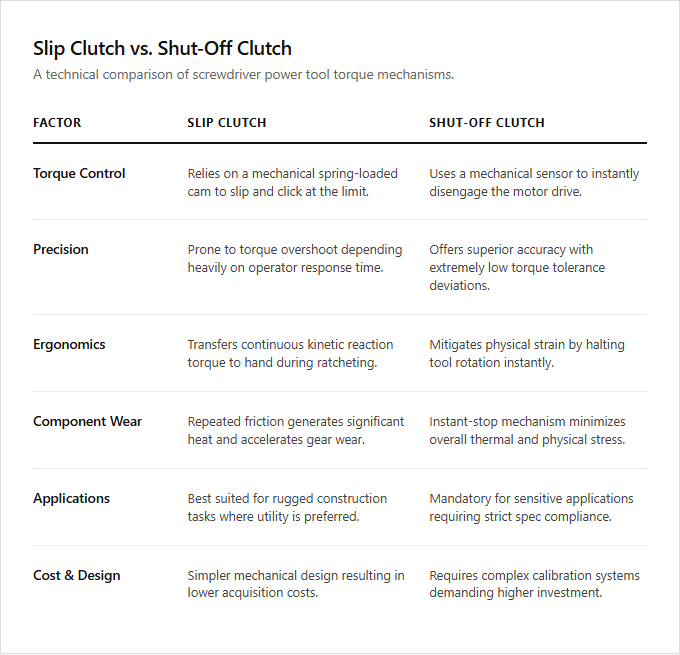
| Torque Control Mechanism | While a slip clutch relies on a mechanical spring-loaded cam to slip and click at the limit, a shut-off clutch uses a mechanical sensor to instantly disengage the motor drive. |
| Precision and Repeatability | Shut-off clutches offer superior accuracy with extremely low torque tolerance deviations, whereas slip clutches are prone to torque overshoot depending on operator response time. |
| Ergonomic Impact | Slip clutches transfer continuous kinetic reaction torque to the operator's hand during ratcheting, while shut-off clutches mitigate physical strain by halting tool rotation instantly. |
| Component Wear | The repeated mechanical friction in slip clutches generates significant heat and accelerates wear on internal gears, whereas the instant-stop mechanism of shut-off clutches minimizes thermal stress. |
| Application Suitability | Slip clutches are best suited for rugged construction tasks, whereas shut-off clutches are mandatory for sensitive applications requiring strict compliance with fastening specifications. |
| Cost and Complexity | Slip clutch screwdrivers feature a simpler mechanical design with lower acquisition costs, whereas shut-off clutch tools require complex calibration systems that demand a higher initial capital investment. |
Why Shut-Off Clutches Outperform Slip Clutches
Power tool clutches manage torque delivery to prevent damage to fasteners and workpieces. Slip clutches, also known as cushion clutches, continuously ratchet and slip once the preset limit is reached, resulting in variable torque output and increased tool wear. In contrast, shut-off clutches immediately stop the motor the moment the target torque is achieved.
This rapid mechanical interruption allows shut-off clutches to deliver superior torque repeatability and significantly higher Cmk values. By minimizing kinetic inertia and operator influence, shut-off tools ensure exceptional precision and joint integrity in high-tolerance manufacturing environments.
Slip clutches are best suited for general construction workers performing non-critical fastening, whereas shut-off clutches are essential for electronics and automotive assembly technicians requiring strict zero-defect quality control.
Key Differences: Slip Clutches vs. Shut-Off Clutches
Screwdriver power tools utilize distinct clutch mechanisms to manage torque delivery and protect materials. Slip clutches utilize a continuous ratcheting mechanism that slips at the torque limit, allowing the motor to keep running while preventing over-tightening. Shut-off clutches employ an automatic sensor to instantly disengage power the moment the target torque is achieved, protecting the fastener and the tool.
This design difference directly affects precision, tool wear, and operator comfort. Slip clutches generate a vibrating, audible feedback and are highly durable, though they produce more physical reaction. Shut-off clutches deliver quiet, highly repeatable results with virtually no mechanical kickback.
General construction professionals benefit from the rugged durability of slip clutches, whereas precision electronics assemblers require the exact torque control and reduced hand fatigue provided by shut-off clutches.
Shut-Off Clutches Minimize Operator Ergonomic Strain
In industrial assembly, the choice between slip clutches and shut-off clutches in power screwdrivers directly impacts safety and precision. Slip clutches continuously slip once target torque is met, creating ongoing vibration. In contrast, shut-off clutches immediately stop the motor the instant the pre-set torque is achieved. This rapid action significantly minimizes the torque reaction transferred to the operator, reducing ergonomic strain and long-term musculoskeletal risks.
By eliminating repetitive jarring forces, shut-off clutches ensure superior comfort during high-frequency fastening. Slip clutches are suitable for general maintenance technicians performing intermittent, lower-precision tasks, whereas shut-off clutches are ideal for high-volume assembly line operators who require precise torque control and maximum ergonomic protection.
Slip Clutches Unsuited for Precision Soft Joints
In industrial fastening, selecting the correct clutch mechanism is critical for joint integrity. Slip clutches operate by ratcheting once a pre-set torque limit is reached. This mechanism is highly susceptible to joint rate variations, making slip clutches less suitable for precision soft joints where torque builds up gradually and predictably.
Conversely, shut-off clutches completely disengage the motor the moment the target torque is achieved, delivering high repeatability across varying joint rates. Slip-clutch tools are best suited for general assembly operators working on robust, non-critical joints, whereas shut-off clutches are essential for precision technicians in aerospace or electronics assembly who require exact torque control.
Shut-Off Clutches Prevent Thread Stripping and Galling
In industrial assembly, selecting the correct clutch mechanism for power screwdrivers is critical for joint integrity. Slip clutches continuously ratchet once the pre-set torque limit is reached. While functional, this mechanical slipping produces repetitive impacts that can compromise sensitive materials.
Shut-off clutches immediately cut motor power the instant the target torque is achieved. By eliminating the repetitive impacts inherent to slip clutch designs, shut-off clutches prevent thread stripping and fastener galling. This mechanism ensures precise torque delivery without placing additional stress on the joint.
Slip clutches are best suited for construction professionals handling robust, non-critical materials, whereas shut-off clutches are ideal for precision electronics assemblers requiring exact calibration to protect delicate components.
Slip Clutch Wear Increases Calibration Frequency
In industrial assembly, selecting the appropriate clutch mechanism for power screwdrivers is critical for torque accuracy. Slip clutches operate by continuously ratcheting once the pre-set torque limit is reached. This repetitive overriding action subjects the internal components to significant friction. Slip clutches experience higher rates of mechanical wear on the clutch seating surfaces, necessitating more frequent calibration intervals to maintain torque repeatability over time.
Shut-off clutches immediately disengage the motor power upon reaching the target torque. This design limits friction, resulting in less component wear and extended calibration lifespans. Slip-clutch tools are suitable for general construction workers who prioritize rugged durability and cost-effectiveness, whereas shut-off clutches are ideal for precision electronics assembly technicians who require exact torque repeatability and minimal maintenance.
Shut-Off Clutches for Precision Assembly Integration
Industrial assembly processes rely on precise torque control to ensure product quality. While a slip clutch continues to ratchet and apply force after reaching its limit, a shut-off clutch immediately cuts power to the motor upon reaching the target torque. This rapid cessation prevents joint damage and eliminates over-torque conditions in sensitive components.
Precision assembly lines require shut-off clutches for seamless integration with torque transducers and digital data logging systems. This capability allows manufacturing facilities to capture real-time fastening data, ensuring strict quality control and complete traceability for critical joints.
Slip clutches are ideal for general utility technicians performing varied, non-critical fastening tasks, whereas shut-off clutches are essential for high-volume assembly operators requiring certified repeatability and strict digital documentation.
Leave a comment