
For metal fabricators and contractors, achieving clean, distortion-free cuts in sheet metal is a constant operational challenge. Too often, selecting the wrong mechanical tool leads to jagged edges, warped workpieces, and excessive material waste. While standard workshop procurement budgets often default to general-purpose grinders or band saws, investing in dedicated mechanical shears grants operators the surgical precision needed to eliminate secondary finishing work entirely.
However, realizing these efficiency gains is subject to certain operating stipulations, particularly regarding material thickness limits and minimum curve radii. For instance, employing a heavy-duty double-cut shear for straight runs or a high-speed nibbler for corrugated roofing serves as the industry standard for clean profile cutting. To help you optimize your tool crib, this article compares the mechanics, capacities, and distinct advantages of nibblers versus sheet metal shears, guiding you to the ideal cutting solution for your specific application.
| Factor | Summary |
|---|---|
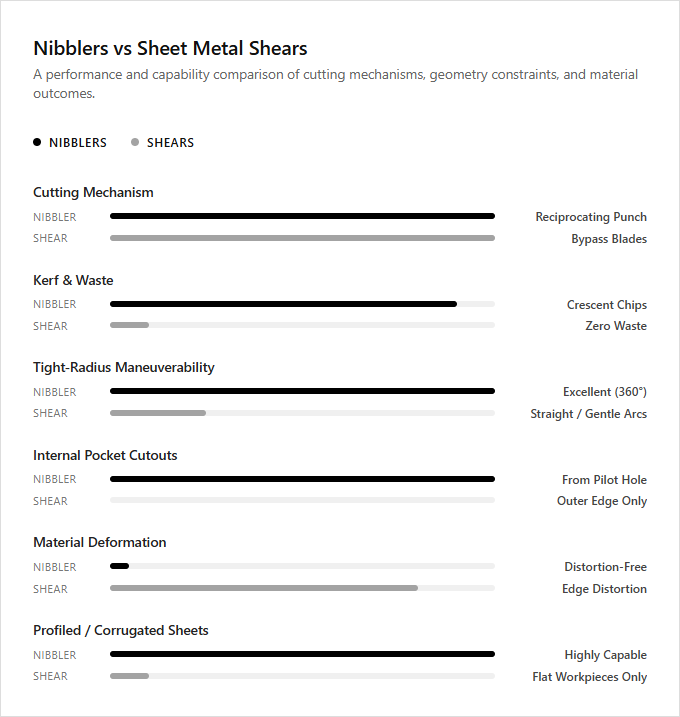
| Cutting Mechanism | Nibblers remove small crescent-shaped chips of metal using a reciprocating punch and die, whereas shears utilize two bypass blades to slice through the material. |
| Kerf and Waste | Nibblers create a distinct kerf channel resulting in tiny, sharp waste chips, while single-cut shears produce a clean cut with zero material waste. |
| Maneuverability | Nibblers excel at cutting tight-radius curves and complex profiles because the head can rotate 360 degrees, whereas shears are restricted to straight lines and gradual arcs. |
| Internal Cutouts | Nibblers can initiate internal pocket cuts from a small pre-drilled pilot hole, whereas sheet metal shears must start cutting from an outer edge of the workpiece. |
| Material Distortion | Nibblers deliver completely distortion-free edges because they do not apply lateral force, whereas shears can cause mechanical deformation along the cut line. |
| Profiled Sheet Capability | Nibblers easily traverse corrugated profiles and trapezoidal metal sheets, whereas shears are limited to flat workpieces due to the physical constraint of their jaws. |
Nibblers utilize a reciprocating punch and die mechanism for cutting.
In sheet metal fabrication, selecting the appropriate cutting tool is essential for precision and efficiency. Nibblers utilize a reciprocating punch and die mechanism for cutting, rapidly removing small semi-circular metal chips along the cut line. This unique action allows for tight radius curves, intricate internal cutouts, and distortion-free results on corrugated or profiled materials without bending the workpiece.
In contrast, sheet metal shears operate with a continuous blade action to slice through material, making them highly efficient for rapid, straight-line cuts with zero kerf waste. While nibblers are ideal for HVAC technicians and custom fabricators requiring complex, detailed shapes, shears are best suited for roofers and installers performing high-speed, linear trimming.
How Bypass Shears Cut Sheet Metal Waste-Free
In professional metalworking, selecting the correct cutting tool is essential for efficiency and finish quality. Sheet metal shears operate using opposing bypass blades that slice without waste. This scissor-like action produces clean, distortion-free edges without generating metal shavings, preserving material and maintaining a clean workspace during straight-line cutting.
Nibblers utilize a rapid punch-and-die mechanism that removes small crescent-shaped chips, allowing for exceptional maneuverability through corrugated materials and tight curves. Sheet metal shears are ideal for roofing contractors requiring swift, waste-free straight cuts on flat panels, while nibblers are best suited for HVAC installers and automotive restorers who frequently navigate complex profiles and interior cutouts.
Nibblers create a distinct kerf width of discarded metal chips.
When choosing between sheet metal shears and nibblers, the method of material removal is a key consideration. Sheet metal shears utilize a bypass blade action to slice through metal without producing waste. Nibblers cut by rapidly punching out tiny, semi-circular metal chips. This punching process creates a distinct kerf width of discarded metal, which must be factored into dimensional layouts but prevents any distortion of the workpiece.
Each tool serves distinct professional needs based on these cutting behaviors. Sheet metal shears are ideal for contractors and roofers who prioritize rapid, waste-free straight runs, while nibblers are best suited for automotive restorers and detailed fabricators who require precise maneuverability through tight curves and corrugated profiles.
Shears can cause edge deformation and lateral material distortion.
When selecting between nibblers and sheet metal shears, the impact on the workpiece is a critical consideration. Sheet metal shears operate by utilizing two blades to slice through metal, a process that inherently exerts significant mechanical pressure. This concentrated force often leads to visible edge deformation and lateral material distortion along the cut line, which can necessitate extensive secondary finishing work to restore the material's flatness.
Nibblers avoid this issue by punching out tiny, successive chips of metal rather than shearing them. This cutting method prevents lateral stress on the panel, ensuring a clean, distortion-free edge even on delicate materials. Sheet metal shears are ideal for high-volume roofers and installers requiring rapid, straight cuts where minor edge warping is acceptable, while nibblers are best suited for precision fabricators and auto-body restorers who demand flawless finishes and intricate curves.
Nibblers Excel at Cutting Tight Curves
When selecting metalworking power tools, understanding the distinction between nibblers and sheet metal shears is essential for achieving precise results. While sheet metal shears utilize dual blades to slice rapidly through straight lines and gentle contours without generating waste material, nibblers operate via a rapid punching action. This unique mechanism allows nibblers to excel at intricate, tight curves, as their exceptionally small minimum cutting radius facilitates complex maneuvers and interior cutouts without distorting the surrounding workpiece.
Choosing the correct tool depends entirely on the specific demands of your fabrication workflow. Sheet metal shears are ideal for roofing contractors and installers requiring fast, clean straight cuts, whereas nibblers are the preferred choice for HVAC technicians and artistic metal fabricators who frequently navigate detailed templates, tight radii, and corrugated profiles.
Pre-Drill Pilot Holes for Internal Nibbler Cutouts
When selecting sheet metal fabrication tools, understanding the operational differences between nibblers and sheet metal shears is essential. Shears perform clean, continuous cuts from the edge of a sheet without producing material waste. In contrast, nibblers utilize a rapidly reciprocating punch and die system to remove tiny metal chips, allowing for exceptional maneuverability along tight radiuses.
This mechanical difference becomes critical during plunge cutting. While shears are generally limited to starting from an outer edge, nibblers excel at internal cutouts. However, achieving an internal cutout with a nibbler requires a pre-drilled pilot hole large enough to accommodate the insertion of the tool's die before the cutting process can commence.
Sheet metal shears are highly suitable for roofing contractors requiring rapid, straight-line trimming, while nibblers are the preferred choice for creative metal fabricators and HVAC technicians who frequently navigate complex, curved templates and internal patterns.
Shears Offer Faster Feed Rates for Straight Cuts
When selecting metalworking tools, the choice between sheet metal shears and nibblers depends on cut geometry. Sheet metal shears excel in high-speed operations, offering a significantly higher linear feed rate for straight cuts compared to nibblers. This continuous blade action slices material without generating waste, ensuring rapid, long-distance straight runs.
Nibblers punch out small metal chips, allowing them to navigate tight curves and corrugated profiles without distorting the workpiece. While nibblers provide unmatched maneuverability, they operate at a slower pace. Sheet metal shears are best suited for high-volume fabricators prioritizing rapid straight-line production, whereas nibblers are ideal for HVAC installers requiring intricate cuts on irregular surfaces.
Leave a comment