
For metal fabricators and contractors, achieving clean, warp-free cuts in sheet metal remains a persistent workshop challenge. Traditional cutting methods frequently distort profiles, leading to costly material waste and tedious edge-refining rework. While standard equipment procurement budgets typically prioritize multi-purpose machinery, investing in specialized precision tools grants operators immediate, compounding savings in both labor hours and material integrity.
However, securing these efficiency gains stipulates a strict understanding of tool mechanics under specific material loads; utilizing the wrong tool for the job still risks deformation. For example, commercial shops relying on industry-standard brands like Trumpf or Makita recognize that tool geometry dictates the final edge quality.
To guide your next tooling investment, this article compares slitting shears against punching nibblers, examining their unique operational profiles, material thickness capacities, and how to choose the ideal distortion-free solution for your specific fabrication workflows.
| Factor | Summary |
|---|---|
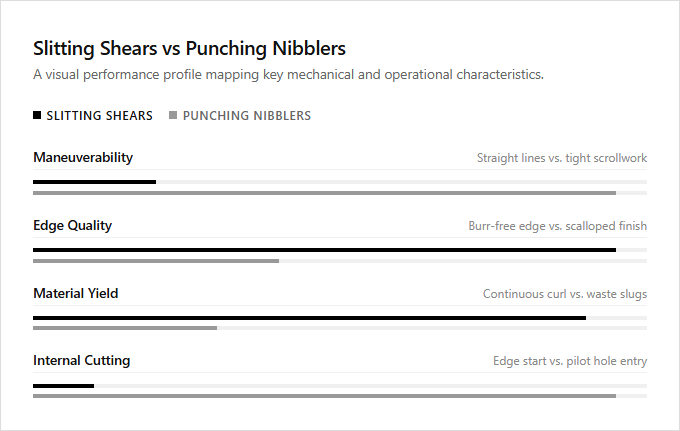
| Cutting Mechanism | Slitting shears utilize a dual-blade system to slice metal without removing material, whereas punching nibblers employ a rapid reciprocating punch and die to stamp out tiny segments. |
| Material Waste | Slitting shears produce a single, continuous spiral metal curl, while punching nibblers generate small, sharp crescent-shaped waste slugs that leave a distinct kerf. |
| Maneuverability | Punching nibblers excel at tight-radius curves and intricate scrollwork, whereas slitting shears are primarily restricted to straight-line ripping and gentle contours. |
| Edge Distortion | Slitting shears leave a smooth, virtually burr-free edge on the workpiece, whereas punching nibblers create a slightly scalloped edge that may require subsequent deburring. |
| Internal Cutouts | Punching nibblers can initiate internal cuts in the middle of a panel after drilling a small pilot hole, while slitting shears generally must begin their cut from an open outer edge. |
Double-Cut Shears Eliminate Material Deformation
Selecting the appropriate sheet metal fabrication tool requires a clear understanding of the mechanical differences between slitting shears and punching nibblers. Double-cut slitting shears utilize a highly efficient three-blade configuration to eliminate lateral material deformation by removing a thin curl of waste metal. This specialized cutting action ensures that the surrounding sheet remains perfectly flat and free of surface distortion.
Punching nibblers employ a rapid punch-and-die mechanism that bites out small semicircular paths, allowing for tight-radius curves and corrugated material handling without bending the workpiece. Slitting shears are best suited for HVAC installers requiring pristine, straight joints, while nibblers are ideal for automotive fabricators and roofers who regularly navigate complex profiles or interior cutouts.
Slitting Shears Produce Continuous Ribbon Waste
When selecting metal-cutting power tools, the mechanism of material removal represents a key differentiator between slitting shears and punching nibblers. Slitting shears utilize a dual-blade system that shears the metal, producing a single, continuous spiral ribbon of waste. This continuous curl keeps the workspace clean and prevents the accumulation of sharp debris along the cut line.
In contrast, punching nibblers operate by rapidly punching out tiny, crescent-shaped metal chips. While nibblers offer excellent maneuverability, these loose chips can scatter easily and damage finished surfaces. Slitting shears are ideal for HVAC technicians and indoor installers prioritizing clean, straight cuts without debris, while punching nibblers are best suited for roofers and custom fabricators requiring tight radius curves in corrugated materials.
How Nibblers Achieve Multi-Directional Cutting
When selecting metalworking power tools, understanding the mechanical distinctions between slitting shears and punching nibblers is essential. Slitting shears utilize two opposing blades to slice through sheet metal with minimal waste, making them highly efficient for long, straight runs. Conversely, punching nibblers employ a rapidly reciprocating punch and die assembly. This unique mechanism enables precise, multi-directional cutting capabilities without distorting the workpiece, allowing operators to navigate tight curves and corrugated profiles with ease.
Each tool serves distinct operational demands based on these cutting actions. Slitting shears are best suited for roofing installers and high-volume fabricators prioritizing speed and waste-free straight cuts, whereas nibblers are the preferred choice for HVAC technicians and custom fabricators who frequently execute complex patterns and internal cutouts.
Optimizing Blade Clearance for Flat Double-Cut Shearing
When selecting sheet metal cutting tools, understanding the mechanical differences between slitting shears and punching nibblers is essential for quality control. Double-cut slitting shears excel in preserving the structural integrity of the metal. By optimizing blade clearance settings, these specialized shears execute a dual-track cut that curls away a thin waste strip, successfully maintaining the flatness of the workpiece without warping the finished edges.
In contrast, punching nibblers utilize a rapid punch-and-die mechanism to bite through metal, which allows for tight radius curves but leaves a scalloped edge. Slitting shears are ideal for precision fabricators requiring perfectly flat, distortion-free straight cuts, while nibblers are best suited for HVAC installers who frequently navigate corrugated surfaces and complex templates.
Nibblers: Best for Corrugated Metal and Tight Curves
When selecting between slitting shears and punching nibblers for metalworking, the profile and geometry of the workpiece dictate the optimal choice. Slitting shears excel at clean, distortion-free straight cuts on flat sheets. However, punching nibblers offer distinct structural advantages when navigating complex geometries. Their unique punching action makes them highly superior for traversing high-profile corrugated sheet metal and executing tight radius curves without distorting the material.
While shears remove a continuous curl of waste metal, nibblers produce tiny chips, allowing for omnidirectional steering. Slitting shears are ideal for roofing contractors and fabricators requiring fast, straight cuts on flat paneling, whereas punching nibblers are best suited for mechanical installers and detailed metal workers who frequently encounter corrugated decking and intricate, curved layouts.
Double-Cut Tools Eliminate Secondary Deburring
When selecting sheet metal fabrication equipment, understanding the distinct material separation methods of slitting shears and punching nibblers is essential. Slitting shears, particularly double-cut designs, utilize a dual-blade system that removes a thin curl of waste material. This precise shearing action produces clean, distortion-free edges, completely avoiding the need for secondary deburring operations and significantly reducing post-processing labor.
In contrast, punching nibblers operate by rapidly punching out tiny semi-circular chips, making them highly effective for tight curves, corrugated profiles, and interior cutouts. Sheet metal roofers and HVAC installers benefit most from the maneuverability of nibblers, while precision fabricators and auto-body technicians prefer slitting shears for straight, finished cuts requiring immediate assembly.
360-Degree Nibbling From a Single Pilot Hole
When selecting sheet metal fabrication tools, understanding the distinction between slitting shears and punching nibblers is crucial for jobsite efficiency. Slitting shears utilize dual blades to slice cleanly through metal, removing a thin curl of waste to produce distortion-free straight cuts or gentle outer curves.
In contrast, punching nibblers employ a rapid punch-and-die mechanism designed for intricate interior work. A key advantage of the nibbler is its ability to perform continuous 360-degree tight-radius maneuvers starting from a single pilot hole, allowing users to cut complex shapes directly from the center of a panel.
Slitting shears are ideal for roofers and installers requiring fast, straight-line trimming, whereas punching nibblers are best suited for custom fabricators and HVAC technicians executing detailed cutout work.
Leave a comment