
Selecting the right fasteners for a high-volume framing nailer often feels like a trade-off between tedious job site cleanup and frustrating tool downtime. Contractors and framing crews frequently struggle with flying plastic debris, collator-induced jams, and the safety hazards of sharp metal flags during rapid-fire installations.
While sourcing standard bulk fasteners from traditional hardware distributors remains the baseline procurement method for most construction firms, analyzing the specific delivery mechanism of your fasteners is key. Selecting the optimal collation method grants your crew uninterrupted operational efficiency and superior joint integrity on every pass.
However, this technical choice carries the stipulation that tool magazine angles and regional building codes must always dictate your final fastener inventory. For example, when fastening dense engineered lumber or securing heavy sheathing on high-load shear walls, the collation material's behavior under drive pressure is critical.
Below, we provide a comprehensive comparison of wire weld and plastic strip collation, evaluating their durability, cost-efficiency, and job site performance to help you streamline your next build.
| Factor | Summary |
|---|---|
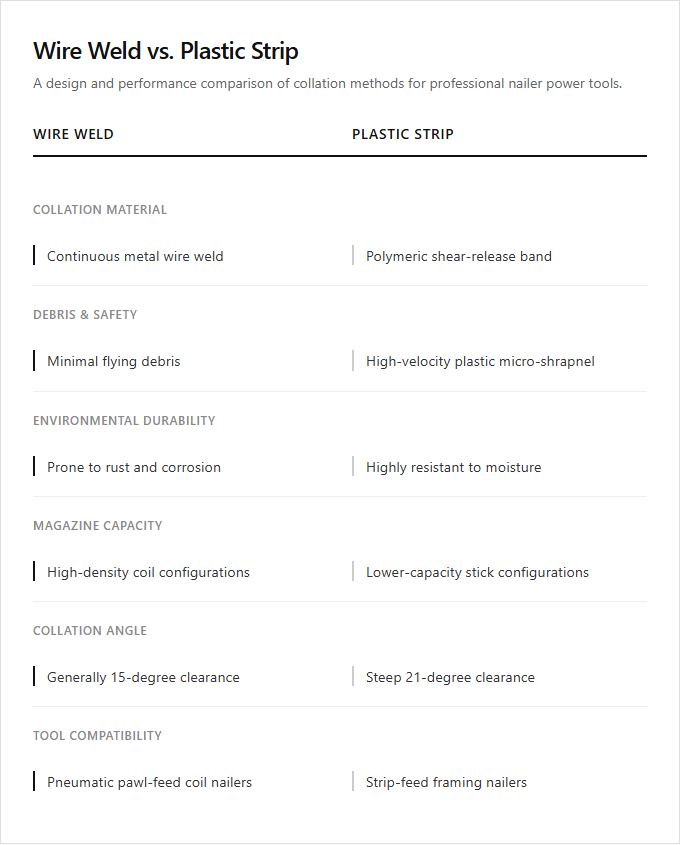
| Collation Material | Wire weld nails are bound together by a continuous metal wire, whereas plastic strip fasteners utilize a polymeric band that shear-releases upon driver blade impact. |
| Debris and Safety | Plastic strip collation produces high-velocity plastic micro-shrapnel during tool actuation, while wire weld systems generate minimal flying debris. |
| Environmental Durability | Plastic strip fasteners resist water degradation in outdoor storage, whereas wire weld coils are highly susceptible to corrosion from moisture exposure. |
| Magazine Capacity | Wire weld nails are arranged in high-density coil magazines to minimize reloading downtime, whereas plastic strip nails are limited to lower-capacity stick configurations. |
| Collation Angle | Plastic strip nails are typically manufactured with a steep 21-degree collation angle, whereas wire weld coil nails generally use a 15-degree angle to optimize magazine clearance. |
| Tool Compatibility | Coil framing nailers utilize a specialized pneumatic pawl-feed mechanism designed specifically to advance wire weld collation. |
Collation Angle Compatibility: 21-Degree Plastic vs. 28-Degree Wire
The choice between wire weld and plastic strip framing nailers depends heavily on tool compatibility and collation angles. Specifically, twenty-one degree plastic collated nails require dedicated framing nailers designed for a steep magazine angle. These fasteners cannot be used in twenty-eight degree wire weld systems, which feature a flatter magazine design. Mixing these distinct collation styles and angles causes severe equipment jamming and potential tool damage.
Plastic strip nails shear cleanly upon firing, leaving no debris on the workpiece, whereas wire weld nails are bound by thin metal wires that break apart during installation. Understanding these physical differences helps contractors match the correct fastener to the appropriate pneumatic system. Heavy-duty framing contractors seeking high magazine capacity and weather resistance prefer wire weld systems, while residential builders and remodelers requiring debris-free, clean workspaces typically select plastic strip collation.
Full round head versus clipped head fastener geometry shear strength
In framing nailers, the choice between wire weld and plastic strip collation directly influences fastener head geometry and structural shear strength. Wire-welding typically supports full round head nails, which offer a complete perimeter of contact. This design maximizes pull-through resistance and ensures superior shear strength under heavy loads. In contrast, plastic strip collation often utilizes clipped head fasteners to allow tighter nesting and higher magazine capacity, though this reduces the head's surface area.
While both styles safely transfer lateral shear forces, full round heads provide superior holding power in high-wind or seismic conditions. Wire-welded full round head nailers are ideal for structural contractors demanding maximum joint integrity, whereas plastic-strip clipped head systems are suited for production framers prioritizing speed and high-capacity reloading.
Polymer embrittlement of plastic collation in sub-freezing temperatures
When selecting collated fasteners for pneumatic nailers, environmental temperature plays a critical role in tool reliability. Plastic strip collation is highly susceptible to polymer embrittlement during winter operations. In sub-freezing conditions, the plastic carrier loses its flexibility, becoming extremely brittle and shattering upon firing, which leads to frequent tool jams and hazardous flying debris on the jobsite.
Wire weld collation avoids this thermal vulnerability by securing the nails with a thin metal wire that remains unaffected by extreme cold, ensuring consistent feeding. Professional framing contractors working in harsh winter climates require the rugged dependability of wire weld collation, whereas indoor finish carpenters and warm-weather residential builders are better suited for the clean, debris-free results of plastic strip collation.
Weld-spatter and flying plastic shard projectile hazards
When selecting collation materials for framing nailers, understanding the specific safety hazards of wire weld and plastic strip options is crucial. Wire-collated nails utilize a thin metal wire welded to each fastener. During deployment, the high-velocity shearing of this wire can generate tiny metal fragments and hot weld-spatter, posing a risk of eye injuries or minor skin punctures if appropriate personal protective equipment is not worn.
Plastic strip collation holds nails in a rigid polymer band. Upon impact, the firing pin shatters this plastic, frequently launching sharp, high-speed shards sideways from the tool. These flying projectiles can accumulate as site debris or strike nearby operators. Wire-weld nails are highly suited for high-volume outdoor framing crews seeking minimal waste cleanup, while plastic-strip nails are ideal for indoor finish carpenters and safety-conscious residential builders who prioritize a spark-free workspace.
Nail shank pitch and magazine load capacity efficiency
When selecting collation for power nailers, shank pitch and magazine capacity are critical efficiency factors. Wire weld nails feature a tight pitch that allows hundreds of fasteners to be wound into a high-capacity coil. This design maximizes magazine capacity, reducing reload frequency during high-volume tasks. Conversely, plastic strip nails are arranged linearly at a wider pitch, which keeps the tool lightweight and agile but restricts capacity to fewer than forty nails per stick.
This structural difference directly affects workflow continuity and tool ergonomics. Wire weld nailers are best suited for high-volume production framers requiring continuous operation, while plastic strip nailers are ideal for residential remodelers who prioritize tool maneuverability and precise, intermittent fastening.
Feed pawl mechanical wear on the framing nailer advancement system
The choice between wire weld and plastic strip collation significantly impacts the mechanical wear of a framing nailer's feed pawl advancement system. Wire-collated nails generate abrasive metal fragments and weld residue during actuation. This debris accumulates in the magazine channels, accelerating the physical erosion of the feed pawl teeth and putting extra strain on the advancement spring.
In contrast, plastic strip collation shears cleanly upon impact, leaving behind non-abrasive polymer debris that causes minimal friction on the feed mechanism. While plastic residue requires less frequent maintenance, cold temperatures can cause the strips to shatter, occasionally disrupting the feed cycle. High-volume production framers prioritizing tool longevity and low maintenance often opt for plastic strip collation, whereas budget-conscious contractors working in diverse weather conditions typically select wire weld systems.
Dual-wire structural integrity versus plastic strip shear failure during transport
When evaluating nail collation methods, physical durability during transit and handling is a primary differentiator. Wire weld collation utilizes dual-wire structural integrity to fuse the nails securely, preventing premature separation. This robust design ensures the collation remains intact despite the vibration, dropping, and impact experienced during transport to the jobsite.
In contrast, plastic strip collation is highly susceptible to shear failure. The brittle nature of the plastic carrier makes it vulnerable to fracturing under thermal stress or rough handling, which often results in broken strips, wasted fasteners, and frequent tool jams before work even begins.
Heavy-duty framing contractors requiring uninterrupted high-volume production benefit most from the resilient wire weld design, whereas residential finish carpenters prioritizing clean, debris-free workspaces are best served by plastic strip collation.
Leave a comment