
Engineers and shop managers constantly battle frame deflection during high-tonnage pressing, a critical failure that compromises part tolerances and accelerates tool wear. When justifying these capital machinery acquisitions through standard equipment procurement budgets or industrial modernization grants, sourcing teams often default to baseline cost-per-ton metrics. However, selecting the proper casting metallurgy grants your operation long-term geometric alignment and near-infinite fatigue life.
With the stipulation that grey iron remains highly effective for low-impact, high-damping applications, severe duty cycles demand superior yield strength. For instance, Tier-1 aerospace manufacturers routinely specify ASTM A536 ductile iron frames to prevent catastrophic structural failure under cyclic loads.
In this technical analysis, we evaluate the tensile strength, deflection limits, and total cost of ownership of ductile iron versus grey iron frames, establishing a clear engineering framework for your next arbor press specification.
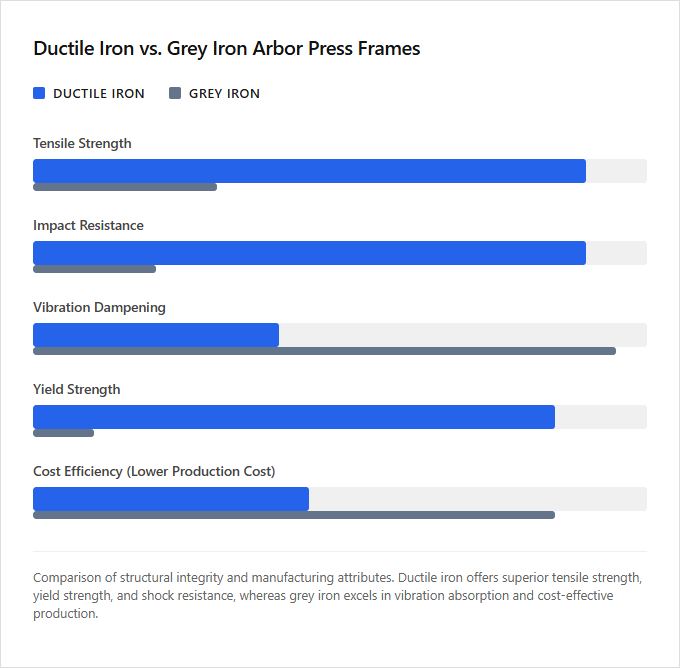
| Factor | Summary |
|---|---|
| Tensile Strength | Ductile iron frames withstand significantly higher tensile stress due to their nodular graphite microstructure, whereas grey iron frames are limited by graphite flakes that act as internal stress concentrators. |
| Impact Resistance | Ductile iron provides superior impact resistance and fracture toughness, making the arbor press frame less prone to catastrophic failure under sudden shock loads compared to brittle grey iron. |
| Vibration Dampening | Grey iron frames exhibit exceptional vibration dampening capacity due to their microstructural graphite flakes, which absorb energy and reduce harmonic resonance during heavy-duty pressing operations. |
| Yield Strength | Ductile iron features a high yield strength allowing for elastic deformation under extreme loads, while grey iron lacks a defined yield point and undergoes immediate brittle fracture when its ultimate limit is exceeded. |
| Manufacturing Cost | Grey iron frames are more economical to cast due to their high fluidity and lower melting point, whereas ductile iron requires precise nodulizing inoculation treatments that increase production expenses. |
Nodular graphite microstructure versus flake graphite morphology
In arbor press construction, the choice of frame material determines the tool's response to operational stress. Grey iron frames feature a flake graphite morphology, which provides excellent vibration damping and high compressive strength but limits tensile durability under heavy shock loads. In contrast, ductile iron frames utilize a nodular graphite microstructure, where the spherical shape of the carbon prevents crack propagation and vastly improves ductility.
This structural divergence dictates how each press handles intense pressure during force-bending or pressing cycles. Heavy-duty industrial operators requiring maximum impact resistance and high-tensile reliability benefit most from ductile iron, whereas precision machinists focusing on high-stability, lighter-load assemblies are best served by grey iron.
Young's modulus of elasticity and its impact on structural deflection
When selecting an arbor press, the frame material directly dictates structural integrity under load. Ductile iron features a significantly higher Young's modulus of elasticity-approximately 170 GPa-compared to grey iron, which typically ranges from 80 to 130 GPa. This difference in material stiffness means a ductile iron frame offers superior resistance to stretching and bending under high pressing forces.
This higher modulus directly minimizes structural deflection, ensuring precise tool alignment and consistent pressure distribution during operation. Grey iron frames exhibit greater deflection under maximum load but offer excellent vibration-dampening properties. High-precision industrial manufacturers requiring maximum rigidity benefit most from ductile iron frames, whereas maintenance technicians performing intermittent, general-purpose pressing find grey iron to be a highly cost-effective solution.
Yield strength thresholds preventing permanent plastic deformation
When selecting an arbor press, the frame material directly dictates the tool's resistance to permanent plastic deformation under load. Grey iron frames possess lower yield strength thresholds, meaning they will fracture rather than bend when their structural limit is exceeded, offering rigidity but minimal elasticity under extreme stress. In contrast, ductile iron frames incorporate spheroidal graphite, which significantly elevates the yield strength threshold. This chemical composition allows the frame to absorb much higher forces without experiencing permanent structural deformation.
Understanding these mechanical limits ensures the proper tool selection for specific operational demands. Grey iron presses are ideal for hobbyists and light-duty assembly technicians requiring precision without high-force risks, while ductile iron presses are essential for heavy-duty industrial operators who perform high-impact pressing and require maximum tool resilience.
Vibration damping capacity of the respective metallic matrices
When selecting an arbor press, the metallurgical composition of the frame determines its performance under load. Grey iron frames feature a flake graphite matrix, which excels at absorbing and dissipating mechanical vibrations. This superior damping capacity minimizes tool chatter and preserves precision during repetitive operations. In contrast, ductile iron contains spherical graphite nodules. While this nodular matrix offers significantly higher tensile strength and impact resistance, it possesses a lower inherent vibration damping capacity than its grey iron counterpart.
The choice between these metallic matrices depends on the specific operational requirements of the workshop. Grey iron presses provide excellent stability for delicate, high-precision assemblies, whereas ductile iron frames resist cracking under extreme, sudden loads. High-precision machinists requiring maximum vibration control benefit most from grey iron frames, while industrial fabricators performing heavy-force bending and pressing find ductile iron indispensable.
Fracture toughness under high-impact shock loading
Arbor press frames manufactured from ductile iron offer superior fracture toughness compared to traditional grey iron. Under high-impact shock loading, grey iron is prone to brittle failure because its flake-like graphite microstructure acts as an internal stress concentrator. The spheroidal graphite structure of ductile iron inhibits crack propagation, allowing the frame to deform elastically and absorb sudden kinetic energy without catastrophic fracturing.
Selecting the appropriate frame material directly impacts operational safety and equipment longevity during demanding pressing tasks. Heavy-duty industrial operators requiring high impact resistance for tasks like riveting and forging are best suited for ductile iron presses, while light-duty technicians performing predictable, static assembly work are well-served by economical grey iron frames.
Compressive strength limits versus ultimate tensile strength
When selecting an arbor press, the frame material dictates the tool's load capacity and durability under stress. Grey iron frames offer exceptional compressive strength, making them highly efficient at handling direct, downward pressing forces. This material possesses low ultimate tensile strength, making it susceptible to fracturing when subjected to significant bending or pulling stresses.
Ductile iron frames incorporate nodular graphite, which significantly enhances the material's ultimate tensile strength and ductility. This structural difference allows ductile iron to absorb high-impact shock loads and resist frame deflection under extreme pressure without cracking.
Grey iron presses are ideal for light-duty hobbyists performing straightforward assembly tasks, whereas ductile iron presses are suited for industrial operators requiring maximum durability for heavy-duty metalworking and high-force applications.
Machinability index and castability of the frame alloys
When selecting an arbor press, the frame's metallurgy dictates both manufacturing efficiency and tool longevity. Grey iron frames offer superior castability due to high fluidity and minimal solidification shrinkage, allowing for highly precise, cost-effective molds. Additionally, grey iron features an exceptionally high machinability index, as its graphite flakes act as natural chip breakers and lubricants during machining. Conversely, ductile iron requires more complex casting systems to manage shrinkage, and its nodular graphite structure lowers its machinability index, though it provides vastly superior tensile strength and fatigue resistance.
These distinct material properties align with different operational demands. Grey iron presses are best suited for hobbyists and light-assembly technicians requiring cost-efficient vibration dampening, whereas ductile iron presses are essential for industrial machinists performing heavy-duty, high-shock pressing operations.
Leave a comment