
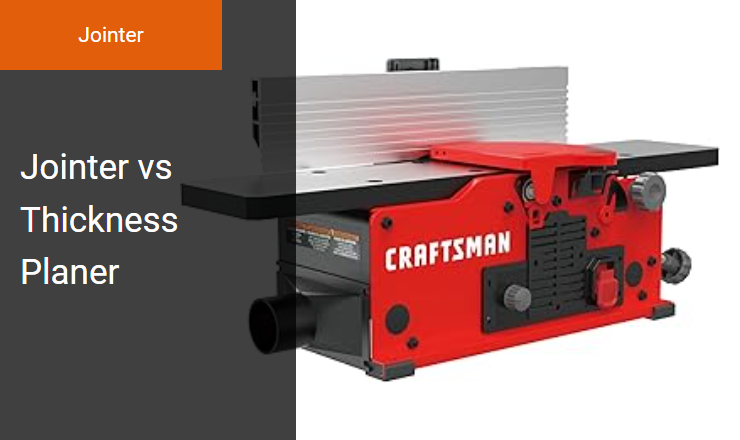
Woodworkers often struggle with the frustrating reality of warped, cupped, or twisted rough lumber that compromises joinery alignment and project precision. While many makers initially rely on standard shop workarounds-such as table saw sleds or labor-intensive hand-planing-to prep their stock, these traditional methods often fall short of absolute accuracy. The jointer serves as the ultimate diagnostic remedy, granting craftsmen a guaranteed, dead-flat reference face and a perfectly square adjacent edge in a fraction of the time.
However, an important educational stipulation must be made: while a jointer flattens, it does not create parallel faces. For example, when reclaiming severely twisted 8/4 walnut, the jointer establishes the initial flat plane, but you must still employ a thickness planer to make the opposite face parallel.
Below, we will compare the distinct mechanics of the jointer versus the thickness planer, outline the step-by-step milling sequence, and explain how to leverage both tools to achieve perfectly dimensioned stock.
| Factor | Summary |
|---|---|
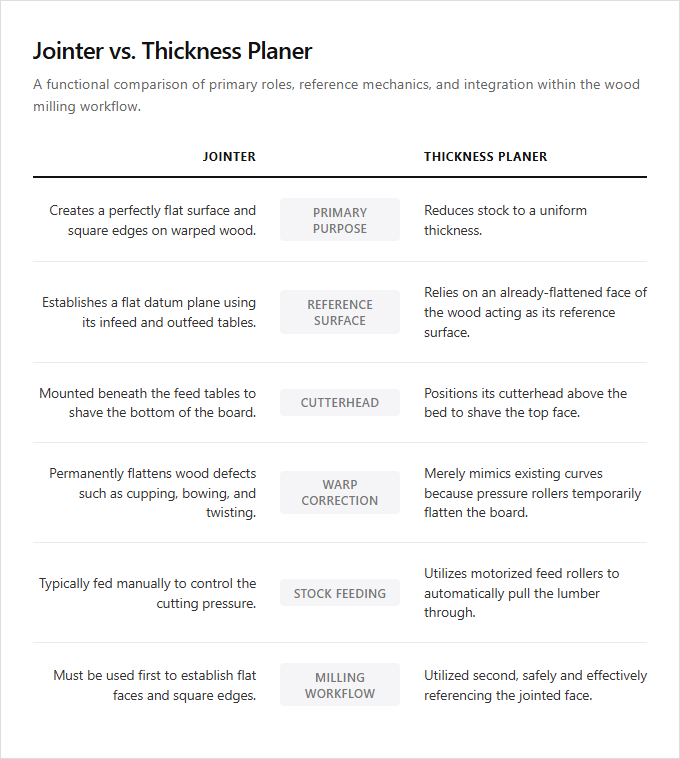
| Primary Purpose | While a jointer is used to create a perfectly flat surface and square edges on warped wood, a thickness planer reduces stock to a uniform thickness. |
| Reference Surface | A jointer establishes a flat datum plane using its infeed and outfeed tables, whereas a thickness planer relies on an already-flattened face of the wood acting as its reference surface. |
| Cutterhead Orientation | The jointer features a cutterhead mounted beneath the feed tables to shave the bottom of the board, while a thickness planer positions its cutterhead above the bed to shave the top face. |
| Warp Correction | A jointer permanently flattens wood defects such as cupping, bowing, and twisting, whereas a thickness planer merely mimics existing curves because its pressure rollers temporarily flatten the board during the cut. |
| Stock Feeding Method | Wood is typically fed manually across a jointer to control the cutting pressure, while a thickness planer utilizes motorized feed rollers to automatically pull the lumber through the machine. |
| Milling Workflow | In the standard milling sequence, the jointer must be used first to establish flat faces and square edges before the thickness planer can be safely and effectively utilized. |
Aligning Jointer Infeed and Outfeed Tables
To achieve perfectly squared lumber, woodworkers must understand the distinct roles of the jointer and the thickness planer. The jointer's primary function is to establish a flat reference face on warped or twisted stock. This process relies on the precise alignment of the infeed and outfeed tables; as wood passes over the cutterhead, these coplanar surfaces guide the board to remove high spots and create an initial, perfectly flat plane.
In contrast, the thickness planer references this newly flattened face to make the opposing side parallel, ensuring uniform thickness across the board. Professional furniture makers requiring absolute precision for rough lumber depend on the jointer-planer combination, while hobbyists working with pre-dimensioned wood often succeed using only a planer.
Squaring Edges with Perpendicular Fence Adjustment
While both jointers and thickness planers process wood, their primary functions are distinct. A jointer excels at creating flat surfaces and squaring rough stock. By adjusting the jointer's rigid fence to a precise 90-degree perpendicular angle, you can hold a pre-flattened face flat against it. Passing the board over the cutterhead in this position machines the adjacent edge perfectly square to the face, a capability unique to the jointer.
A thickness planer cannot square edges or flatten warped wood; it only reduces a board to a uniform thickness parallel to the opposite face. Jointers are essential for furniture makers who mill raw, rough-sawn lumber, while planers are ideal for carpenters and DIYers who need to dimension pre-flattened boards to consistent thicknesses.
Achieving Parallel Thickness with Planer Beds and Rollers
While a jointer is designed to establish a single flat reference face and a perpendicular edge, a thickness planer is engineered to achieve uniform thickness across the entire board. The planer relies on a precision-ground bed and powerful feed rollers to reference the pre-flattened bottom face. As the rollers pull the stock beneath the cutterhead, the bed maintains a constant distance, ensuring the newly machined top face is perfectly parallel to the bottom.
Attempting to reduce thickness on a jointer results in tapered boards because it lacks this parallel referencing system. Woodworkers preparing warped, rough-sawn lumber require a jointer for initial flattening, whereas craftsmen executing precise cabinetry and finish carpentry rely on the thickness planer to dimension their stock to exact tolerances.
Aligning Jointer Tables to Prevent Bowed Stock
While both prepare wood, a jointer flattens a face and squares an edge, whereas a thickness planer creates uniform thickness. For a jointer to perform accurately, the infeed and outfeed tables must remain perfectly coplanar. If these beds fall out of parallel alignment, the machine will introduce bows or tapers into the lumber rather than eliminating them.
Periodic calibration using a high-precision straightedge ensures the tables run parallel to each other and the cutterhead. Maintaining this alignment is essential for producing straight, reference-grade surfaces. Jointers are indispensable for craftsmen prepping raw, warped lumber, whereas planers are ideal for makers who require exact, uniform thickness on pre-flattened stock.
Orienting Wood Grain to Prevent Tearout
When preparing rough lumber, both jointers and thickness planers require careful attention to wood grain orientation to prevent tearout. Because cutterheads rotate against the feed direction, feeding the board so the knives cut down and with the grain, rather than lifting it, ensures a smooth finish. On a jointer, where the cutterhead is positioned below the table, the wood grain on the face being machined should slope down and backward toward the operator.
A thickness planer features an overhead cutterhead, meaning the grain on the top face of the board must slope down and forward, away from the feed direction. Properly reading the edge grain before feeding lumber into either machine is critical for preserving wood fibers. Jointers are ideal for precision craftsmen who need to establish flat reference faces and straight edges, whereas thickness planers are suited for production-minded woodworkers who must quickly dimension multiple boards to a uniform thickness.
Controlling board feed rate and downforce to eliminate end-of-board snipe
Achieving a perfectly flat board requires precise control over feed rate and downforce to eliminate end-of-board snipe. On a jointer, operators prevent snipe by transferring downward pressure entirely to the outfeed table as soon as the leading edge clears the cutterhead, maintaining a constant feed pace. A thickness planer relies on internal rollers, meaning operators must actively support the overhanging ends of long boards to prevent the wood from tipping into the cutterhead as it enters or exits the machine.
Mastering these physical techniques ensures flawless, snipe-free surfaces on both machines. A jointer is ideal for custom furniture makers needing to flatten warped faces and square crooked edges, while a thickness planer is best suited for production-oriented woodworkers requiring uniform thickness across pre-flattened stock.
Correcting Wood Defects During Initial Face Jointing
Woodworking preparation begins with establishing a perfectly flat reference surface. A jointer is engineered to eliminate inherent structural defects such as cupping, bowing, and twisting during the initial face jointing stage. By passing a warped board over the jointer's cutterhead and coplanar tables, the machine removes high spots until a true, flat face is established.
A thickness planer cannot correct these foundational warps, as its feed rollers temporarily press the board flat against the bed, causing the warp to spring back after the cut. The planer relies on the flat reference face already created by the jointer to safely mill the opposite side of the lumber to a uniform, parallel thickness.
Jointers are essential for craftsmen who regularly mill rough-sawn lumber from scratch, while thickness planers are suited for DIYers and builders working with pre-flattened stock who need consistent, precise board dimensions.
Leave a comment