
Woodworkers and shop managers constantly battle fine airborne dust that bypasses standard collection systems, settling on surfaces and compromising respiratory health. Maintaining consistent static pressure while managing these microscopic particles is a persistent challenge in high-production environments.
Traditionally, facility operators rely on standard OEM cloth bags or basic external venting to manage this debris-default setups that prioritize initial budget constraints over long-term particulate capture. However, investing in engineered filtration upgrades grants facilities a dramatic increase in usable surface area, capturing the dangerous PM2.5 particles that standard bag setups recirculate. This efficiency upgrade operates under the strict stipulation that the collector's CFM capacity must be precisely matched to the filter media's resistance to prevent system bottlenecking.
For example, upgrading from a standard 30-micron polyester bag to a pleated 1-micron canister filter has consistently proven to stabilize airflow across high-volume sanding and CNC routing stations. In this article, we will analyze the technical differences between canister and bag filters, evaluate their respective particulate filtration efficiencies, and provide a framework for optimizing your dust collection performance.
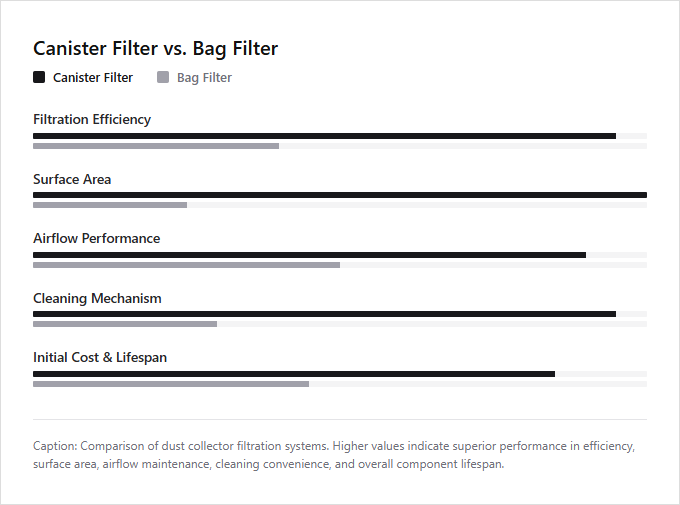
| Factor | Summary |
|---|---|
| Filtration Efficiency | Canister filters provide superior fine-particle capture down to 1 micron, whereas standard bag filters typically allow smaller particulate matter to bypass back into the workshop. |
| Surface Area | The pleated design of a canister filter vastly increases the total surface area compared to the limited envelope area of a fabric bag filter. |
| Airflow Performance | Canister filters maintain a higher Cubic Feet per Minute (CFM) rate over time, while bag filters suffer from rapid static pressure loss as dust cakes the fabric. |
| Cleaning Mechanism | Many canisters feature internal agitator flappers to easily knock dust into the collection bin, whereas bag filters require manual shaking which releases dust back into the air. |
| Initial Cost and Lifespan | Canister filters require a higher initial capital expenditure but offer a longer operational lifespan compared to less expensive, wear-prone fabric bag filters. |
Air-to-cloth ratio and filtration surface area optimization
When selecting a dust collector, the choice between canister and bag filters hinges on optimizing the air-to-cloth ratio. Canister filters utilize a pleated design that vastly increases the filtration surface area within a compact footprint. This high surface area lowers the air-to-cloth ratio, allowing air to pass through the media at a lower velocity, which enhances fine particle separation and maintains optimal CFM performance.
Conversely, traditional bag filters offer less surface area, resulting in a higher air-to-cloth ratio that requires higher velocity airflow and more frequent maintenance. Standard bag systems are suited for hobbyists on a budget who primarily generate coarse wood chips, while canister filters are ideal for professional craftsmen requiring maximum containment of hazardous fine dust.
Minimum Efficiency Reporting Value rating and sub-micron particulate capture
When selecting a dust collection system, the choice between canister and bag filters hinges on filtration efficiency. Canister filters utilize pleated spun-bond media to provide a massive surface area, achieving high Minimum Efficiency Reporting Value (MERV) ratings of 15 to 16. This design excels at capturing hazardous sub-micron particulates down to 0.3 microns. Standard cloth bag filters typically offer lower MERV ratings around 11, allowing fine, respirable dust to bypass the fabric and recirculate into the workspace.
While bag filters sustain higher airflow and cost less upfront, canister filters deliver superior air purification. Fabric bag filters are best suited for casual hobbyists managing coarse debris in well-ventilated shops, whereas canister systems are vital for professional woodworkers and CNC operators requiring rigorous containment of toxic, fine-particle dust.
Differential pressure drop and fan static energy consumption
In dust collection, the choice between canister and bag filters directly impacts pneumatic efficiency. Canister filters utilize a pleated design that vastly increases surface area compared to traditional cloth bags. This expanded area results in a significantly lower differential pressure drop across the media, allowing air to pass through with minimal resistance.
Lower resistance directly reduces fan static energy consumption. Because the fan overcomes less static pressure, the motor requires less electrical power to maintain optimal airflow. Standard bag filters create higher static resistance, forcing the fan to consume more energy to achieve the same performance. Canister filters are ideal for precision woodworkers prioritizing fine-dust capture and low energy costs, whereas bag filters suit high-volume, budget-conscious operators handling coarser debris.
Reverse pulse-jet cleaning cycle efficiency and dust release
Canister filters feature pleated media that offers a large surface area, capturing fine particles down to one micron. When integrated with a reverse pulse-jet system, the shockwave of compressed air efficiently dislodges caked dust from the tight pleats. This design minimizes dust release during cleaning cycles because the debris drops directly into the collection drum within a sealed environment.
Standard bag filters rely on woven fabric, which typically yields lower filtration efficiency and allows more fine dust release during pulse cleaning as the fabric flexes. While pulse-jet cycles on bags are effective for larger debris, the porous material permits micro-dust bypass. Woodworkers requiring pristine air quality for fine sanding benefit most from canister systems, while high-volume shops processing coarse wood chips find bag filters more practical.
Nanofiber surface-loading versus needle-punched felt depth-loading media
Canister filters utilize advanced nanofiber media to capture fine dust directly on the filter's surface. This surface-loading technology prevents micro-particles from embedding deeply within the substrate, allowing for efficient cleaning via internal paddles and maintaining consistent, high-volume airflow during operation.
Standard bag filters employ thick, needle-punched felt that relies on depth-loading. Dust particles penetrate the fabric pores to build a cake layer, which improves filtration efficiency over time but gradually restricts airflow and requires manual shaking to clear the embedded debris.
Canister filters suit detail-oriented woodworkers and professionals who require superior fine-dust capture to protect respiratory health, while bag filters are best for budget-conscious hobbyists or high-volume shops managing coarse, abrasive materials.
Canister pleat bridging and interstitial velocity limits
Canister filters offer superior filtration surface area due to tightly folded pleats, capturing fine dust down to one micron. However, they are highly susceptible to pleat bridging, a condition where heavy or fibrous debris becomes permanently trapped within the tight folds, restricting airflow. This configuration requires careful management of interstitial velocity-the speed of air passing between the pleats-to prevent premature clogging and static pressure loss.
In contrast, bag filters tolerate higher interstitial velocity limits due to their open, vertical design, which facilitates natural dust cake release and reduces clogging from larger chips. While less effective at trapping ultra-fine particles, the simplified airflow path maintains consistent CFM under heavy loads. Canister filters are ideal for precision woodworkers prioritizing clean air and fine dust capture, whereas bag filters suit high-production workshops handling large volumes of coarse waste.
Gas stream operating temperature and hygroscopic dust compatibility
When selecting dust collector filtration, gas stream operating temperature and dust characteristics are critical decision factors. Standard canister filters, utilizing pleated paper or synthetic media, generally operate within lower temperature limits and are highly prone to clogging when handling hygroscopic dust, as moisture causes particles to cake within the tight pleats. Bag filters utilize durable felted or woven fabrics that withstand elevated operating temperatures and release sticky, moisture-absorbent dust more efficiently during cleaning cycles.
Industrial facility managers dealing with high-heat emissions and moisture-laden chemical processing require robust bag filter systems, whereas woodworking hobbyists and dry-debris operators benefit most from the superior fine-particle capture of canister filters.
Leave a comment