
Many workshop operators face the frustrating reality of a high-powered dust collector that delivers lackluster suction at the machine port. While standard funding sources-such as capital allocations for upgrading to larger 3-HP or 5-HP collector units-are the typical go-to solutions, optimizing your existing ductwork infrastructure often yields a far better return on investment.
Correctly configuring your ducting layout grants your shop maximum static pressure recovery, reclaiming lost CFM without the cost of a new motor. However, this efficiency boost is contingent on a critical stipulation: the duct network must be engineered to match the specific airflow requirements of your machinery, from high-waste cabinet saws to CNC routers.
Below, we evaluate the performance trade-offs of flexible hoses versus rigid piping. We will detail how interior wall friction impacts static pressure and outline how to design an optimal, high-velocity extraction system for your workshop.
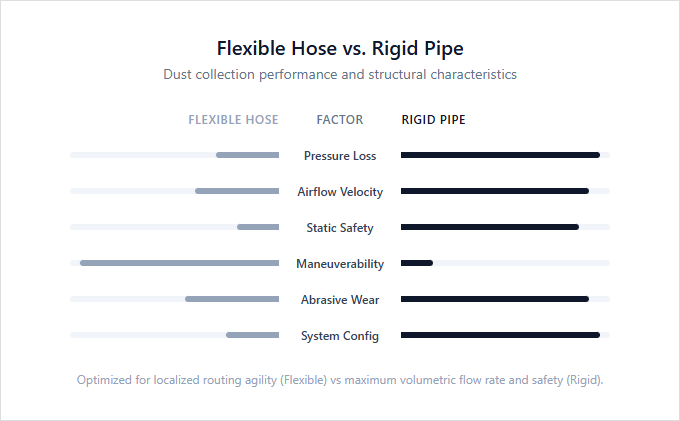
| Factor | Summary |
|---|---|
| Static Pressure Loss | Rigid pipes minimize static pressure loss due to their smooth interior surfaces, whereas the corrugated interior of flexible hoses creates high boundary layer friction that restricts airflow. |
| Airflow Velocity | Rigid pipes maintain optimal CFM and velocity by promoting laminar flow, while the internal ridges of flexible hoses introduce turbulence that decreases dust collection efficiency. |
| Electrostatic Discharge | Flexible hoses are highly prone to triboelectric charging and require copper grounding wire to mitigate spark hazards, whereas metal rigid pipes easily dissipate static electricity when properly bonded. |
| Maneuverability | Flexible hoses provide excellent bend radius and versatility for direct connections to moving power tools, whereas rigid pipes require dedicated elbow fittings to navigate workshop layouts. |
| Abrasive Wear | Rigid pipes, particularly those constructed from metal or schedule 40 PVC, offer superior resistance to particulate abrasion compared to thin-walled polyurethane flexible hoses. |
| System Configuration | A permanent rigid pipe network utilizes strategically placed blast gates to optimize localized volumetric flow rates, which is difficult to replicate with temporary flexible hose setups. |
Smooth Pipe Walls Prevent Pressure Loss
When designing an efficient workshop dust collection system, the choice between rigid pipe and flexible hose significantly impacts overall system performance. Rigid piping, typically constructed from PVC or metal, provides superior airflow efficiency. The smooth interior walls of rigid pipe minimize the coefficient of friction to prevent static pressure loss, ensuring that suction remains strong throughout the entire ductwork run.
Flexible hose introduces internal ridges that create turbulence and restrict air velocity, making it less suitable for main lines. However, its pliability is indispensable for making tight bends and connecting directly to moving machine ports. Rigid pipe layouts are best suited for professionals establishing permanent, high-capacity workshops, while flexible hoses are ideal for hobbyists with limited space who require highly adaptable, mobile tool setups.
Airflow Turbulence Loss in Corrugated Hoses
When designing a dust collection system, the choice between flexible hose and rigid pipe directly impacts static pressure and airflow efficiency. Flexible hoses feature corrugated inner walls that severely disrupt the airflow boundary layer. This continuous surface roughness generates high turbulence loss and friction, significantly reducing the dust collector's suction capacity over extended distances. Smooth-walled rigid piping maintains stable, laminar airflow, preserving static pressure and ensuring optimal debris transport throughout the main ducting runs.
Minimizing flexible runs to the absolute minimum is standard engineering practice for high-performance extraction. Rigid pipes suit stationary operators requiring maximum suction across a permanent workshop, while flexible hoses are ideal for craftsmen managing mobile machinery in adaptable workspaces.
Rigid Pipes Maintain Velocity Better Than Flexible Ducting
In workshop dust collection systems, the choice between rigid pipe and flexible hose directly impacts static pressure and airflow efficiency. Rigid pipes feature smooth interior walls that minimize friction, allowing the system to maintain the necessary minimum transport velocity required to keep heavy sawdust suspended in the airstream. This streamlined design prevents debris accumulation and ensures consistent suction performance throughout the main duct run.
Conversely, flexible ducting introduces significant static resistance due to its ribbed interior and frequent bends, which rapidly degrades air velocity. Rigid piping is ideal for dedicated professionals seeking a permanent, high-performance workshop layout, while flexible hose is best suited for hobbyists requiring a highly adaptable, mobile setup for limited spaces.
Sharp Bends Increase Flexible Duct Equivalent Length
When designing a workshop dust collection system, the choice between flexible hose and rigid pipe directly impacts static pressure and airflow efficiency. Flexible hoses offer convenience but introduce substantial airflow resistance. Sharp bends in flexible hoses are particularly detrimental, as they significantly increase the equivalent duct length of the run, restricting airflow and reducing the dust collector's overall effectiveness. Conversely, rigid pipes feature smooth interior walls and gradual bends that maintain optimal air velocity.
To maximize system performance, rigid ductwork should form the main trunk line, while short runs of flexible hose connect individual machinery. Rigid pipe is ideal for professional woodworkers with permanent, high-volume shops requiring maximum suction, whereas flexible hose is best suited for hobbyists or small-scale craftsmen who operate mobile machinery in tight spaces.
Optimizing Static Pressure in Rigid Fan Systems
Designing an efficient dust collection system requires a strategic choice between flexible hoses and rigid pipes. Rigid ducting offers smooth interior walls that minimize frictional resistance. This optimization of static pressure is crucial for maintaining the dust collector's designated operating point on its fan performance curve, ensuring consistent volumetric airflow and preventing debris settlement within the lines.
Flexible hoses, conversely, introduce turbulence and friction due to their corrugated construction and frequent bends, which can significantly degrade fan performance. Rigid piping networks are best suited for professional woodworkers with permanent, high-production stationary machinery, whereas flexible hoses cater to hobbyists and small-scale operators requiring adaptable, temporary connections for mobile tools.
Flexible Hose Vulnerability to Vacuum Collapse
When designing an effective workshop dust collection system, the choice between flexible hose and rigid pipe significantly impacts performance. Rigid pipes, typically constructed from PVC or metal, offer superior structural integrity, maintaining their shape under high static pressure. Flexible hoses exhibit much lower structural resistance to negative static pressure, making them susceptible to collapse when subjected to high-vacuum conditions.
This physical limitation of flexible hoses restricts air velocity and increases friction loss over long runs, whereas smooth-walled rigid pipes optimize airflow efficiency. Rigid systems are ideal for professional woodworkers with permanent, multi-station workshops, while flexible hoses are best suited for hobbyists or mobile craftsmen who require versatile, temporary connections for individual portable power tools.
Grounding Flexible Hoses to Prevent Static Discharge
When designing a workshop dust collection system, the choice between flexible hose and rigid pipe significantly impacts both safety and airflow efficiency. Flexible hoses offer excellent maneuverability but present a distinct safety hazard due to electrostatic buildup. As dry particulates frictionally charge the non-conductive plastic walls, the risk of electrostatic discharge increases. To mitigate this potential ignition hazard, flexible hoses require specialized grounding, typically achieved by wrapping or running a bare copper wire along the hose to safely dissipate the static charge.
In contrast, rigid pipes, particularly metal ducts, inherently reduce static buildup and provide superior airflow with minimal friction loss. While rigid systems require more upfront planning and permanent installation, they offer a highly efficient, low-maintenance solution for centralized setups. Flexible hoses are ideal for hobbyists requiring adaptable connections for mobile machinery, whereas rigid piping suits professional woodworkers establishing a permanent, high-capacity workshop layout.
Leave a comment