
Maintaining optimal airflow in a busy workshop is a constant struggle, especially when fine dust and heavy chips quickly choke system performance. Traditionally, operators turn to standard equipment capital or basic upgrades-such as purchasing larger motor units or redesigning duct runs-to restore lost suction.
However, focusing on the core fan assembly grants operators a dramatic increase in CFM and static pressure without the cost of a full system replacement. Naturally, this efficiency gain carries the stipulation that your primary filter media must be rated to handle the increased airflow velocity.
In high-volume applications like CNC routing or continuous thickness planing, the ultimate bottleneck often comes down to a single component: the impeller. Below, we examine the structural and aerodynamic trade-offs between metal and plastic impellers, providing a clear roadmap to optimize your dust collector's performance and long-term reliability.
| Factor | Summary |
|---|---|
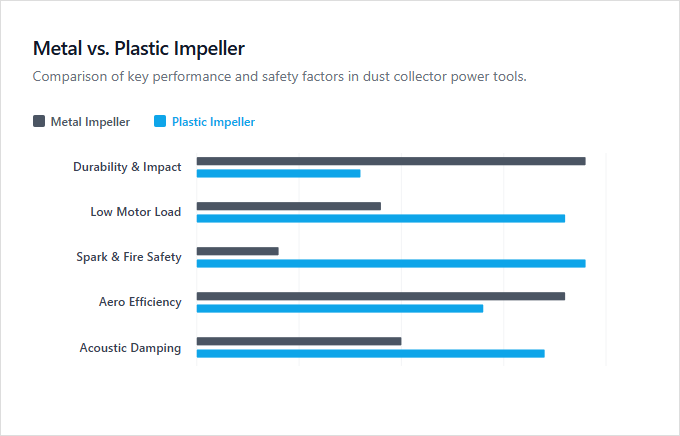
| Durability and Impact Resistance | Metal impellers offer superior tensile strength and impact resistance against large debris like wood knots or stray screws, preventing the catastrophic structural failure common in plastic alternatives. |
| Rotational Inertia and Motor Load | Plastic impellers feature significantly lower rotational inertia, which reduces the required startup torque and minimizes long-term wear on the induction motor. |
| Spark and Fire Safety | Plastic impellers eliminate the hazard of frictional sparking when striking metal objects, reducing the risk of combustible dust ignition within the collector. |
| Aerodynamic Efficiency | Metal impellers can be engineered with thinner, more rigid profiles that do not flex under high static pressure, resulting in more consistent volumetric airflow. |
| Acoustic Output and Vibration | Plastic impellers exhibit superior material vibration damping, which dampens acoustic resonance and lowers the overall decibel output of the dust collector. |
Metal Rigidity Prevents Blade Deflection Under High Pressure
When evaluating dust collection systems, the choice between a metal and a plastic impeller directly impacts long-term performance. Metal impellers excel in demanding environments due to their superior material strength. The structural rigidity of metal prevents blade deflection under high static pressure, maintaining optimal aerodynamic geometry for consistent, maximum airflow. This resistance to deformation ensures the system operates at peak efficiency even during heavy-duty collection tasks.
Plastic impellers offer a lightweight, cost-effective alternative that reduces motor startup strain, though they are susceptible to flexing and damage from larger debris. Industrial professionals and heavy-use woodworkers require the durability of metal impellers to handle abrasive waste, whereas hobbyists and weekend DIYers are well-suited to the economical and quiet operation of plastic impellers for light-duty filtration.
Low-Inertia Plastic Impellers Reach Peak CFM Faster
When selecting a dust collector, the choice between a metal and a plastic impeller significantly impacts system startup and operational efficiency. Plastic impellers possess a lower moment of inertia compared to their heavier metal counterparts. This reduced mass minimizes the motor startup torque required, allowing the dust collection system to accelerate quickly to its peak cubic feet per minute (CFM) rating. This rapid acceleration reduces electrical strain and minimizes wear on the motor during frequent on-off cycles.
Metal impellers offer superior durability against large, abrasive debris but require more energy and time to reach full operating speed. High-volume commercial woodworkers who process heavy debris benefit from the ruggedness of metal impellers, while hobbyists and small-shop operators prioritizing energy efficiency and frequent stop-start cycles are better suited for the responsive performance of plastic impellers.
Molded Plastic Airfoils Maximize Static Pressure Efficiency
In dust collection systems, the choice between metal and plastic impellers significantly impacts overall performance. While metal impellers offer durability against large debris impact, modern plastic impellers leverage advanced manufacturing techniques. Complex injection-molded plastic allows for intricate, backward-curved airfoil designs that maximize static pressure efficiency, delivering superior airflow with lower energy consumption.
These aerodynamic plastic designs also reduce noise levels and startup strain on the motor. In contrast, heavy-gauge metal impellers excel in demanding environments where abrasive materials or large wood chips are constantly processed. Heavy-duty industrial operators requiring maximum impact resistance should choose metal impellers, while hobbyists and precision woodworkers seeking high CFM efficiency and quieter operation are better suited for plastic impellers.
Metal Impellers Resist High-Speed Centrifugal Stress
When selecting a dust collector, the choice between a metal and a plastic impeller significantly impacts long-term performance and operational safety. Metal impellers, typically constructed from heavy-gauge steel or aluminum, offer superior durability under demanding conditions. The high tensile strength of metal impellers resists centrifugal stress at elevated tip speeds, preventing blade deformation and ensuring structural integrity when handling high-velocity airflow and abrasive debris.
Plastic impellers provide a lightweight, corrosion-resistant, and spark-free alternative, though they remain more vulnerable to impact damage from large wood knots or stray fasteners. Metal units are best suited for industrial operators and professional woodworkers requiring continuous, high-volume material extraction, whereas plastic alternatives are ideal for hobbyists and small workshops seeking cost-effective, light-duty filtration systems.
Non-Sparking Thermoplastic Prevents Static Ignition
When selecting a dust collection system, the choice of impeller material directly impacts both operational safety and durability. Metal impellers offer robust resistance against larger debris, yet they present a distinct hazard of generating sparks if metallic foreign objects enter the airstream. In contrast, modern plastic impellers utilize non-sparking thermoplastic construction. This engineering choice effectively eliminates static electricity hazards and minimizes ignition risks during high-speed particulate impingement.
While metal options withstand heavy physical impacts, thermoplastic alternatives provide a safer, corrosion-resistant solution for managing fine, highly combustible dust. Heavy-duty metal impellers are best suited for industrial operators processing large, abrasive wood waste, whereas safety-conscious woodworkers and professionals handling fine particulate matter are better served by spark-resistant thermoplastic impellers.
Wear-Resistant Steel Impellers Preserve Dynamic Balance
When selecting a dust collector, the choice between a metal and a plastic impeller significantly impacts long-term performance. Steel impellers offer high resistance to abrasive wear, which prevents erosion caused by high-velocity wood chips and debris. This structural integrity ensures the impeller preserves its dynamic balance over extended operation, minimizing motor strain and system vibration.
In contrast, plastic impellers are lightweight and cost-effective, but they are more susceptible to damage from large knots or accidental impact from stray workshop hardware. Heavy-duty commercial woodworkers requiring continuous, high-volume extraction benefit most from durable metal impellers, while casual hobbyists and light-duty DIYers find plastic impellers highly suitable for occasional, smaller-scale projects.
Low Thermal Expansion Maintains Precise Impeller Clearance
When selecting a dust collector, the choice between a metal and a plastic impeller significantly impacts long-term operational efficiency. Metal impellers offer a distinct advantage due to their low coefficient of thermal expansion. Under continuous operation, the heat generated within the system can cause plastic components to distort. Metal resists this thermal deformation, maintaining the precise clearances between the impeller and the housing necessary to prevent housing strikes and sustain optimal airflow.
Plastic impellers provide a lightweight and cost-effective alternative, though they are more prone to warping under thermal stress and debris impact. High-volume industrial workshops requiring continuous, heavy-duty extraction are best served by rugged metal impellers, whereas weekend hobbyists and small-scale creators will find the affordability of plastic impellers adequate for intermittent use.
Leave a comment