
Woodworkers frequently struggle with warped, cupped, or twisted rough lumber that ruins joinery and compromises final project alignment. While relying on expensive pre-milled S4S lumber or commercial milling services are the standard sourcing routes to bypass this headache, bringing a thickness planer into your workshop grants you absolute control over your stock dimensions and unlocks massive long-term material savings.
However, an important educational stipulation must be noted: a thickness planer alone cannot flatten a bowed board because its feed rollers temporarily compress the wood, meaning it simply mirrors existing curves unless you establish a flat reference face first. High-performance setups, such as using a DeWalt DW735 planer with a rigid, shop-made melamine sled, prove that you can achieve perfectly flat faces without needing a dedicated jointer.
In this guide, we will compare the jointer versus the thickness planer, clarify the distinct processes of flattening and dimensioning, and outline how to master both to produce perfectly square lumber for your next build.
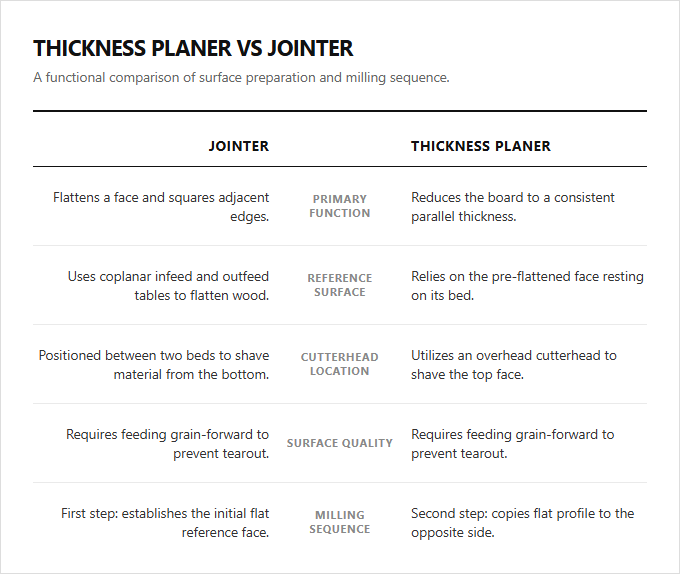
| Factor | Summary |
|---|---|
| Primary Function | A jointer flattens a face and squares adjacent edges, whereas a thickness planer reduces the board to a consistent parallel thickness. |
| Reference Surface | The jointer uses its coplanar infeed and outfeed tables as a reference plane to flatten wood, while the planer relies on the pre-flattened face resting on its bed. |
| Cutterhead Location | Jointers feature a cutterhead positioned between two beds to shave material from the bottom of the stock, whereas planers utilize an overhead cutterhead to shave the top face of the board. |
| Surface Quality | Proper operation of both tools requires feeding wood in the direction of the grain to prevent tearout and ensure a smooth surface finish. |
| Milling Sequence | In the standard milling workflow, wood must first pass over the jointer to establish a flat reference face before the thickness planer can be used to copy that flat profile onto the opposite side. |
Creating Flat Reference Faces Using Coplanar Jointer Tables
A jointer and a thickness planer serve distinct yet complementary roles in milling lumber. A jointer utilizes coplanar infeed and outfeed tables to establish a perfectly flat reference face on bowed, cupped, or twisted boards. This machine also squares the adjacent edge of the wood, ensuring a precise ninety-degree angle relative to the flat face.
Once a flat reference surface is established, a thickness planer mills the opposite face parallel to ensure uniform thickness across the entire board. These tools work in tandem to transform rough-sawn lumber into dimensioned stock. Custom furniture makers require a jointer for processing raw, distorted lumber, while DIY hobbyists utilizing pre-dimensioned wood find a thickness planer more suitable.
How Thickness Planers Establish Parallelism
In professional woodworking, preparing flat, square lumber requires a precise sequence using both the jointer and the thickness planer. The jointer is designed to establish a single flat reference face and a perpendicular edge on warped stock, though it cannot ensure that the opposite side of the board is parallel.
To achieve parallel faces, a thickness planer references the pre-flattened face against its bed to establish parallelism on the opposing face. As the stock feeds through, the cutterhead removes material from the top surface to mirror the flat bottom profile. Jointers are indispensable for custom artisans who regularly mill raw, warped timber from scratch, while thickness planers are best suited for production woodworkers who require precise, uniform thickness across pre-surfaced boards.
Why Planers Require Sleds to Flatten Warped Wood
A jointer and a thickness planer serve distinct roles in preparing lumber. While a jointer creates a flat reference face on warped boards, a thickness planer is designed to make the opposite face parallel. Crucially, a thickness planer alone cannot flatten a cupped or bowed board because its powerful feed rollers temporarily compress the warp flat against the bed during the cut. Once the board exits the machine, it springs back into its distorted shape.
To successfully flatten unjointed stock on a thickness planer, woodworkers must use a planer sled with shims to support the wood and prevent this compression. Jointers are ideal for production-heavy shops requiring rapid face-flattening, while thickness planers with sleds suit hobbyists with limited space who need multi-functional capabilities.
Wrong Board Orientation Causes Severe Grain Tear-Out
Woodworking precision relies on understanding the distinct functions of the thickness planer and the jointer. While a jointer flattens a board's face or squares its edge, a thickness planer reduces the stock to a uniform thickness. For both machines, proper stock feed direction is critical. Feeding wood against the grain direction relative to the cutterhead's rotation lifts the wood fibers, resulting in severe grain tear-out and a ruined workpiece.
To achieve a pristine finish, operators must read the grain direction along the edge of the board, ensuring the cutterhead knives cut "downhill" with the grain. This principle applies equally to both tools, as incorrect orientation compromises both surface quality and workshop safety. Jointers are essential for custom furniture makers who must establish perfectly flat reference faces, while thickness planers are indispensable for production shops requiring consistent, parallel board dimensions.
Upgrade to Helical Cutterheads for Smoother Finishes
While both the jointer and the thickness planer are essential for preparing flat, square lumber, their cutting performance relies heavily on cutterhead design. Upgrading either machine from standard straight knives to a helical cutterhead significantly improves workpiece quality. Helical heads utilize small, angled carbide inserts that shear the wood fibers progressively rather than chopping them. This shearing action drastically reduces scallop marks and tear-out, resulting in a superior, glass-like surface finish even on highly figured hardwoods.
The two machines serve distinct roles in the workshop, as a jointer flattens one face and squares an adjacent edge, whereas a thickness planer reduces a board to a uniform thickness. Jointers are indispensable for furniture makers who need to prepare raw, warped lumber, while thickness planers are ideal for production woodworkers and DIYers who require precise, consistent board dimensions for assembly.
How Pressure Loss Causes Lumber Snipe
In wood milling, both the thickness planer and the jointer serve essential but distinct roles. A primary challenge when using a thickness planer is snipe, which is an undesired, deeper gouge at the leading and trailing ends of the board. This issue occurs due to a temporary loss of downward pressure from the machine's internal pressure bars as the lumber enters and exits the cutterhead. In contrast, jointers flatten faces and square edges without this specific mechanism, relying instead on manual feed pressure over coplanar tables.
Managing snipe in a planer involves supporting the overhanging lumber or adjusting the extension tables to maintain upward tension. Fine furniture makers seeking perfectly flat, straight reference edges rely heavily on the precision of a jointer, whereas production shops and DIYers prioritizing uniform thickness across multiple boards are best suited for a thickness planer.
S4S Milling Sequence for Accurate, Square Lumber
Achieving perfectly dimensioned lumber requires understanding the distinct roles of the jointer and the thickness planer. Following the standard S4S (Surfaced 4 Sides) milling sequence is essential, as it ensures absolute dimensional accuracy and squareness across all four faces of the wood. The process begins on the jointer, which flattens one face and squares an adjacent edge to establish a reliable reference point.
Once these flat reference surfaces are established, the thickness planer is used to mill the opposing face perfectly parallel, reducing the board to its final, uniform thickness. Attempting to run a warped board through a planer without first jointing a flat face will only replicate the existing twist. Woodworkers preparing raw, rough-sawn lumber require a jointer to correct warping, while DIYers and furniture makers working with pre-milled stock find a thickness planer sufficient for resizing boards to custom project specifications.
Leave a comment