
Many fabricators and automotive restorers routinely struggle with abrasive blasters that sputter, clog, and lose pressure, turning what should be a swift surface-prep job into a frustrating, stop-and-start ordeal. To resolve this, operators frequently rely on standard factory compressor ratings-treating generic, high-pressure retail specs as their primary resource for performance troubleshooting.
However, prioritizing the correct airflow metrics grants operators a level of continuous stripping speed and media consistency that high pressure alone cannot achieve. As a critical stipulation, one must recognize that while PSI provides the impact force, CFM delivers the volume; high pressure is functionally useless if the volumetric flow cannot sustain the nozzle's exit velocity.
For example, projects like stripping rust from a classic car chassis or prepping heavy structural steel require sustained, high-volume air to prevent equipment stalling. Below, we analyze the crucial differences between CFM and PSI, outlining how to calculate your nozzle requirements and optimize your compressor setup for maximum efficiency.
| Factor | Summary |
|---|---|
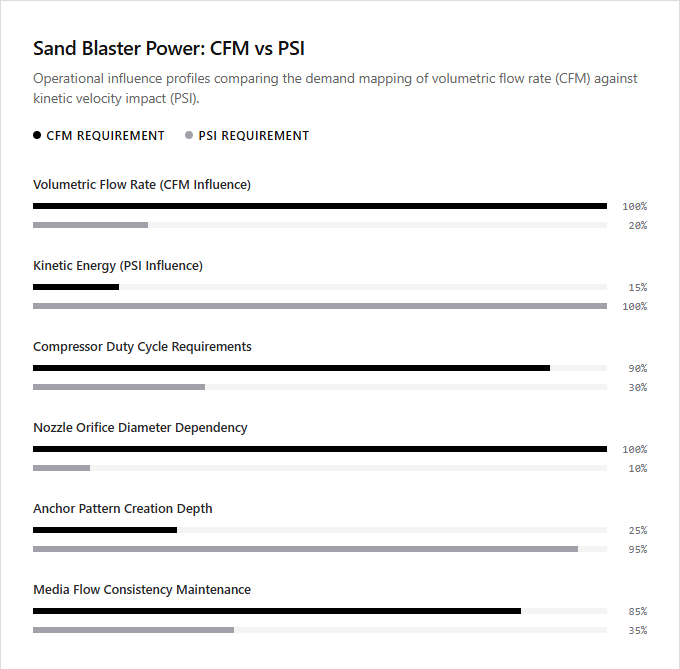
| Volumetric Flow Rate (CFM) | High CFM is crucial for maintaining continuous abrasive media delivery through larger nozzle orifices without experiencing pressure drops. |
| Kinetic Energy (PSI) | High PSI directly increases the velocity of the blasting media, maximizing the impact kinetic energy required to strip stubborn coatings. |
| Compressor Duty Cycle | Adequate CFM prevents the air compressor from overheating by ensuring the system maintains a sustainable duty cycle during continuous blasting operations. |
| Nozzle Orifice Diameter | The size of the nozzle orifice dictates the required CFM, as larger diameters need more volume to maintain the target blasting pressure. |
| Anchor Pattern Creation | Operating at higher PSI allows for deeper substrate penetration, which is essential for creating the precise anchor pattern profile needed for coating adhesion. |
| Media Flow Consistency | Insufficient CFM leads to pressure drop-offs at the nozzle, causing intermittent media flow and inefficient pneumatic transport of the abrasive. |
Sizing Nozzles with CFM to Prevent Pressure Drop
In abrasive blasting, balancing Cubic Feet per Minute (CFM) and Pounds per Square Inch (PSI) is critical for system efficiency. While PSI dictates the velocity and impact force of the media, CFM measures the volume of air flow. Crucially, CFM determines the maximum allowable nozzle orifice diameter. If the nozzle orifice is too large for the compressor's CFM capacity, a severe system pressure drop occurs, which drastically reduces the velocity of the abrasive media.
To maintain consistent blasting pressure, the air compressor must supply enough volume to fill the nozzle opening continuously. High-PSI configurations are suited for DIY enthusiasts performing detailed, localized rust removal, whereas high-CFM setups are essential for industrial operators requiring rapid, continuous coverage on large-scale projects.
How PSI Dictates Target Anchor Profiles
When selecting a sand blaster, understanding the distinction between CFM (cubic feet per minute) and PSI (pounds per square inch) is critical. While CFM determines the volume of media delivered, PSI dictates the kinetic energy and abrasive velocity required to achieve the target anchor profile. High-PSI systems excel at fracturing tough coatings and etching deep profiles into hard substrates, ensuring optimal paint adhesion.
A high CFM rating maintains a continuous flow of media, allowing larger nozzles to cover massive surface areas efficiently without pressure drops. High-PSI setups are ideal for industrial specialists restoring heavily corroded steel structures, while high-CFM systems are best suited for commercial operators requiring rapid, large-scale surface preparation.
Flow Rate Drives Blasting Productivity and Coverage
When selecting a sand blaster, understanding the distinction between Cubic Feet per Minute (CFM) and Pounds per Square Inch (PSI) is critical for operational efficiency. While PSI determines the stripping velocity of the media, CFM measures the volumetric flow rate of air. This volumetric flow rate serves as the primary driver of blasting productivity, directly dictating the volume of media projected and the speed of square-footage coverage. High CFM setups support larger nozzles, which dramatically accelerates surface preparation.
High PSI systems focus energy on fracturing tough surface bonds, making them effective for deeply pitted rust and heavy coatings. High-CFM setups are ideal for industrial contractors requiring rapid, large-scale paint and rust removal, whereas high-PSI systems are best suited for detail-oriented automotive restorers tackling localized, stubborn corrosion.
Low Air Volume Causes Blast Hose Pressure Loss
When selecting a sandblaster, understanding the balance between High CFM and High PSI is critical for operational efficiency. While PSI delivers the initial impact force of the abrasive, CFM represents the sustained volume of air moving through the system. Inadequate air volume causes frictional pressure loss inside the blast hose, which drastically reduces nozzle velocity and slows down the stripping process.
Maintaining high CFM ensures a steady, pressurized flow that prevents performance drops over long distances. High-CFM configurations are ideal for industrial contractors requiring continuous, large-scale surface preparation, whereas high-PSI systems with lower CFM are best suited for DIY hobbyists performing intermittent, detailed restoration work.
100% Compressor Duty Required for Stable Pressure
When selecting a sandblaster, understanding the relationship between Cubic Feet per Minute (CFM) and Pounds per Square Inch (PSI) is critical for operational efficiency. PSI determines the force of the abrasive impact, while CFM dictates the volume of air delivering that media. To prevent pressure drops during extended blasting, a compressor capable of a continuous 100% duty cycle is required. This uninterrupted performance ensures the system maintains stable operating pressure throughout the process.
High-CFM setups excel at rapidly clearing large surface areas, whereas high-PSI systems are engineered to strip stubborn coatings and deeply corroded metal. Industrial refinishers tackling continuous, large-scale surface preparation require high-CFM configurations, whereas automotive restorers targeting localized, deep rust spots benefit most from high-PSI tools.
Venturi Nozzles: Accelerate Media Without Higher PSI
In abrasive blasting, balancing cubic feet per minute (CFM) and pounds per square inch (PSI) determines overall system efficiency. While PSI provides the initial force to push media through the blast hose, CFM dictates the volume of air and media delivered. Venturi nozzles leverage this relationship by utilizing a tapered internal design that constricts and then expands the airflow. This rapid CFM expansion accelerates the abrasive particles to supersonic speeds at the nozzle exit without requiring an increase in input compressor pressure.
Optimizing these parameters depends on the specific project requirements and operator objectives. High-PSI setups are suited for industrial operators tackling heavy corrosion on thick steel, while high-CFM systems paired with Venturi nozzles are ideal for commercial refinishers requiring rapid, wide-area coverage and efficient media consumption.
Balancing Air-to-Abrasive Ratio to Prevent System Clogging
When selecting a sandblaster, understanding the relationship between High CFM (Cubic Feet per Minute) and High PSI (Pounds per Square Inch) is crucial for operational efficiency. High PSI provides the impact velocity needed to strip tough coatings, while high CFM determines the volume of air, which dictates the overall speed and coverage area of the operation. Operating at a high CFM requires precise control over the media feed; the air-to-abrasive ratio must be carefully balanced using a metering valve to prevent system clogging and inconsistent flow.
Proper calibration of this valve ensures a smooth, continuous mixture through the nozzle, maximizing productivity without overloading the airflow. Industrial operators requiring rapid, large-scale surface preparation benefit most from high-CFM systems, whereas DIY enthusiasts and detail-oriented restorers tackling precise, heavy-rust removal are better suited for high-PSI setups.
Leave a comment