
For professional contractors and workshop managers, few setbacks are as frustrating-or costly-as material damage and safety incidents caused by an improperly configured pneumatic stapler. When evaluating workshop capital or securing tool procurement funding, decision-makers often overlook the critical nuances of tool firing mechanisms, focusing instead purely on brand reputation or PSI output.
Yet, mastering trigger selection grants operators an immediate advantage in both workflow speed and workplace safety. To manage expectations, it is crucial to establish the stipulation that no single actuation mode is universally superior; the ideal choice depends entirely on the operator's experience and the task at hand.
For instance, high-volume pallet manufacturing relies on rapid contact firing, whereas precise cabinetry installation requires the strict control of sequential triggers. This article provides a comprehensive comparison of Contact Actuation versus Sequential Triggers, helping you determine the best mode to optimize your team's speed and precision.
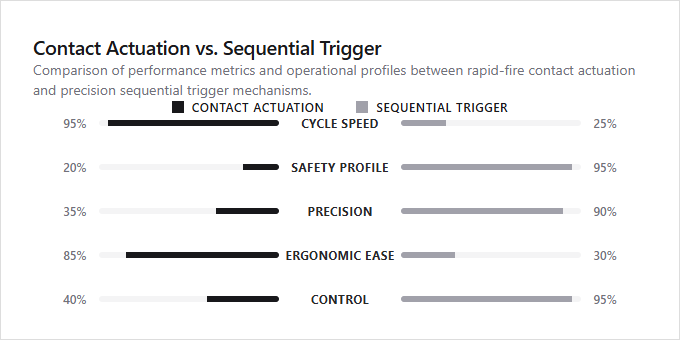
| Factor | Summary |
|---|---|
| Actuation Sequence | Contact actuation allows firing by holding the trigger and depressing the safety contact element, whereas sequential triggers require releasing and pulling the trigger for each individual cycle. |
| Cycle Speed | Contact actuation enables rapid-fire "bump firing" for high-volume production, while sequential mode limits output to single-shot operations. |
| Accidental Discharge Risk | Sequential triggers significantly reduce the risk of unintentional actuation by requiring a strict order of operations, whereas contact actuation has a higher risk of accidental firing upon rebound. |
| Fastener Precision | Sequential actuation provides superior control for exact fastener placement in delicate carpentry, whereas contact actuation is prone to accuracy degradation due to recoil-induced double-firing. |
| Ergonomic Demand | Contact actuation reduces user fatigue during prolonged tasks through continuous-motion firing, while sequential triggers increase hand strain due to repetitive finger trigger cycles. |
Contact actuation utilizes a bump firing technique for rapid fastening
In industrial fastening, selecting the correct trigger mechanism is vital for balancing productivity and safety. Contact actuation, often referred to as bump firing, operates by keeping the trigger depressed and tapping the safety nose against the work surface to instantly discharge a staple. This method allows for rapid, continuous fastening across large surface areas, making it highly efficient for high-volume production environments.
Single-sequential triggers, by comparison, require the safety contact to be fully depressed before the trigger is pulled, ensuring precise placement and preventing accidental firing. High-volume roofers and pallet builders benefit greatly from the rapid speed of contact actuation, while precision cabinet makers and safety-conscious novice users are better suited for the controlled operation of sequential triggers.
Sequential triggers require work contact element depression prior to activation
In professional fastening, understanding the mechanical distinction between contact actuation and sequential trigger staplers is essential for both safety and efficiency. Contact actuation models allow for rapid-fire stapling by keeping the trigger depressed and bouncing the nose of the tool against the work surface. In contrast, sequential trigger staplers utilize a strict operating sequence designed to prevent accidental firing. With a sequential mechanism, the operator must fully depress the work contact element against the material before pulling the trigger to discharge each staple.
This design variation directly influences the tool's suitability for different work environments. Sequential trigger staplers are ideal for safety-conscious carpenters and detailed finish woodworkers prioritizing precision, while contact actuation models are best suited for high-volume production operators requiring maximum speed.
Bump fire modes increase the risk of recoil double-firing
Contact actuation and sequential trigger systems represent the two primary firing mechanisms in power staplers. While contact actuation, or bump firing, offers rapid operation by discharging a staple whenever the safety nose is depressed against a workpiece, this high-speed function introduces a significant safety risk. The rapid physical recoil of the stapler can cause the tool to bounce and unintentionally strike the work surface a second time, resulting in a dangerous double-fire.
Sequential trigger systems require the operator to depress the safety contact before pulling the trigger for each individual staple, which eliminates recoil-induced double-firing. High-volume production workers requiring maximum speed benefit most from contact actuation, whereas precision woodworkers and safety-conscious operators are best suited for sequential trigger models.
Full sequential actuation maximizes safety by preventing unintentional discharge
Selecting the correct trigger mechanism for power staplers is essential for balancing operational speed and workplace safety. Contact actuation allows rapid staple placement by holding the trigger and bumping the safety nose against the workpiece. Full sequential actuation requires the safety nose to be depressed before pulling the trigger for each cycle, which maximizes safety by preventing accidental discharges and double-fires during recoil.
Contact actuation models are best suited for high-volume production workers and roofers who prioritize speed, while sequential trigger staplers are ideal for trim carpenters, cabinet makers, and less experienced operators who require precise placement and enhanced safety control.
Sequential mode delivers superior fastener placement accuracy
When selecting a power stapler, understanding the distinction between contact actuation and sequential trigger mechanisms is essential for project success. Sequential trigger staplers require the safety contact pin to be depressed before the trigger is pulled for each individual fastener. This deliberate, two-step process delivers superior fastener placement accuracy, preventing accidental firing and allowing the operator to align the tool precisely before driving the staple.
Conversely, contact actuation drives a staple whenever the safety nose taps the work surface while the trigger remains depressed, sacrificing precision for rapid output. Contact actuation models are highly suited for high-speed production workers such as roofers and pallet builders, whereas sequential trigger staplers are ideal for finish carpenters and cabinetmakers who require absolute precision and enhanced safety.
Contact trip mode reduces cycle time in high-production environments
In industrial fastening, choosing between contact actuation and sequential trigger staplers depends largely on production demands. Contact actuation, often called bump firing, significantly reduces cycle times by allowing the tool to discharge a staple each time the safety contact nose is depressed against the work surface while the trigger is held. This rapid-fire capability maximizes output in high-volume manufacturing environments where speed is the primary objective.
Sequential trigger staplers require the safety contact to be depressed before the trigger is pulled for each individual staple, prioritizing precise placement and operator safety over speed. Contact actuation staplers are ideal for high-speed assembly line workers and roofers who require rapid, repetitive fastening, while sequential models are best suited for precision woodworkers and novice operators who prioritize exact placement and safety.
Full Stroke Reset Between Sequential Drives
In industrial fastening, choosing between contact actuation and sequential trigger staplers depends heavily on the safety mechanism and operational control. Sequential triggers require a strict operating sequence: the safety nose must contact the work surface before pulling the trigger. To drive a subsequent staple, the actuation stroke must be fully reset by lifting the tool completely off the work surface and releasing the trigger before repeating the cycle, which prevents accidental double-fires and ensures precise placement.
In contrast, contact actuation allows rapid-fire stapling by keeping the trigger depressed and bouncing the safety nose against the material. While contact actuation maximizes production speed, sequential firing prioritizes precision and operator safety. Contact actuation is ideal for high-volume production workers like roofers and crate builders, whereas sequential trigger staplers are best suited for detail-oriented carpenters, furniture makers, and operators prioritizing strict workshop safety protocols.
Leave a comment