
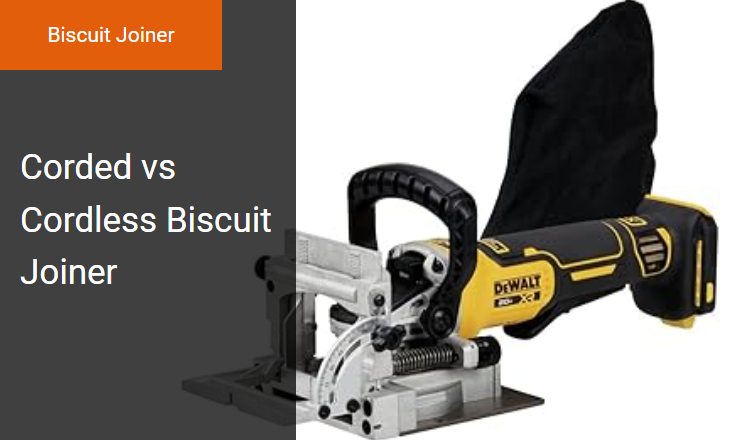
Achieving perfectly flush, rock-solid wood joints is a persistent challenge for woodworkers, often resulting in frustrating misalignment and wasted material during critical glue-ups. While traditional fastening methods like pocket screws or dowels offer basic structural support, they frequently fall short in lateral precision and require tedious, time-consuming setup.
The biscuit joiner (or plate joiner) bridges this gap by granting craftsmen a unique combination of rapid, seamless alignment and invisible, high-tensile joint strength. However, successfully integrating this tool into demanding applications-such as edge-to-edge tabletop glue-ups or heavy-duty cabinet face frames-stipulates a clear understanding of how power delivery and runtime limitations affect cut accuracy.
To help you select the ideal tool for your workshop, this guide provides a comprehensive comparison of corded versus cordless biscuit joiners, evaluating the key differences in mobility, torque, and long-term reliability.
| Factor | Summary |
|---|---|
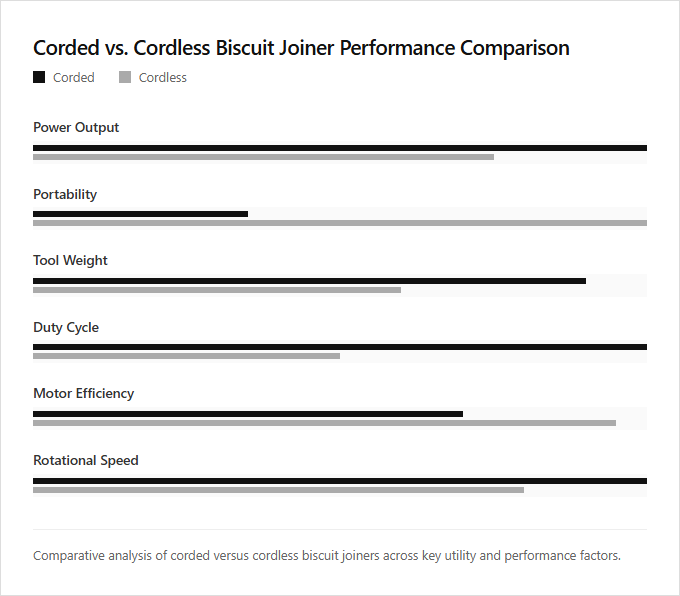
| Power Output | Corded biscuit joiners deliver consistent electrical current to maintain high torque, whereas cordless units depend on the voltage stability of a lithium-ion battery. |
| Portability | Cordless models provide unmatched jobsite portability, freeing the user from cord management and AC outlet dependency. |
| Tool Weight | Corded tools feature a lighter chassis and superior ergonomics because they lack the heavy footprint of an onboard battery pack. |
| Duty Cycle | For high-volume cabinetry fabrication, corded joiners offer an indefinite continuous duty cycle without the interruption of battery swap-outs. |
| Motor Efficiency | Modern cordless joiners frequently implement brushless motor technology to optimize electronic speed control and extend runtime. |
| Rotational Speed | Corded models consistently sustain their rated maximum RPM during deep plunge cuts, preventing the blade binding that can occur with a depleting battery. |
Consistent Power and Sustained RPM in Corded Models
When selecting a biscuit joiner, the choice between corded and cordless models significantly impacts workshop efficiency. Corded biscuit joiners excel in demanding environments due to their uninterrupted power supply, which translates to superior power output consistency. Under continuous load, these machines maintain a sustained RPM, preventing the motor from bogging down during deep cuts in dense hardwoods. This reliable performance ensures clean, precise slots without the risk of battery degradation or thermal throttling.
Cordless alternatives offer unmatched portability and convenience for quick adjustments on-site, though they may experience a drop in RPM as the battery charge depletes. Dedicated workshop woodworkers and high-volume cabinet makers are best suited for the continuous, relentless power of a corded model, while mobile contractors and installers will benefit most from the cordless alternative's maneuverability.
How Battery Capacity Determines Cordless Runtime
When selecting a biscuit joiner, the decision between corded and cordless models hinges primarily on power delivery and mobility. Cordless units offer unparalleled portability for on-the-go tasks, though their operational duration depends heavily on battery capacity, measured in Ampere-hours (Ah). A higher Ah rating directly translates to extended runtimes, enabling woodworkers to complete numerous consecutive slot cuts without interruption.
In comparison, corded biscuit joiners provide consistent, unlimited power, eliminating concerns over battery depletion. Stationary workshop professionals requiring continuous operation for high-volume production typically choose corded models, while on-site contractors and installers prioritize cordless versatility for quick, remote joinery applications.
Brushless motor efficiency and torque delivery in modern cordless platforms
While traditional corded biscuit joiners offer relentless, uninterrupted power directly from the mains, modern cordless alternatives have closed the performance gap through advanced engineering. The integration of brushless motors in cordless platforms has revolutionized tool efficiency. By eliminating physical brushes, these motors minimize friction and heat, translating battery power directly into high-torque delivery that prevents stalling during deep plunge cuts in dense hardwoods.
These electronic control systems dynamically adjust energy output to maintain consistent blade speed under load, rivaling the steady performance of corded counterparts. Station-based woodworkers engaged in high-volume shop production benefit most from the endless runtime of corded joiners, whereas finish carpenters and mobile installers requiring maximum agility on-site are ideal candidates for high-efficiency brushless cordless models.
How Lithium Batteries Impact Tool Weight and Balance
Corded biscuit joiners offer a lightweight, streamlined design with a consistent center of gravity aligned directly along the tool's barrel. This balanced distribution allows for effortless, flat alignment on wood surfaces. In contrast, cordless models incorporate a heavy lithium-ion battery pack, typically positioned at the rear of the handle. This battery shifts the center of gravity backward, creating a slight pivoting effect that requires more conscious wrist control to keep the fence perfectly flush during plunge cuts.
While cordless joiners provide unmatched portability, the added battery weight can increase hand fatigue during prolonged workshop sessions. Corded units remain lighter and stably balanced, ensuring high precision for repetitive slotting tasks. A corded joiner is ideal for stationary cabinetmakers requiring maximum precision and endurance, while a cordless model best serves mobile installers needing quick, tether-free adjustments on-site.
Dust Extraction CFM & Velocity: Shop vs. Jobsite
Effective dust extraction in biscuit joining depends heavily on matching port velocity with appropriate vacuum CFM. Stationary woodshops utilizing corded biscuit joiners require high-volume dust extractors delivering at least 100 to 120 CFM to maintain the static pressure needed for complete wood chip evacuation. Mobile jobsites employing cordless joiners typically rely on compact, battery-powered extractors operating at 50 to 90 CFM, which manage localized debris through smaller, highly-efficient port designs.
Airflow requirements dictate tool selection based on the working environment and production volume. High-volume furniture makers requiring uninterrupted power and maximum dust containment favor corded models, whereas finish carpenters prioritizing rapid setup and mobility on active jobsites benefit most from cordless versatility.
Micro-adjustment rack-and-pinion fence systems for precise biscuit slot alignment
When comparing corded and cordless biscuit joiners, the inclusion of a micro-adjustment rack-and-pinion fence system is vital for precise slot alignment. This mechanical system guarantees the fence remains perfectly parallel to the blade, allowing for minute height adjustments that prevent misaligned joints. Corded models offer constant, uninterrupted power, ensuring the blade cuts cleanly at a consistent RPM to fully leverage the accuracy of the rack-and-pinion tracking.
Cordless alternatives provide exceptional portability, allowing woodworkers to align and cut joints anywhere without cord interference. Premium cordless models maintain excellent fence precision, though battery runtime must be managed during heavy production runs. Dedicated workshop furniture makers requiring continuous power typically choose corded models, while finish carpenters and on-site installers favor the agility of cordless tools.
Spring-loaded plunge mechanism resistance and depth stop turret accuracy
Corded biscuit joiners consistently offer a highly responsive spring-loaded plunge mechanism, as the constant power supply allows manufacturers to optimize spring tension without worrying about battery-induced weight imbalances. This stable design ensures the depth stop turret remains perfectly aligned and accurate through repeated heavy-duty adjustments. Cordless models provide unmatched portability, but the added battery weight can alter the tool's center of gravity, occasionally requiring more operator effort to manage plunge resistance smoothly during delicate cuts.
While cordless units feature precision-machined depth stop turrets, slight vibrations from battery-powered motors can demand closer calibration checks. Corded joiners are best suited for high-volume workshop woodworkers who prioritize continuous, highly precise alignment, whereas cordless models are ideal for mobile installers and carpenters requiring quick, on-site joinery.
Leave a comment