
Achieving perfectly flush joints in fine woodworking is a persistent challenge, often resulting in tedious sanding and wasted material. While traditional doweling jigs and pocket screws serve as standard alignment methods, they frequently fall short on expansive glue-ups. This is where the plate joiner steps in. This specialized tool grants woodworkers unmatched lateral flexibility, ensuring seamless alignment across demanding projects like tabletop assemblies and cabinet shelving.
However, realizing these precise results comes with a critical stipulation: the tool's physical ergonomics must align with your specific workflow. Even the most advanced plate joiner fails to perform if control is compromised during the plunge cut.
To help you optimize your workshop setup, this guide analyzes the two primary ergonomic configurations. We will evaluate the precision of the low-profile Barrel Grip against the leverage and comfort of the D-Handle design, helping you select the ideal tool for your biscuit joinery needs.
| Factor | Summary |
|---|---|
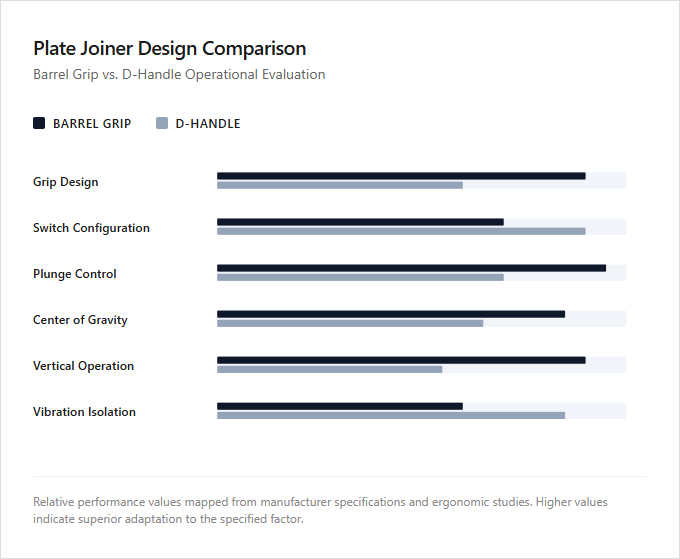
| Grip Design | Barrel grip models allow the hand to be positioned closer to the drive spindle axis for superior control, whereas D-handle models utilize a pistol-style grip that prioritizes comfort during prolonged horizontal operations. |
| Switch Configuration | Barrel grips typically feature a top-mounted slide switch, whereas D-handle designs employ a trigger switch incorporated directly into the handle for immediate motor actuation. |
| Plunge Control | The barrel grip design facilitates direct linear thrust along the tool's centerline, enhancing the precision of the spring-loaded plunge mechanism during slot cutting. |
| Center of Gravity | D-handle plate joiners project the operator's hand weight further back, shifting the center of gravity and altering the leverage applied to the adjustable fence. |
| Vertical Operation | When cutting vertical slots, the slim profile of a barrel grip provides better tactile feedback for keeping the base plate flush against the workpiece surface. |
| Vibration Isolation | D-handle tools often provide space for integrated elastomeric dampening materials within the handle loop to isolate the operator from high-frequency motor vibration. |
Barrel Grip: Enhanced Stability and Plunge Alignment
When selecting a plate joiner, the handle configuration significantly impacts control and precision. The barrel grip design is highly regarded for its ergonomic advantages, as it positions the user's hand closer to the workpiece. This layout offers a lower center of gravity and superior axial alignment during the plunge stroke, minimizing the risk of tool rotation and ensuring highly accurate, stable biscuit slots.
D-handle plate joiners feature a top-mounted loop handle that provides familiar trigger control and leverage. While the D-handle excels in rapid, repetitive workshop tasks, the barrel grip design excels in delicate, precision-focused joinery. Woodworkers prioritizing ultimate control over plunge mechanics typically prefer the barrel grip, whereas high-volume cabinetmakers often opt for the comfortable leverage of the D-handle.
D-Handle Models Prone to Plunge Axis Deflection
When selecting a plate joiner, the choice between a barrel grip and a D-handle configuration significantly impacts tool control and joint accuracy. Barrel grip models allow the operator's hand to align closely with the plunge axis, facilitating a direct, stable forward thrust. In contrast, D-handle models position the hand higher and further back from the working surface. This offset leverage makes D-handle units more susceptible to tool deflection along the plunge mechanism axis during operation, which can compromise slot alignment.
Each design serves distinct operational preferences and workshop environments. Barrel grip joiners are ideal for precision-focused furniture makers requiring maximum stability, while D-handle models suit high-volume carpenters who prioritize comfortable trigger operation and rapid, repetitive routing.
D-Handle vs. Barrel Grip: Joiner Switch Comparison
When selecting a plate joiner, the choice between a barrel grip and a D-handle configuration often comes down to control preference and safety mechanisms. D-handle joiners feature an integrated trigger switch, allowing for rapid safety cutoff simply by releasing the grip. Barrel grip models utilize a locking slide switch, which remains engaged during operation to allow for alternative hand placements and continuous power.
The locking switch on a barrel grip enables operators to hold the tool closer to the workpiece, facilitating precise alignment on vertical joints. The D-handle design provides a familiar, pistol-style grip that excels in repetitive workshop tasks where constant power cycling is required. Barrel grip models are ideal for detail-oriented artisans who prioritize maneuverability, while D-handle units best suit production-oriented woodworkers who value immediate safety controls.
Barrel Grips: Direct Thrust Prevents Misalignment
Choosing between a barrel grip and a D-handle plate joiner depends largely on the operator's requirement for stability and control. Barrel grip models are highly favored for precision work because the slim body allows the operator to apply thrust directly in line with the arbor shaft. This direct alignment prevents the tool from pivoting or misaligning during the plunge cut, ensuring highly accurate biscuit slots.
D-handle plate joiners feature a top-mounted handle that provides a familiar, saw-like grip, which some users find more comfortable for prolonged horizontal operations. This design offers excellent leverage for downward pressure but can introduce a slight pivot risk compared to the inline force of the barrel grip. Woodworkers prioritizing absolute joint precision benefit most from the barrel grip, while production-line carpenters focusing on continuous comfort prefer the D-handle.
D-Handle Grips Boost Vertical Fence Leverage
When choosing a plate joiner, the grip configuration significantly impacts control and ergonomics. The D-handle design excels in vertical applications, as the enclosed loop allows operators to apply direct, forward pressure. This provides superior mechanical leverage when referencing the registration fence against vertical workpieces, ensuring the tool remains stable and square during the plunge.
Barrel grip models offer a slimmer profile, letting users guide the tool with a hand wrapped directly around the motor housing for precise, horizontal bench work. Barrel grips suit detail-oriented woodworkers who prefer agile, close-to-the-workpiece alignment, while D-handle models are best for professional installers frequently joining upright panels that require maximum leverage.
Tactile Barrel Grips for Precise Manual Control
Choosing between a barrel grip and a D-handle plate joiner depends largely on your ergonomic preferences and the nature of your woodworking projects. Barrel grip models feature a slim, cylindrical design where the user grasps the motor housing directly. This close contact offers enhanced tactile feedback, allowing operators to feel the subtle vibrations and alignment of the tool for exceptionally precise manual control during critical cuts.
In contrast, D-handle plate joiners utilize a looping handle with a built-in trigger switch at the rear. This configuration provides familiar ergonomics and excellent leverage, making it easier to apply consistent forward pressure during repetitive joining tasks. Barrel grips are best suited for detail-oriented artisans who require maximum precision and feedback, while D-handles are ideal for production-focused woodworkers prioritizing comfort during extended operations.
D-Handle Offset Force Causes Blade Misalignment
When selecting a plate joiner, the choice between a barrel grip and a D-handle design directly impacts cut accuracy and stability. The primary distinction lies in how force is applied relative to the tool's centerline during the plunging action.
A D-handle configuration positions the operator's hand above and behind the motor axis. This offset force can induce an upward pivot moment that disrupts the parallelism between the blade and the fence, potentially leading to misaligned biscuit slots. The barrel grip design keeps the hand aligned directly with the axis of plunge, maintaining precise blade-to-fence alignment throughout the operation.
Precision-focused cabinetmakers seeking maximum alignment accuracy typically prefer the barrel grip, whereas woodworkers prioritizing ergonomic comfort during repetitive, high-volume jointing tasks often opt for the D-handle.
Leave a comment