
For many professional builders and DIY enthusiasts, achieving a perfectly straight freehand cut is a persistent frustration, often compromised by a blocked line-of-sight that forces operators into awkward, unsafe postures just to see the mark. While standard tool procurement evaluations often focus solely on basic factors like motor amperage or tool budget funding sources, these financial metrics overlook the vital physical relationship between the craftsman and the machine.
Choosing the correct blade orientation grants users an immediate advancement in cutting accuracy and operational safety by placing the cutline directly in view. However, realizing this benefit carries a critical stipulation: the tool's configuration must align precisely with your dominant hand and stance. For example, a right-handed carpenter utilizing a traditional right-blade sidewinder faces a completely different sightline and shoe-support dynamic than one operating a left-blade worm-drive saw.
This article analyzes the crucial differences between left-blade and right-blade circular saws, compares their ergonomics for both left- and right-handed users, and provides a clear framework to help you select the optimal saw for your cutting accuracy.
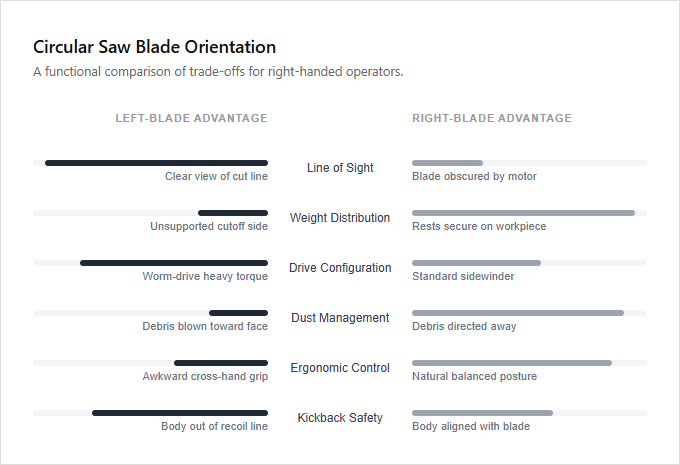
| Factor | Summary |
|---|---|
| Line of Sight | Left-blade saws provide right-handed users with an unobstructed line of sight to the cut line, enhancing cutting precision. |
| Weight Distribution | Right-blade saws allow the heavier motor housing to rest securely on the supported workpiece for right-handed operators, preventing drops at the end of a cut. |
| Drive Configuration | Left-blade designs are historically synonymous with high-torque worm-drive saws, while right-blade designs are the standard layout for direct-drive sidewinder models. |
| Dust Management | Right-blade models typically direct debris away from right-handed users via the dust ejection port, whereas left-blade models can blow sawdust toward the operator's face. |
| Ergonomic Safety | Using a blade orientation that forces cross-handed operation increases user fatigue and reduces overall control of the tool. |
| Kickback Risk | The blade side dictates the operator's body positioning to ensure they remain out of the direct recoil path of a potential rotational kickback. |
Left-Blade Saws Offer Right-Handers Better Cut Visibility
The orientation of the blade on a circular saw significantly impacts visibility and control during operation. For right-handed users, a left-blade layout positions the motor housing to the right of the blade, offering an unobstructed, direct line-of-sight to the cut line. This configuration allows operators to guide the tool accurately without leaning over the saw, enhancing both safety and precision during demanding cutting tasks.
Right-blade circular saws place the motor on the left, keeping the weight of the tool supported on the workpiece for right-handed users, though it obscures direct blade visibility. Left-blade models are ideal for professionals prioritizing precise line-of-sight alignment, while right-blade models best suit users seeking maximum stability on the material.
Blade Position: Sidewinder vs. Worm-Drive Saws
Circular saw design is heavily influenced by the internal motor configuration, which dictates the placement of the blade. Standard sidewinder saws utilize a spur-gear mechanism where the motor sits alongside the blade, typically placing the blade on the right side. This right-blade configuration provides a stable base on the main workpiece for right-handed users making standard cuts.
Worm-drive saws employ a rear-motor layout with specialized gearing that positions the blade on the left side. This left-blade orientation offers right-handed operators a direct line of sight to the cutting line, though it positions the heavy motor over the fall-off piece. Heavy-duty construction professionals who prioritize visibility and high torque favor left-blade worm drives, whereas residential DIYers and carpenters seeking a lighter, easily maneuverable tool for framing typically prefer right-blade sidewinders.
Rest Wide Shoe Plate on Supported Workpiece
When choosing between left-blade and right-blade circular saws, the primary operational consideration is the positioning of the tool's base. To ensure maximum stability and control during a cut, the wider section of the shoe plate must rest securely on the supported portion of the workpiece, rather than the waste piece. This prevents the saw from tilting as the cut finishes, maintaining a straight line and reducing kickback risks.
Blade orientation also dictates visibility and balance based on hand dominance. Right-blade models are typically favored by right-handed professionals who prioritize having the motor weight over the supported wood, while left-blade models are best suited for left-handed users or right-handed operators who require a clear, unobstructed line of sight.
Blade Orientation Dictates Sawdust Direction
When evaluating left-blade versus right-blade circular saws, blade orientation is a primary factor influencing both line-of-sight and safety. For a right-handed operator, a left-blade saw positions the cutting edge on the left side of the motor, offering an unobstructed view of the cut line. This specific blade orientation dictates the trajectory of the dust ejection port, which often expels sawdust directly toward the operator's face and upper body during standard operation.
Right-blade saws position the blade to the right of the motor, directing the dust port and flying debris safely away from a right-handed user's face. Right-handed professionals prioritizing direct line-of-sight cut visibility typically select left-blade saws, while safety-focused operators and left-handed craftspeople generally benefit from the superior debris redirection of right-blade models.
Align Blade with Dominant Eye for Easier Cutting
When selecting a circular saw, the choice between a left-blade and right-blade design significantly impacts line-of-sight and overall cutting accuracy. The primary ergonomic factor is how easily the operator can view the cutting path. Aligning the blade's kerf with the marked cut line is substantially easier when the blade is positioned on the same side as the user's dominant eye, as this direct line of sight eliminates the need to lean over the tool body to monitor the cut.
Beyond visibility, blade orientation affects weight distribution and where the cut-off piece falls. Right-handed craftspeople prioritizing maximum sightline visibility and fast, freehand cuts typically benefit from left-blade models, while those prioritizing stable, two-handed operation with the tool's weight resting securely on the workpiece generally prefer right-blade configurations.
Blade Mounting Affects Bevel Scale Visibility
The choice between left-blade and right-blade circular saws significantly influences the visibility of key tool adjustments. On left-blade saws, the motor sits to the right of the blade, which typically positions the bevel scale on the left. This design allows right-handed operators to read and adjust angles without leaning over the motor housing.
Right-blade saws place the motor on the left, often shifting the bevel scale to the opposite side where it may require tilting the tool to inspect. Left-blade saws are ideal for right-handed carpenters who prioritize a direct line-of-sight to the cut line, while right-blade saws are best suited for left-handed tradespeople or users who prefer traditional sidewinder balance.
How Hand Dominance Affects Blade Guard Control
In circular saws, the placement of the blade on the left or right side of the motor significantly impacts operator safety and line-of-sight. Hand dominance dictates whether the user must lean over the tool to view the cut line. For example, a right-handed user operating a right-blade saw must lean over the body of the tool for a clear view, which inherently alters their body positioning and balance.
This physical positioning directly affects the operator's control over the lower blade guard retraction during specialized cuts. A compromised stance limits the hand's leverage and responsiveness when manually retracting the guard. Right-blade saws are typically preferred by right-handed professionals seeking traditional weight distribution, while left-blade saws are ideal for left-handed tradespeople or right-handed users who prioritize a direct, unobstructed view of the cutting line.
Leave a comment