
Optimizing the Cut: Navigating the Shearing Divide
Metal fabricators frequently struggle with edge deformation, excessive scrap rates, and costly production bottlenecks caused by utilizing mismatched cutting equipment. While relying on standard band saws or general-purpose CNC plasma tables offers a familiar baseline for material preparation, these conventional methods often introduce unnecessary labor costs and slower throughput for straight-line tasks.
Investing in dedicated shearing technology grants operations the power to dramatically reduce cycle times while securing pristine, burr-free edge quality. However, unlocking this efficiency stipulates a rigorous alignment with your specific production variables, particularly material thickness limits and shearing frequency. For example, high-volume HVAC duct fabrication demands a vastly different kinematic approach than heavy structural steel plate processing.
To help you optimize your shop floor, this article analyzes the critical differences between Rotary Shears and Guillotine Shears, comparing their cutting mechanics, material capacities, and long-term operational value.
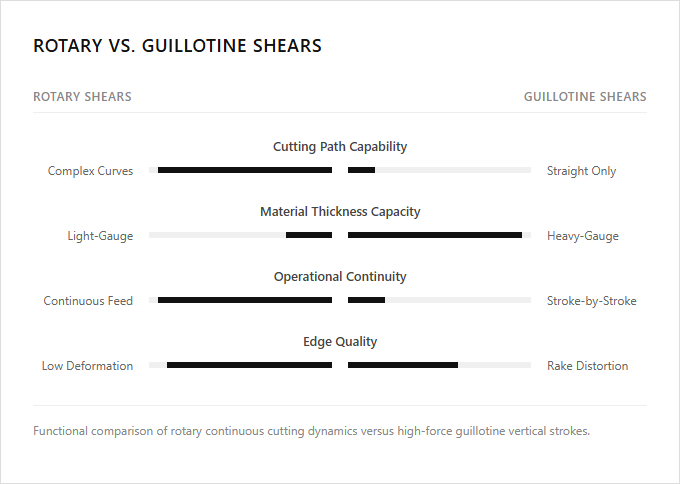
| Factor | Summary |
|---|---|
| Cutting Mechanism | Rotary shears utilize circular, rotating blades to continuously slice material, whereas guillotine shears employ a straight, vertically descending blade to make a single, linear cut. |
| Cutting Path Capability | Rotary shears excel at cutting complex curves and contours due to their maneuverability, while guillotine shears are restricted to straight-line cutting along a fixed axis. |
| Material Thickness Capacity | Guillotine shears exert massive hydraulic force to cut thick, heavy-gauge sheet metal, whereas rotary shears are typically limited to thinner, light-gauge materials. |
| Operational Continuity | Rotary shears offer continuous, high-speed slitting operations for coil feeding, while guillotine shears operate in a discrete, stroke-by-stroke cycle. |
| Edge Quality | Guillotine shears can cause slight blade-rake distortion on the sheared edge, whereas rotary shears distribute force evenly to produce a cleaner, low-deformation cut. |
Rotary vs. Guillotine Shears: Cutting Mechanisms Compared
In industrial metalworking, selecting the appropriate shearing mechanism is essential for optimizing production efficiency. Rotary shears utilize overlapping circular knives for continuous slitting, allowing for high-speed, uninterrupted feeding of sheet metal. This continuous motion is highly effective for processing long master coils and achieving consistent, straight cuts without stopping the material flow.
Guillotine shears employ a reciprocating upper blade that descends vertically against a fixed lower bed to sever the material. This design delivers immense concentrated force, making it the preferred method for cutting thicker, rigid metal plates with precise edge quality. High-volume manufacturing facilities requiring continuous coil processing benefit most from rotary shears, whereas custom fabricators handling varied material thicknesses are better suited to the versatile, high-tonnage capacity of guillotine shears.
Guillotine vs. Rotary Shearing: Rake Angle and Deformation
Guillotine shears operate with a linear cutting action designed for high-precision metal fabrication. A key advantage of these machines is the adjustable rake angle, which allows operators to alter the slope of the upper blade. Optimizing this angle relative to sheet thickness minimizes material deformation, ensuring exceptionally flat and accurate cuts.
Conversely, rotary shears utilize overlapping circular blades that maintain constant-contact with the metal. This continuous shearing method lacks an adjustable rake angle, which can result in slight sheet distortion but enables rapid, uninterrupted cutting. Guillotine shears are best suited for precision fabricators requiring flat, straight edges on varied sheet gauges, while rotary shears are ideal for high-volume manufacturers prioritizing continuous coil processing speed.
Blade Clearance and Calibration in Guillotine and Rotary Shears
In metal fabrication, selecting the appropriate shearing technology depends heavily on the cutting mechanism and specific calibration demands. Guillotine shears utilize a linear cutting action where precise blade clearance adjustment is critical to prevent burr formation and ensure a clean, square edge. Minor deviations in this clearance can lead to material deformation and premature blade wear.
Rotary shears employ circular overlapping blades that require meticulous axial and radial gap calibration. Proper synchronization of these two dimensions ensures continuous, high-speed cutting without material slippage. Guillotine shears suit fabricators focused on precise, straight-line plate cutting, while rotary shears are ideal for high-volume operators requiring continuous coil slitting and complex curved profiles.
Rotary vs. Guillotine Shears: Continuous vs. Discrete
In industrial metal fabrication, selecting the appropriate shearing technology is critical for optimizing production efficiency and material throughput. Rotary shears are engineered to maximize feed rates within continuous coil processing lines. By utilizing synchronized rotating blades, these systems cut moving material seamlessly without interrupting the line flow, making them indispensable for high-speed, high-volume manufacturing operations.
In contrast, guillotine shears operate on discrete cycle times determined strictly by their mechanical stroke speed. These machines employ a powerful vertical cutting action to process individual metal sheets, requiring the workpiece to remain stationary during each cycle. High-volume mill operators requiring non-stop production thrive with rotary shears, whereas precision fabricators and custom job shop technicians benefit most from the versatility and heavy-gauge capacity of guillotine shears.
Rigid Frames Enable Heavy-Duty Guillotine Shearing
When selecting industrial metalworking machinery, the primary choice between rotary and guillotine configurations depends on material thickness and alloy composition. Guillotine shears excel in heavy-duty applications because their rigid, closed-frame designs effectively resist torsional deflection under extreme pressure. This structural integrity allows operators to process high yield strength alloys and thick metal plates with exceptional edge quality and minimal distortion.
Rotary shears utilize synchronized circular cutters to deliver continuous, high-speed slitting, making them ideal for rapid coil processing and thinner gauge materials. High-volume sheet metal manufacturers optimize their workflow with rotary shears, whereas heavy industrial fabricators processing high-strength structural plates rely on the uncompromising power of guillotine systems.
Rotary vs. Guillotine Shears: Contour vs. Straight Cutting
In industrial metalworking, selecting the appropriate shearing technology depends on the required geometry of the cut. Rotary shears utilize rotating circular blades to deliver continuous strip slitting and navigate complex contour paths with high precision. This rolling mechanism allows operators to execute curved profiles and continuous material feeds without interrupting the cutting cycle.
In contrast, guillotine shears employ a straight upper blade that descends vertically, restricting their application to straight-line orthogonal shearing. While this mechanism lacks the maneuverability of rotary systems, it excels in rapid, high-capacity straight cuts. Rotary shears are ideal for specialty fabricators requiring intricate custom profiles, whereas guillotine shears best serve high-volume manufacturers focused on rapid, square-edge sheet prep.
Rotary Shearing Minimizes Kerf Strain Over Guillotine Cutting
In industrial metalworking, the mechanical approach of a cutting tool dictates the finished edge quality. Rotary shears utilize a continuous, progressive shearing action where circular blades rotate against one another. This progressive contact significantly minimizes localized shear strain along the kerf, preserving the material's structural integrity. In contrast, guillotine shears rely on a high-impact, vertical force delivered across the entire cutting line at once, which can induce greater stress and deformation near the cut.
Choosing between these technologies depends on the specific demands of the fabrication workflow. Rotary shears are ideal for precision craftsmen who require intricate, distortion-free curved cuts in thin sheet metals, while guillotine shears are suited for industrial operators processing heavy-gauge plates who prioritize high-speed, straight-line production.
Leave a comment