

Selecting the right router setup often begins with a frustrating realization: unexpected chatter marks or bit slippage have just ruined a precision workpiece. When equipping a workshop, woodworkers typically rely on standard tooling sources and default manufacturer packages to fund their initial routing capabilities. However, optimizing your choice of shank diameter grants you significantly cleaner cuts, minimized vibration, and enhanced operational safety.
To achieve these results, we must proceed under the technical stipulation that router horsepower and spindle speed must strictly align with your shank selection. For example, demanding tasks like routing deep mortises or spinning large raised-panel profile bits require structural rigidity that lighter hardware simply cannot provide.
In the following guide, we will demystify the 1/4-inch versus 1/2-inch collet debate, comparing torque transmission, deflection resistance, and project versatility to help you choose the optimal configuration for your woodworking needs.
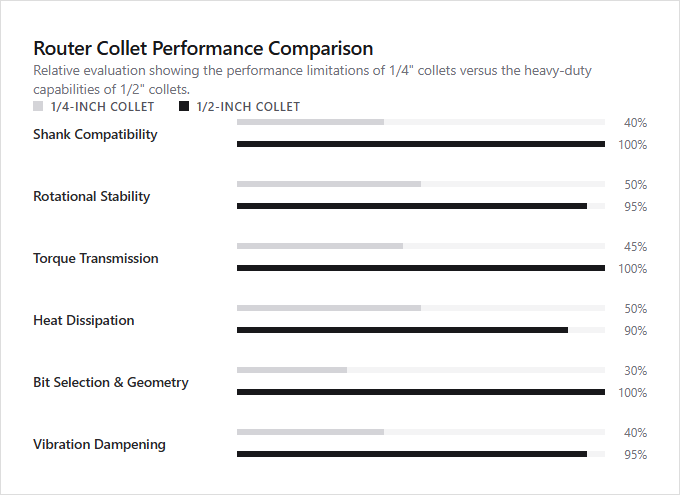
| Factor | Summary |
|---|---|
| Shank Compatibility | While 1/4-inch collets are limited to smaller shank diameters, 1/2-inch collets offer superior versatility by accepting heavy-duty bits directly or smaller bits using collet reducers. |
| Rotational Stability | The larger mass of a 1/2-inch collet significantly reduces runout and rotational deflection, resulting in cleaner cuts than the more flexible 1/4-inch alternative. |
| Torque Transmission | A 1/2-inch collet provides a larger surface contact area to prevent bit slippage and optimize torque transfer during heavy material removal. |
| Heat Dissipation | The increased metal mass of 1/2-inch collets and shanks improves thermal conductivity, reducing friction heat that can cause tool burn and edge dulling. |
| Bit Selection and Geometry | Large-diameter profile cutters, such as raised panel bits, require a 1/2-inch shank to safely withstand high centrifugal forces and lateral stress. |
| Vibration Dampening | Heavy-duty 1/2-inch collets exhibit superior vibration dampening characteristics, which extends the operating lifespan of the router motor bearings. |
1/2-Inch Shanks: Greater Rigidity, Less Deflection
Selecting the appropriate collet size is a critical decision that directly impacts routing precision and safety. The primary advantage of a one-half inch collet lies in the stability of its larger bit shank. These robust shanks provide significantly greater torsional rigidity and reduced deflection under heavy loads, which minimizes vibration and ensures a smoother, more accurate cut.
One-quarter inch collets accommodate smaller bits designed for light-duty tasks, though they are more prone to flexing under stress. Hobbyists performing intricate, detailed engraving benefit most from the lightweight quarter-inch system, while professional woodworkers executing heavy-duty edge profiling and deep material removal require the stability of the half-inch platform.
Why 1/2-Inch Collets Prevent Tool Slippage
When selecting a woodworking router, the choice between a one-quarter inch and a one-half inch collet significantly impacts performance and safety. The primary advantage of the one-half inch option lies in its physical dimensions. The larger surface area of 1/2-inch collets yields superior clamping force to prevent tool slippage under heavy loads, ensuring a stable and precise cut during demanding operations.
While one-quarter inch collets are lighter and highly maneuverable for intricate detail work, they are more prone to deflection under stress. One-half inch collets offer increased stability, reduced vibration, and better heat dissipation for heavy-duty profiling. Light-duty hobbyists focusing on delicate crafting benefit most from the nimble one-quarter inch collet, whereas professional carpenters and tradespeople performing heavy material removal require the robust stability of the one-half inch variety.
How 1/2-Inch Shanks Extend Carbide Tool Life
Selecting the appropriate router collet size is a critical decision that directly influences machining efficiency and tool longevity. The primary advantage of the one-half inch shank over the one-quarter inch alternative lies in its superior thermal mass. During demanding routing operations, this larger volume of steel more effectively absorbs and dissipates the friction-induced heat generated at the cutting edge.
By facilitating rapid heat dissipation, the one-half inch shank significantly reduces thermal stress on the router bit. This thermal management preserves the integrity of the carbide cutters, preventing premature dulling and micro-chipping, which extends overall tool life. Conversely, one-quarter inch shanks possess less mass, making them more susceptible to heat buildup and deflection under heavy loads.
One-quarter inch collets serve DIY hobbyists performing light-duty, intricate detail work, while one-half inch collets are essential for professional woodworkers executing heavy-duty, high-volume production routing.
Why Large Cutters Need 1/2-Inch Shanks
When selecting a woodworking router, the choice between a one-quarter inch and a one-half inch collet directly impacts the tool's capacity and safety. The primary differentiator lies in the shank size of the router bits they accept. Large-diameter cutter geometries, such as panel raisers used in cabinet making, generate significant rotational forces and require one-half inch shanks to handle these extreme radial loads without bending or snapping.
One-half inch collets offer superior stability, reduced vibration, and access to a wider variety of heavy-duty profile cutters. Conversely, one-quarter inch collets are ideal for light-duty edge routing, template work, and tasks requiring compact, highly maneuverable tools. Hobbyists and DIY enthusiasts performing occasional light trim work benefit most from the lighter one-quarter inch models, whereas professional cabinetmakers and heavy-duty woodworkers require the robust capability of one-half inch machines.
1/4-Inch Collets for Light-Duty Trim Routers
Woodworking routers utilize different collet sizes to secure cutting bits, with one-quarter inch and one-half inch configurations serving distinct operational needs. The one-quarter inch collet is optimized for low-horsepower trim routers executing light-duty detailing, laminate trimming, and intricate profile work. This compact setup minimizes tool weight and maximizes control during delicate, freehand operations.
Conversely, one-half inch collets are engineered for high-horsepower plunge or table-mounted routers. The larger surface area of a half-inch shank offers superior grip, reduces spindle deflection, and safely accommodates larger cutter diameters for heavy material removal. Hobbyists and mobile installers prioritizing portability and detail work favor the one-quarter inch system, while production cabinetmakers and heavy-duty furniture builders require the robust stability of the one-half inch platform.
Heavier 1/2-Inch Shanks Dampen Vibration for Cleaner Finishes
When selecting between a one-quarter inch and a one-half inch router collet, shank mass plays a critical role in machining quality. The increased mass of a one-half inch shank significantly dampens harmonic vibrations during operation. This stability minimizes tool deflection and chatter, resulting in a noticeably cleaner, smoother surface finish on the workpiece.
One-quarter inch shanks offer less resistance to deflection under heavy loads, making them more prone to vibration during deep cuts. Smaller shanks are restricted to lighter tasks, whereas half-inch collets accommodate larger, more complex profile bits. Hobbyists focusing on delicate, intricate engraving suit the nimble one-quarter inch size, while professional woodworkers executing heavy-duty edge shaping require the stability of the one-half inch collet.
Safe Spindle Speeds for 1/2-Inch Shank Bits
Woodworking routers typically utilize either a one-quarter inch or a one-half inch collet to secure cutting bits. While one-quarter inch collets are standard in compact trim routers designed for light-duty detailing, one-half inch collets provide the essential stability and reduced vibration required for heavy-duty material removal.
When operating larger one-half inch shank bits, adjustable spindle speed is critical to regulate safe peripheral velocity. Because larger diameter cutters feature much higher outer-edge speeds at standard rotations, reducing the router's RPM prevents dangerous tool deflection, material burning, and hazardous kickback. Proper speed calibration ensures both operational safety and clean, precise cuts.
Light-duty hobbyists and sign-makers benefit most from the maneuverability of one-quarter inch models, while professional cabinetmakers and heavy-duty woodworkers require the power and versatility of one-half inch machines.
Leave a comment