
Achieving a flawless finish on woodworking projects often turns into a frustrating gamble when delicate trim splits or structural joints fail to hold. While standard hand-nailing and basic brad nailers are the traditional defaults for many workshops, they frequently fall short on specialized fastening tasks.
Transitioning to dedicated pneumatic fastening grants you a level of joint integrity and aesthetic precision that general-use tools simply cannot match. However, deploying these tools successfully requires a key stipulation: neither tool is a universal solution, as their utility depends entirely on material density and structural load. For example, while securing thin cabinet backs requires the wide surface holding power of a medium-crown stapler, installing delicate bead molding demands the near-invisible entry of a 23-gauge pin nailer.
This article compares crown staplers and pin nailers directly, detailing their mechanics, structural capacities, and specific applications to help you choose the ideal pneumatic tool for your next build.
| Factor | Summary |
|---|---|
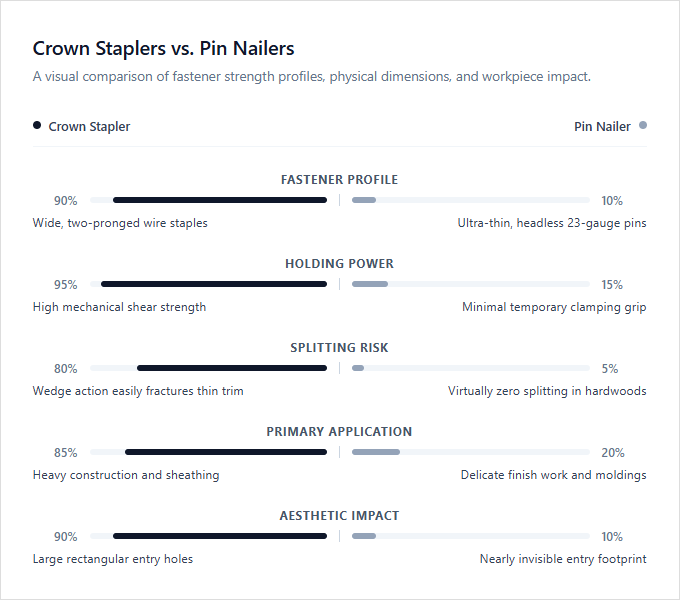
| Fastener Type | Crown staplers utilize wide, two-pronged wire staples, whereas pin nailers drive extremely thin, headless 23-gauge fasteners. |
| Holding Power | Crown staplers offer exceptional mechanical holding power due to their wider surface area, while pin nailers provide minimal shear strength, acting primarily as temporary clamps while wood glue cures. |
| Material Splitting | Pin nailers virtually eliminate workpiece splitting in delicate hardwoods, whereas the larger wedge action of crown staples can easily fracture thin trim. |
| Primary Application | Crown staplers are ideal for heavy-duty construction tasks like securing sheathing, whereas pin nailers excel in intricate finish carpentry and attaching delicate molding. |
| Aesthetic Impact | Pin nailers leave nearly invisible entry holes that bypass the need for wood filler, while crown staplers leave large rectangular entry marks that require extensive surface finishing. |
23-Gauge Headless Pin Nailers: No Wood Filler Needed
Crown staplers and pin nailers serve distinct roles in woodworking and construction. While crown staplers provide exceptional holding power for structural tasks, pin nailers excel in delicate, detail-oriented applications. Specifically, 23-gauge headless pin nailers are highly valued because they leave virtually invisible entry holes. This eliminates the need for wood filler, preserving the natural appearance of the wood and saving significant finishing time on intricate trim pieces.
In contrast, crown staplers utilize wider fasteners that distribute pressure across a larger surface area, making them ideal for securing materials like cabinet backs, soffits, and underlayment. Crown staplers are best suited for contractors undertaking heavy-duty assembly and framing, whereas pin nailers are ideal for finish carpenters and hobbyists executing delicate trim work and detailed craft projects.
Narrow Crown Staplers: Superior Hold for Cabinets
When selecting fastening tools for woodworking and construction, the choice between crown staplers and pin nailers depends on the required holding power. Narrow crown staplers utilize two-pronged fasteners that bridge wood fibers, providing superior holding strength. This structural integrity makes them the preferred choice for securing heavy cabinet backs and outdoor soffits where resistance to pulling forces is critical.
Pin nailers drive thin, headless 23-gauge pins that leave virtually invisible holes, preserving the aesthetics of delicate trim but offering minimal structural hold. Detailed finish carpenters and trim specialists favor pin nailers for intricate molding, while cabinet builders and general contractors rely on crown staplers for heavy-duty assembly tasks.
Pneumatic drive depth adjustment prevents over-penetration of fasteners
In professional woodworking and construction, choosing between a crown stapler and a pin nailer depends on the structural and aesthetic requirements of the project. Both tool categories feature pneumatic drive depth adjustment, a critical mechanism that regulates fastener penetration. By precisely controlling the drive force, this feature prevents the over-penetration of staples or pins, protecting delicate wood fibers from surface damage and ensuring a perfectly flush finish across varying material densities.
While both tools utilize this depth-control technology, their applications differ significantly. Crown staplers are ideal for production builders and cabinet makers requiring high-strength mechanical holding power, whereas pin nailers are best suited for detail-oriented finish carpenters executing delicate trim work where invisible fastening is paramount.
Shear strength differences between single-pin fasteners and double-shank staples
Crown staplers and pin nailers differ fundamentally in structural resistance due to their fastener design. Crown staplers utilize double-shank staples that span across wood fibers, distributing lateral load across two penetration points. This dual-leg configuration provides superior shear strength and prevents material pull-through under stress. Conversely, pin nailers drive a single, ultra-thin, headless wire that offers minimal surface area and very low resistance to shear forces, relying primarily on adhesive backing for permanent hold.
While staples provide the mechanical durability necessary for structural joints, pins are reserved for light-duty, aesthetic applications. Heavy-duty builders and upholstery technicians require the robust holding power of crown staplers, whereas finish carpenters and detailed furniture restorers benefit most from the virtually invisible fastening of pin nailers.
Plywood underlayment installation using 18-gauge pneumatic crown staplers
When preparing subfloors, selecting the correct fastening tool is essential for long-term structural integrity. For plywood underlayment installation, 18-gauge pneumatic narrow crown staplers serve as the industry standard, offering superior holding power compared to pin nailers. The staple's crown bridges the wood fibers, securing the plywood tightly to the subfloor to prevent shifting and future floor squeaks.
While pin nailers utilize ultra-thin, headless fasteners designed for delicate trim work where visibility must be minimized, they lack the shear strength required to anchor underlayment under constant foot traffic. Pneumatic crown staplers are ideal for flooring contractors and installers requiring maximum holding power for structural panels, whereas pin nailers are best suited for finish carpenters and hobbyists executing detailed cabinetry and light trim work.
Operating pressure CFM and PSI requirements for consistent fastener seating
Crown staplers demand robust pneumatic support to achieve consistent fastener seating, typically requiring operating pressures between 70 and 120 PSI along with a moderate airflow of 2 to 4 CFM. This higher volume and pressure ensure the wide crown and dual legs penetrate dense construction materials securely without leaving the fastener proud of the surface.
In contrast, pin nailers operate efficiently on much lower pneumatic volume, often utilizing less than 1 CFM and a pressure range of 60 to 100 PSI. Precision pressure regulation is essential with pin nailers to prevent the ultra-thin, headless 23-gauge pins from bending during insertion or countersinking too deeply into delicate woods.
Heavy-duty crown staplers are ideal for framing contractors and roofers securing subfloors or sheathing, while micro-pin nailers are best suited for detail-oriented finish carpenters and cabinetmakers performing delicate trim work.
Tensile holding power of crown staples compared to headless pins
Crown staplers deliver exceptional tensile holding power due to their wide metal bridge, which straddles and compresses wood fibers. This design distributes mechanical stress across a larger surface area, preventing materials from pulling apart under tension. The dual-pronged penetration creates robust resistance against withdrawal, making crown staples highly effective for structural joints that must withstand shear forces.
In contrast, pin nailers utilize extremely thin, headless pins that offer minimal tensile strength. These fasteners rely entirely on friction along the smooth shaft to hold materials together, making them easily prone to pull-through under pressure. They are designed for invisible alignment rather than load-bearing capability.
Crown staplers are ideal for framing carpenters and cabinet makers requiring heavy-duty mechanical fastening, while pin nailers are best suited for detail-oriented finish carpenters and hobbyists performing delicate trim work.
Leave a comment