
Trade professionals and DIY enthusiasts alike frequently battle the frustration of stripped screw heads, damaged workpieces, and stalled drill motors-costly setbacks typically caused by a mismatched balance of speed and torque.
To address these performance gaps, operators traditionally rely on basic single-speed drills or standard, entry-level power tool configurations. However, understanding gearbox mechanics grants users the distinct advantage of precision control, shifting the focus from brute force to engineered efficiency. Crucially, we must stipulate that higher RPM does not inherently translate to superior performance; rather, success depends on the strategic trade-off between rotational speed and torque.
For example, driving heavy lag screws into structural timber requires low-speed, high-torque settings, while boring clean holes through sheet metal demands high-speed rotation. This article will compare single-speed and two-speed gearboxes, detail their mechanical differences, and provide a definitive guide to selecting the ideal transmission for your workflow.
| Factor | Summary |
|---|---|
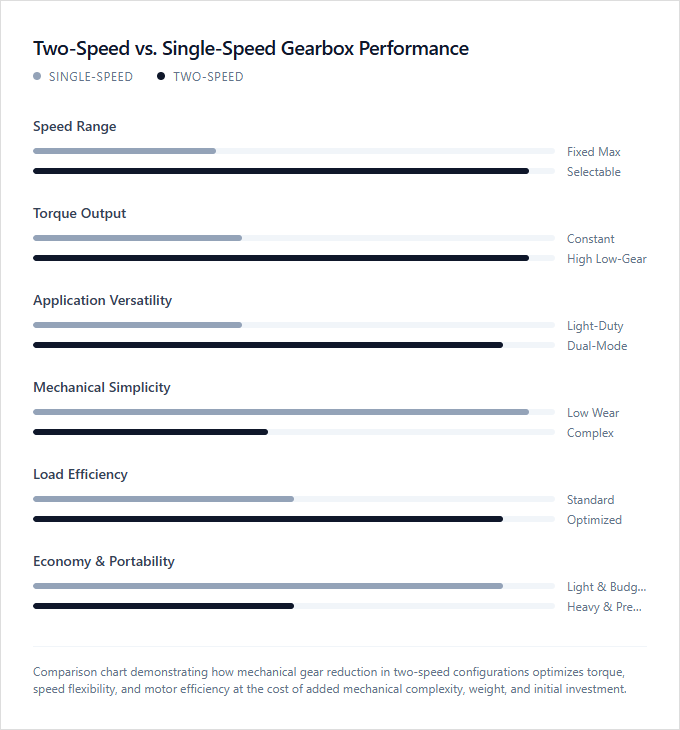
| Speed Range | A two-speed gearbox offers selectable high and low RPM ranges for varied materials, whereas a single-speed gearbox is restricted to a fixed maximum rotation speed. |
| Torque Output | Two-speed gearboxes utilize mechanical gear reduction to deliver significantly higher torque in low gear, while single-speed models maintain a constant torque profile across their operating range. |
| Application Versatility | The dual-gear configuration allows seamless transition between high-torque driving and high-speed drilling, whereas single-speed drills are optimized primarily for light-duty, repetitive tasks. |
| Mechanical Complexity | Two-speed systems incorporate complex planetary gear sets and selector linkages, increasing the potential for mechanical wear compared to the simpler setup of single-speed gearboxes. |
| Efficiency and Power Delivery | A two-speed transmission optimizes motor efficiency by matching the gear ratio to the specific resistance of the workpiece, preventing motor stalling under heavy loads. |
| Cost and Weight | Drills with two-speed gearboxes generally feature heavier housings and higher retail prices due to the additional internal metallic components, whereas single-speed drills offer a lighter and budget-friendly design. |
Mechanical advantage adjustment via planetary gear carrier modification
The distinction between single-speed and two-speed drill gearboxes lies in the mechanical advantage adjustment achieved through planetary gear carrier modification. Single-speed systems employ a fixed planetary gear configuration, delivering a set ratio of torque to speed. Conversely, two-speed gearboxes feature a movable ring gear and modified carrier assembly. Sliding the speed selector locks or releases specific components within the planetary array, altering the gear reduction ratio to shift between high-torque capacity and high-speed operation.
This internal engineering directly influences tool utility on the job. Single-speed models are ideal for casual users performing basic, light-duty household tasks, whereas two-speed gearboxes are best suited for trade professionals and serious hobbyists who require precise control across diverse drilling and driving applications.
Fixed gear ratio limitations on torque multiplier capabilities
A single-speed gearbox operates on a fixed gear ratio, which inherently limits its torque multiplier capabilities. Without the ability to mechanically shift gears, the motor must balance speed and torque across a single compromise range. When tackling high-resistance materials, a single-speed drill cannot leverage a lower gear ratio to multiply motor torque, which often leads to stalling or motor strain under heavy loads.
A two-speed gearbox overcomes this mechanical constraint by offering two distinct gear ratios. The low-speed setting acts as a powerful torque multiplier, reducing rotational speed to maximize driving force for heavy-duty fastening, while the high-speed setting facilitates rapid, light-duty drilling. Single-speed drills are ideal for casual homeowners performing basic maintenance, whereas two-speed models are best suited for tradespeople and serious DIYers requiring adaptability for complex tasks.
Clutch collar calibration for precise slip torque threshold management
In power drills, the integration of the gearbox with the clutch collar determines the precision of torque delivery. A single-speed gearbox operates on a fixed gear ratio, meaning the clutch collar's numerical settings correspond to a single, static range of slip torque thresholds. This configuration provides straightforward calibration but limits the tool's versatility when transitioning between varying material densities.
A two-speed gearbox introduces two distinct mechanical advantages, effectively doubling the utility of the clutch collar. In low-speed, high-torque mode, the slip torque thresholds scale upward, requiring careful calibration to prevent fastener overdrive, while the high-speed mode offers highly sensitive, low-torque thresholds for delicate workpieces.
Single-speed drills are ideal for DIY enthusiasts performing basic, repetitive household tasks, whereas two-speed drills suit professional contractors who require precise, adaptable torque control for diverse fastening and drilling applications.
Brushless DC motor operating efficiency optimization through mechanical advantage
Brushless DC (BLDC) motors achieve peak operating efficiency within specific, high-RPM ranges. A two-speed gearbox leverages mechanical advantage to keep the motor in this optimal zone, shifting gears to trade speed for torque without forcing the motor to draw excessive current at low rotational speeds. A single-speed gearbox relies solely on electronic speed regulation, which often forces the BLDC motor to operate outside its efficiency sweet spot under heavy loads, increasing thermal stress and accelerating battery depletion.
While single-speed designs offer a lighter, more streamlined tool profile, two-speed configurations maximize the mechanical potential of the motor. Single-speed drills are suited for homeowners undertaking light, repetitive assembly tasks, whereas two-speed gearboxes are essential for trade professionals who demand high-torque driving and rapid drilling across varied materials.
High-gear pinion engagement for rapid rotary percussive drilling speeds
In power drills, the mechanical distinction between a two-speed gearbox and a single-speed configuration lies in transmission versatility. A two-speed gearbox utilizes a dual-pinion drive system to shift between high-torque and high-speed ranges. Engaging the high-gear pinion delivers rapid rotational velocity directly to the spindle, which is essential for maximizing the blow frequency required in rapid rotary percussive drilling through masonry and concrete.
Single-speed gearboxes operate on a fixed ratio, offering a reliable but standardized torque output that lacks this specialized mechanical adaptability. While single-speed models are suited for DIY enthusiasts undertaking light, repetitive household assembly tasks, two-speed models are indispensable for trade professionals executing diverse drilling and heavy-duty fastening applications.
Spur Gear Configurations for Maximum Boring Stall Torque
Single-speed gearboxes deliver reliable, fixed-rate performance optimized for standard, light-duty applications. These systems lack the adaptable mechanical advantage required to overcome high-resistance materials without stalling the motor.
Two-speed gearboxes resolve this limitation by utilizing a selectable transmission. The low-gear setting employs heavy-duty spur gear configurations designed with high reduction ratios to maximize stall torque during demanding, large-diameter boring operations in dense timber or structural steel.
Single-speed drills are best suited for DIY enthusiasts and maintenance technicians performing repetitive, light-duty fastening, whereas two-speed drills are essential for professional contractors and fabricators who regularly execute heavy-duty construction and deep-hole drilling.
Frictional Power Loss in Multi-Stage Gear Trains
Single-speed drill gearboxes employ a simplified, direct drive-train layout, minimizing the number of meshing gear teeth and rotating bearings. This streamlined architecture results in minimal mechanical drag and highly efficient power transmission from the motor to the chuck. In contrast, two-speed gearboxes require additional gear stages, selector mechanisms, and support bearings to facilitate ratio changes. The increased component count in these multi-stage gear trains escalates parasitic frictional losses, which slightly reduces the overall energy efficiency of the tool.
Engineers balance these efficiency losses against the necessity for torque versatility. While single-speed units deliver maximum energy transfer efficiency, two-speed configurations offer critical torque multiplication for heavy-duty applications. Single-speed drills are ideal for DIY homeowners performing light, repetitive fastening tasks, whereas two-speed drills suit professional contractors requiring adaptable speed and high torque for demanding masonry and heavy carpentry work.
Leave a comment