
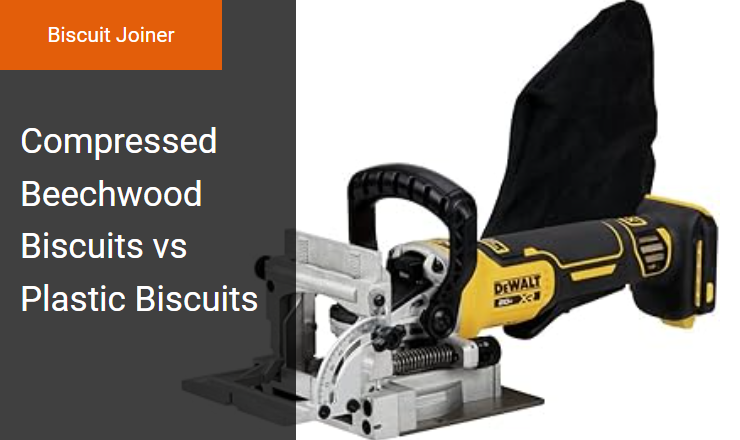
Woodworkers frequently struggle to achieve perfectly flush, durable joints that resist the natural warping of timber over time. While traditional dowels, pocket screws, and mortise-and-tenon joints serve as standard industry solutions, they often demand tedious setups or compromise the wood's aesthetic. Integrating a biscuit joiner grants craftsmen rapid alignment capabilities and forgiving lateral adjustments that traditional methods lack.
However, one must stipulate that biscuits are engineered primarily for alignment and shear strength rather than resisting heavy tensile loads. When utilized correctly in applications like solid oak tabletop glue-ups or plywood cabinet carcases, they provide exceptional stability. To achieve peak structural integrity, the choice of insert material is critical. Below, we examine the mechanical differences between compressed beechwood and plastic biscuits, analyzing how moisture absorption, shear resistance, and material behavior dictate joint longevity.
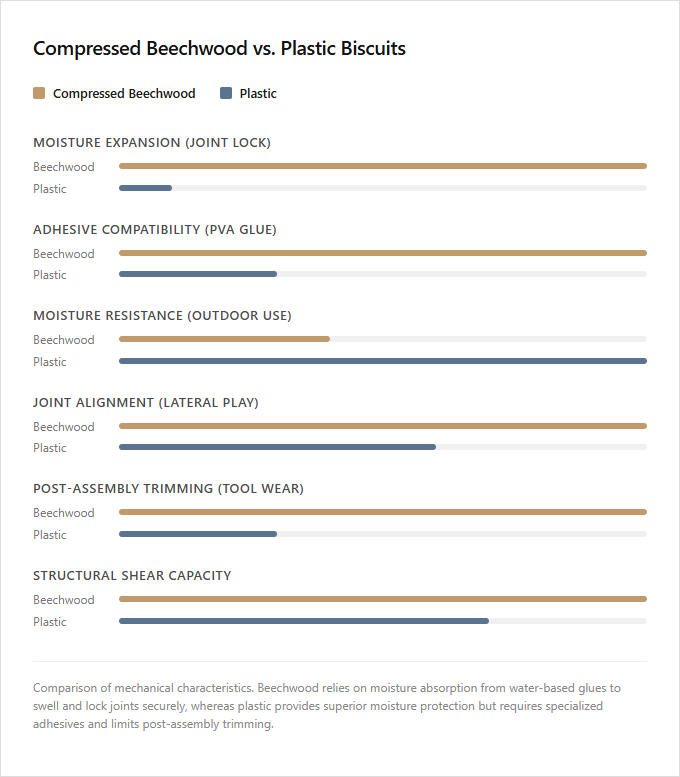
| Factor | Summary |
|---|---|
| Moisture Expansion | Compressed beechwood utilizes hygroscopic expansion to swell and lock tightly into the slot when exposed to water-based glues, unlike inert plastic biscuits. |
| Adhesive Compatibility | Wood biscuits form a strong mechanical bond with standard polyvinyl acetate glue, whereas plastic biscuits require specialized epoxy or polyurethane adhesives due to their low surface energy. |
| Moisture Resistance | Plastic biscuits are immune to biodegradation and rot in outdoor applications, whereas beechwood biscuits can decay when exposed to chronic high humidity. |
| Joint Alignment | Beechwood allows for slight lateral tolerance adjustments during assembly before the fibers swell, while some plastic biscuits feature self-clamping mechanisms that lock instantly. |
| Post-Assembly Trimming | Excess beechwood can be easily trimmed flush using standard hand tools without causing abrasive tool wear, whereas cutting through plastic biscuits can dull woodworking blades. |
| Structural Load Capacity | Plastic biscuits offer superior tensile strength in synthetic materials like solid surface countertops, while beechwood provides optimal shear resistance in natural timber joints. |
Beechwood Biscuits Swell, While Plastic Remains Static
When utilizing a biscuit joiner for woodworking, the choice between compressed beechwood and plastic joinery biscuits significantly impacts the joint's structural integrity. Compressed beechwood biscuits rely on hygroscopic expansion to secure the connection. Upon contact with water-based wood glues, the compressed beechwood absorbs moisture, causing the wood fibers to swell within the routed slot to create a highly secure, tight mechanical lock.
In contrast, plastic biscuits remain dimensionally static, unaffected by moisture or adhesive application. They rely strictly on adhesive adhesion or mechanical friction, offering consistent shape stability but lacking the self-tightening properties of organic wood. Traditional furniture makers seeking permanent, seamless wood-to-wood bonds benefit from beechwood, whereas professionals working with composites, non-porous materials, or high-moisture outdoor fixtures prefer the stable, rot-resistant nature of plastic.
PVA Adhesive Bonds to Wood but Not Plastic
When selecting biscuits for joinery, the material composition dictates the overall strength and longevity of the joint. Compressed beechwood biscuits are engineered to expand upon absorbing water-based polyvinyl acetate (PVA) adhesive. This moisture absorption triggers physical swelling within the slot, while the PVA glue forms a highly resilient chemical bond with the porous wood fibers to create a virtually seamless connection.
In contrast, plastic biscuits feature a completely non-porous surface. Because PVA adhesive fails to adhere to plastic, these joints require alternative bonding agents like polyurethane or epoxy to secure the workpiece. Traditional cabinetmakers seeking maximum structural strength in wood-to-wood joinery rely on beechwood, whereas installers working with composite materials or requiring reusable dry-fits prefer plastic components.
Superior Axial Strength of Compressed Beechwood Joints
In professional woodworking, selecting the correct joining medium is critical for structural integrity. Compressed beechwood biscuits offer a distinct mechanical advantage over plastic alternatives. The compressed beechwood construction provides superior anisotropic tensile strength along the long axis of the joint, aligning the natural wood fibers with the primary stress lines of the workpiece. When exposed to water-based adhesives, these wood inserts expand within the slot to lock the joint securely.
Plastic biscuits do not expand and rely on mechanical friction or specialized adhesives. While they lack the expansion-driven joint reinforcement of natural wood, they provide excellent moisture resistance in wet environments. Traditional cabinetmakers requiring maximum structural load capacity for fine furniture typically choose beechwood, whereas outdoor builders and fabricators working with composite materials benefit more from waterproof plastic inserts.
How Plastic and Beechwood Biscuits Secure Joints
In professional woodworking, the choice of joining media significantly impacts joint integrity. Compressed beechwood biscuits utilize a dynamic conforming process; upon contact with water-based glues, the compressed fibers expand within the routed kerf. This expansion ensures the wood biscuit molds precisely to the slot's internal geometry, creating a permanent, high-strength bond.
In contrast, plastic biscuits do not react to adhesives. They rely entirely on raised surface barbs for a friction-based mechanical interlock within the slot, allowing for immediate handling without waiting for glue to cure. Traditional cabinetmakers requiring maximum joint strength and wood-to-wood integration typically select beechwood, while shopfitters and installers working with solid surfaces or temporary mock-ups benefit most from plastic fasteners.
Beechwood Biscuits Boost Shear Resistance via Grain Integration
When selecting joining splines for biscuit joiner applications, professionals must evaluate the mechanical differences between compressed beechwood and plastic alternatives. Compressed beechwood biscuits provide superior structural integrity, delivering higher ultimate shear load resistance. Upon contact with water-based wood glue, these wood splines expand within the slot, integrating directly with the surrounding wood grain structure to create a strong, permanent bond.
Plastic biscuits do not expand, relying instead on mechanical friction or specialized adhesives. They perform reliably in high-moisture environments or with non-porous composite materials where wood expansion is disadvantageous. Fine furniture makers requiring maximum load-bearing joint strength prefer compressed beechwood, while commercial installers working with solid-surface materials or outdoor cabinetry benefit most from plastic alternatives.
Beechwood Prevents Stress by Matching Substrate Movement
When selecting joinery components for a biscuit joiner, the material composition of the insert significantly impacts joint longevity. Compressed beechwood biscuits offer a distinct engineering advantage by matching the hygroscopic movement of the surrounding wood substrate. As ambient humidity fluctuates, the beechwood expands and contracts at a rate consistent with the workpiece. This natural compatibility prevents localized stress concentrations that can otherwise lead to joint failure or telegraphing through the finish.
In contrast, plastic biscuits remain dimensionally static. While they do not swell upon contact with water-based glues, this lack of movement can introduce shear stress in dynamic wood assemblies under environmental fluctuations. Traditional furniture makers seeking seamless, long-term timber integration prefer beechwood biscuits, whereas commercial fabricators working with non-porous composites or outdoor PVC trim favor plastic alternatives.
Beechwood Biscuits Maintain Joint Tension Better Than Plastic
In professional woodworking, the choice of biscuit joinery material significantly dictates the long-term durability of the assembly. Compressed beechwood biscuits are engineered to absorb water-based adhesives, expanding within the slot to establish a high-friction mechanical lock. This expansion, combined with the natural resilience of beech wood, maintains crucial joint pre-tension that keeps the mating workpieces tightly bound over time.
Conversely, thermoplastic or solid plastic biscuits present structural limitations under continuous stress. Plastic is highly susceptible to viscoelastic creep under sustained loads, meaning the material will slowly deform and flow over time, eventually compromising the tightness of the joint.
Traditional furniture makers requiring permanent, load-bearing joints will benefit most from compressed beechwood, whereas installers working on temporary alignments or highly damp outdoor projects may find the moisture-resistant characteristics of plastic biscuits more appropriate.
Leave a comment