
Achieving a flawless, swirl-free finish is a persistent challenge for woodworkers, often resulting in wasted hours of tedious correction. While traditional hand-sanding blocks and standard random orbital sanders are common workshop staples, they frequently fall short on flat, wide surfaces.
Selecting the correct sheet finishing sander resolves this struggle, granting craftsmen pristine surfaces and uniform texture with remarkable efficiency. However, achieving these results carries a vital stipulation: tool selection must align strictly with project scale and material sensitivity to avoid damaging delicate veneers. For example, prepping expansive dining tabletops demands a fundamentally different tool footprint than detailing narrow cabinet stiles.
To guide your workshop decision, this article analyzes the critical differences between quarter-sheet and half-sheet orbital sanders, comparing their material removal rates, ergonomics, and cost-efficiency to help you determine the optimal choice for your upcoming woodworking projects.
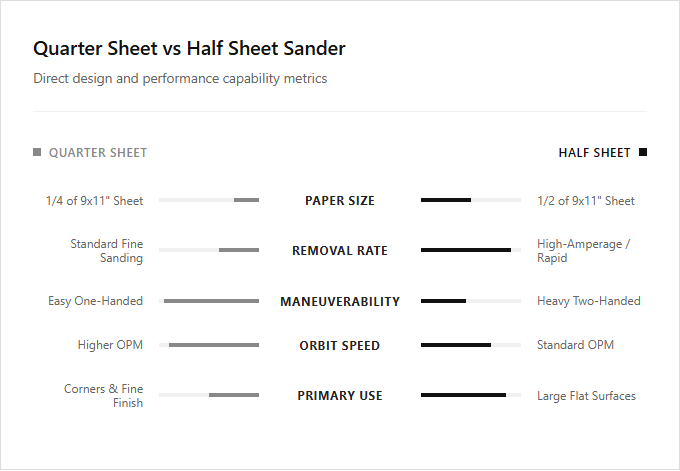
| Factor | Summary |
|---|---|
| Paper Size | A quarter sheet sander uses a one-fourth segment of a standard nine-by-eleven-inch abrasive sheet, whereas a half sheet sander utilizes a larger one-half segment to maximize cutting surface area. |
| Material Removal Rate | Half sheet sanders feature wider platens and higher-amperage motors that deliver superior material removal rates compared to the smaller, less aggressive quarter sheet sanders. |
| Maneuverability | Quarter sheet sanders offer excellent one-handed maneuverability in tight corners and vertical vertical axes, while heavier half sheet sanders require two-handed operation optimized for flat, horizontal planes. |
| Orbit Speed (OPM) | While both devices utilize orbital motion, quarter sheet sanders typically operate at a higher Orbits Per Minute (OPM) rate to compensate for their smaller contact footprint. |
| Primary Application | Quarter sheet models excel at fine finish work and detail sanding on furniture, whereas half sheet models are designed for rapid stock removal and flattening large tabletop surfaces. |
Platen surface area differences for scaling task sizes
Quarter sheet sanders utilize a platen of approximately 4.5 by 5.5 inches, representing one-fourth of a standard sandpaper sheet. This compact footprint is engineered for precision, allowing operators to navigate tight corners, detailed trim, and narrow profiles where control is paramount. The smaller surface area limits aggressive material removal, optimizing the tool for delicate finishing phases on smaller workpieces.
Half sheet sanders feature a larger platen of roughly 4.5 by 9 inches, doubling the active contact area. This expanded footprint is designed for rapid material removal across expansive, flat surfaces such as tabletops and wide panels, ensuring greater flatness over large spans. DIY enthusiasts and furniture restorers requiring high maneuverability benefit most from the nimble quarter sheet sander, while professional carpenters and installers managing flat, high-volume surfaces will find the half sheet sander indispensable.
Orbits per minute ratings affecting finishing speed
Orbits per minute (OPM) directly determines the material removal rate and finishing speed of sheet sanders. Quarter-sheet sanders typically operate at higher OPM ranges, often between 12,000 and 14,000, allowing them to rapidly smooth smaller areas despite their compact pad size. In contrast, half-sheet sanders generally run at slightly lower OPM rates, around 10,000 to 12,000, but utilize a larger motor and double the surface area to achieve superior efficiency on expansive workpieces.
While the higher speed of the quarter-sheet model excels at quick, fine-detail prepping, the half-sheet model leverages its massive footprint to outpace smaller sanders on flat, broad surfaces. Quarter-sheet sanders are ideal for DIY enthusiasts and woodworkers tackling intricate furniture, whereas half-sheet sanders are suited for professional cabinetmakers and contractors refinishing large tabletops or doors.
Material removal rate variations between sheet capacities
Quarter-sheet and half-sheet sanders differ significantly in their material removal rates due to the surface area of their sanding pads. A half-sheet sander utilizes a larger footprint, allowing it to cover double the surface area of a quarter-sheet model in a single pass. This expansive capacity, combined with typically more powerful motors, results in a much higher material removal rate, making the half-sheet sander highly efficient for flattening large, flat expanses of wood quickly.
Quarter-sheet sanders operate at a lower material removal rate but offer superior maneuverability and control in confined spaces. Their compact design allows for precise detail work and easy corner access where larger units cannot fit. While the half-sheet sander is ideal for professional furniture makers and contractors managing large-scale surface preparation, the quarter-sheet sander is best suited for DIY enthusiasts and hobbyists focusing on intricate, detailed finishing tasks.
Paper clamp tension mechanisms for abrasive retention
Quarter-sheet sanders typically employ wire-style spring clamps to secure the abrasive paper. These mechanisms require manual leverage to release, offering a compact design suited for smaller paper sizes. While highly convenient for quick changes, these lighter clamps can occasionally allow minor paper slippage under heavy pressure.
Half-sheet sanders utilize heavy-duty, lever-activated metal tensioning bars to secure the abrasive sheet. Because these larger tools generate significant lateral friction, their robust clamping systems are engineered to maintain high tension across a wider surface area, effectively preventing the paper from tearing or loosening during operation.
Quarter-sheet models are ideal for DIYers and detail woodworkers tackling tight corners, while half-sheet models are best suited for professional carpenters and refinishers preparing expansive, flat surfaces.
Orbit stroke diameter influencing the scratch pattern
Quarter sheet and half sheet orbital sanders differ significantly in performance, primarily due to their orbit stroke diameter. This diameter-the size of the circular path the sanding pad travels-directly dictates both the rate of material removal and the refinement of the resulting scratch pattern.
Quarter sheet sanders typically feature a smaller orbit stroke, often around 1/16 inch. This tight, rapid motion produces a highly concentrated, finer scratch pattern that easily blends into the wood grain for an ultra-smooth finish. Half sheet sanders utilize a larger orbit stroke, frequently 3/32 inch or greater. This wider sweep covers more area and removes material rapidly, but it leaves a more pronounced scratch pattern that requires progressive grit changes to completely erase.
Quarter sheet models are best suited for detail-oriented DIYers and cabinetmakers working on intricate projects, whereas heavy-duty half sheet sanders are ideal for professional renovators preparing large, flat expanses like tabletop surfaces and doors.
Dust extraction port efficiency for workpiece visibility
In professional woodworking, maintaining a clear line of sight on the workpiece is essential for precision. Quarter sheet sanders feature compact dust extraction ports that efficiently clear fine particles from smaller surface areas. Because the sanding pad is smaller, the localized suction is highly concentrated, preventing dust buildup directly ahead of the tool and ensuring the sanding path remains highly visible during detailed operations.
Conversely, half sheet sanders utilize larger extraction ports designed to manage the high volume of debris generated by their expansive pads. While these systems excel at clearing substantial waste across broad surfaces, the sheer volume of dust can occasionally obscure fine layout lines before the vacuum captures it. Quarter sheet models are ideal for detail-oriented crafters requiring maximum visibility on intricate joints, whereas half sheet sanders suit production-scale cabinetmakers who prioritize rapid material removal on large panels.
Counterweight balance configurations managing vibration attenuation
Quarter sheet and half sheet orbital sanders differ significantly in their internal counterweight configurations designed to mitigate vibration. In quarter sheet sanders, the smaller platens require lighter, integrated counterweights optimized for high-frequency, low-amplitude vibration attenuation, isolating the user's hand during delicate detailing. Conversely, half sheet sanders utilize heavier, dual-counterweight mechanisms to offset the substantial mass of the larger pad. This robust configuration targets lower-frequency, high-amplitude energy, stabilizing the tool against aggressive material removal and preventing hand fatigue during prolonged operation.
Understanding these balance dynamics ensures proper tool selection for specific finishing demands. Quarter sheet sanders are ideal for cabinetmakers and hobbyists requiring precise control on intricate trim work, whereas larger half sheet sanders are suited for professional refinishers and installers prepping expansive, flat wooden surfaces.
Leave a comment