
For high-volume fastening projects, relying on manual staplers inevitably leads to severe hand fatigue, joint strain, and inconsistent staple depth. While standard procurement budgets and workshop funding sources often default to these manual hand tools due to their low upfront cost, upgrading to a power stapler is a necessary investment for professional-grade output.
Selecting the correct electric tacker grants operators sustained physical relief and a massive boost in installation speed. However, as an important educational stipulation, users must carefully match the tool's drive-force settings to their specific material density to avoid damaging workpieces. For example, professional installers securing heavy carpet underlayment or wire lath rely on these automated systems to ensure flush, damage-free penetration every time.
To help you make an informed decision, this guide will analyze the critical differences between corded electric and battery-powered staplers, comparing their power output, mobility, run-time, and overall suitability for heavy-duty fastening applications.
| Factor | Summary |
|---|---|
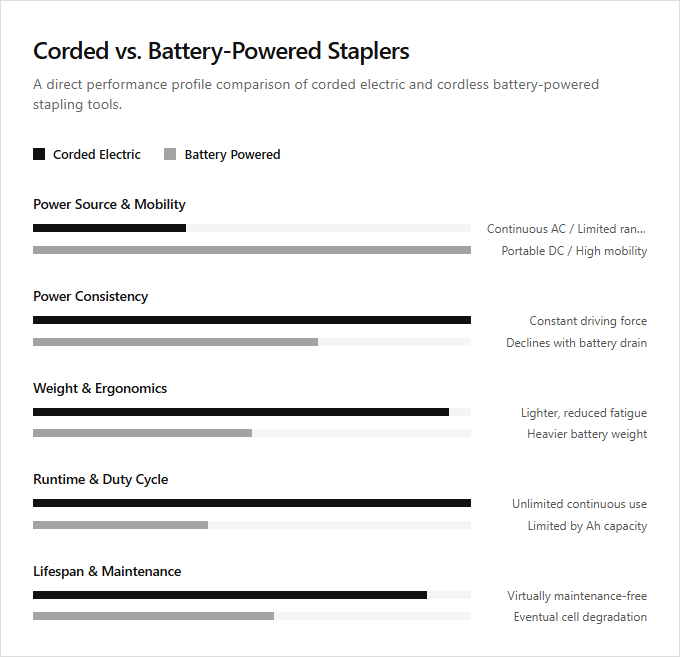
| Power Source and Mobility | Corded staplers rely on a continuous alternating current (AC) power supply, whereas cordless models offer superior maneuverability by utilizing direct current (DC) from portable batteries. |
| Power Consistency | Corded electric staplers provide consistent driving force without voltage drop, while battery-powered tools can experience diminished impact force as the battery's state of charge depletes. |
| Weight and Ergonomics | Corded staplers feature a lighter tool chassis due to the absence of heavy onboard battery cells, which significantly reduces operator fatigue during repetitive actuation. |
| Runtime and Duty Cycle | Corded models boast an unlimited duty cycle for uninterrupted fastening, whereas cordless staplers are constrained by the Ampere-hour (Ah) capacity of their rechargeable power packs. |
| Lifespan and Maintenance | Battery-powered staplers require eventual battery replacement due to the natural degradation of lithium-ion chemistry over successive charge-discharge cycles, unlike their virtually maintenance-free corded counterparts. |
AC vs. Lithium-Ion Battery: Impact Energy Consistency
Corded electric staplers utilize a continuous AC voltage supply to maintain uniform impact energy throughout operation. Because the tool draws power directly from an electrical grid, the drive mechanism receives constant voltage, ensuring every staple is driven to an identical depth without power degradation during extended use.
In contrast, cordless models rely on lithium-ion batteries, which feature a distinct voltage discharge curve. As the battery depletes, the declining voltage can subtly reduce the driving force, leading to inconsistent staple depth near the end of the charge cycle. High-volume workshop professionals requiring flawless, repetitive depth consistency benefit most from corded tools, while onsite installers and mobile contractors prioritize the maneuverability of cordless models despite minor power variations.
Corded Solenoid vs. Cordless Flywheel Impact Energy
Corded electric staplers utilize an electromagnetic solenoid to deliver immediate, consistent impact force. Upon trigger activation, a powerful magnetic field drives the driver blade instantly, ensuring uniform depth in dense materials. This direct power source enables rapid firing cycles without performance degradation.
Battery-powered staplers rely on a motorized flywheel system to store and transfer mechanical energy. An internal motor spins a heavy flywheel to speed before engaging the drive mechanism to sink the staple. While this system introduces a minor ramp-up delay, it provides high-energy output without the restriction of power cords.
Stationary assembly technicians requiring rapid, high-volume fastening benefit most from the consistent output of corded solenoid tools, whereas mobile contractors prioritize the portable versatility of cordless flywheel systems.
Continuous Runtime vs. Corded Range Constraints
Corded electric staplers deliver continuous power directly from an electrical outlet, enabling an unlimited duty cycle. This constant power supply allows for uninterrupted, high-volume fastening without the downtime associated with recharging batteries. This reliance on a physical outlet imposes a fixed operational range, restricting movement to the length of the cord and any connected extension leads.
Battery-powered staplers eliminate these tethering constraints, providing complete mobility across dynamic work environments. Cordless models excel in tight spaces and overhead applications where cords present safety hazards. High-production workshop professionals requiring nonstop firing benefit most from corded models, while mobile contractors and DIY enthusiasts prioritizing portability are better suited for battery-powered alternatives.
Tool Ergonomics vs. High-Capacity Battery Weight
Corded electric staplers offer superior ergonomic mass distribution by eliminating onboard power sources. Since the tool relies on a continuous external power supply, the center of gravity remains centered within the handle. This balanced design minimizes wrist fatigue during prolonged use, as there is no heavy battery pack to create an anchor effect during vertical or overhead fastening tasks.
Battery-powered models trade this balance for untethered mobility. Attaching high-capacity, high-amp-hour (Ah) battery packs significantly increases overall tool weight and shifts the balance point downward. While this provides cord-free convenience, the added mass demands greater physical exertion and grip strength during extended operation.
Corded models are best suited for stationary workshop professionals requiring lightweight, continuous operation, while cordless units are ideal for mobile contractors who prioritize portability on dynamic job sites.
Rapid-Fire Bump Actuation Speed
In high-volume fastening applications, actuation speed during rapid-fire bump mode is a critical performance metric. Corded electric staplers provide consistent, uninterrupted power, maintaining a reliable firing rate of approximately 20 to 30 cycles per minute. Because they draw power directly from an electrical outlet, these tools suffer no speed degradation or performance drops during prolonged, highly repetitive operations.
Battery-powered staplers offer comparable rapid-fire capabilities, with modern high-voltage cordless models briefly reaching up to 30 to 40 cycles per minute. However, their sustained cycle rate can decline as the battery depletes or when thermal protection limits engage during intensive bump firing. Stationary workshop professionals requiring continuous, non-stop production favor the reliable speed of corded units, while mobile installers and roofers prioritizing cordless maneuverability are better suited for battery-powered alternatives.
Micro-adjustable depth-of-drive adjustment mechanism for varying substrate density
When securing fasteners into materials of varying densities, a micro-adjustable depth-of-drive mechanism is essential for preventing both under-penetration and surface damage. Corded electric staplers deliver consistent, uninterrupted power, ensuring that depth-of-drive settings remain highly predictable during high-volume repetition. This stable energy flow allows operators to calibrate the dial precisely for hard or soft substrates without experiencing power drops.
Battery-powered staplers offer unmatched mobility, allowing users to adjust the depth mechanism on-site across diverse work areas. Although minor power fluctuations can occur as the battery depletes, the cordless design provides the physical freedom necessary for navigating complex angles and varied materials. Corded models are ideal for stationary workshop technicians requiring constant, predictable output, whereas cordless units suit mobile contractors needing adaptability across changing job sites.
Motor Torque Limits Heavy-Duty Staple Compatibility
Corded electric staplers deliver consistent, high-torque output directly from a constant power source, enabling them to reliably drive wide-crown, heavy-gauge staples-such as 16-gauge wires-into dense hardwoods without performance degradation. In contrast, battery-powered staplers rely on DC motor efficiency, where torque output is constrained by battery voltage and thermal limits. While advanced brushless cordless models successfully manage thick-wire fasteners, they often face limitations with maximum crown widths or extremely dense substrates as the battery charge depletes.
Selecting the appropriate power source depends heavily on the workspace environment and material demands. Corded models are ideal for stationary industrial manufacturers requiring continuous, maximum-penetration force for heavy assembly, whereas battery-powered models are best suited for mobile contractors and roofers who prioritize tool portability over unlimited high-torque runtime.
Leave a comment