
Professional contractors and finish carpenters frequently struggle with onsite productivity bottlenecks, constantly balancing the physical fatigue of managing heavy air hoses against the battery-drain anxieties of cordless alternatives. Selecting the wrong fastening system directly compromises project timelines and labor budgets.
Traditionally, operators rely on standard capital equipment budgets to fund traditional pneumatic setups, assuming centralized compressor lines are the only baseline for industrial-grade power. However, optimizing your tool fleet is a strategic investment; selecting the correct platform grants your crew reduced setup times and streamlined workflow efficiency.
With the stipulation that no single fastening technology excels in every scenario-as pneumatic tools dominate high-volume shop floors while cordless units thrive on remote, off-grid sites-managing operational expectations is key. For example, cabinet manufacturers rely on pneumatic medium-crown staplers for continuous assembly, whereas commercial punch-list contractors utilize cordless fine-wire staplers for rapid, ladder-free punch work.
This article provides an executive comparison of pneumatic and cordless staplers, analyzing power output, total cost of ownership, and situational mobility to guide your next procurement decision.
| Factor | Summary |
|---|---|
| Power Source | Pneumatic staplers rely on compressed air generated by an external air compressor, whereas cordless staplers utilize rechargeable lithium-ion battery packs for operation. |
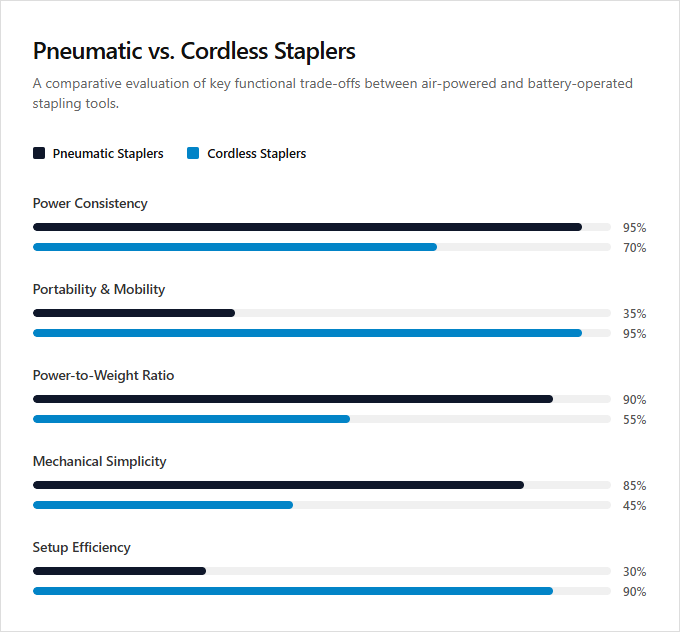
| Portability and Mobility | Cordless staplers offer unrestricted mobility on job sites due to the absence of an air hose, while pneumatic staplers are tethered to a pneumatic hose and compressor setup. |
| Performance and Output | Pneumatic staplers deliver consistent driving energy measured in PSI without performance drop-offs, whereas cordless staplers may experience reduced cycle rates as battery voltage declines. |
| Tool Weight and Ergonomics | Pneumatic staplers possess a superior power-to-weight ratio because they lack the heavy onboard motor and battery cells found in cordless alternatives. |
| Maintenance and Durability | Pneumatic models require routine tool lubrication but feature simple mechanical designs, whereas cordless models utilize complex brushless motors and integrated circuits that are maintenance-free but have more potential electronic failure points. |
Air Consumption (CFM) vs. Battery Capacity (Ah)
Pneumatic staplers rely on constant air supply, where performance is dictated by Cubic Feet per Minute (CFM) consumption. High-volume projects demand a compressor that meets the tool's CFM requirements to ensure rapid, consistent firing without pressure loss. This pneumatic design maintains a lightweight profile and endless power, provided the air supply remains uninterrupted.
In contrast, cordless staplers rely on Lithium-ion battery technology, where runtime is governed by Amp-hour (Ah) capacity. Higher Ah batteries extend operating time but increase the tool's overall weight, offering a trade-off between endurance and physical maneuverability. Pneumatic models are ideal for stationary high-production workshop environments, while cordless staplers suit mobile contractors requiring on-the-go portability.
Rapid actuation cycle rate versus electronic flywheel ramp-up latency
Pneumatic staplers utilize compressed air to deliver an instantaneous driving force, resulting in a rapid actuation cycle rate that allows for continuous, high-speed fastening. In contrast, cordless battery-powered staplers rely on an internal electric motor to spin up a flywheel, introducing a brief but noticeable electronic ramp-up latency before each shot.
This physical difference in power delivery directly impacts productivity and tool responsiveness during repetitive applications. Pneumatic systems are ideal for stationary, high-production manufacturing environments requiring rapid-fire efficiency, whereas cordless models are best suited for mobile contractors and service technicians who prioritize portability over maximum cycle speed.
Pneumatics vs. Batteries: Power-to-Weight Comparison
Pneumatic staplers leverage compressed air, utilizing a lightweight cylinder to drive fasteners with substantial force. This engineering design delivers an exceptional power-to-weight ratio, offering high-impact performance without adding physical strain during prolonged use. Because the primary power source remains external, the tool chassis is kept compact and highly maneuverable in tight spaces.
In contrast, cordless staplers must house heavy lithium-ion battery packs and internal electric motors directly on the frame. While modern battery technology provides impressive driving power, the added weight shifts the tool's center of gravity and increases operator fatigue over extended periods of operation.
Pneumatic models are ideal for high-volume workshop assembly and professional installers requiring continuous, rapid firing, while cordless staplers are best suited for mobile contractors and DIY users prioritizing portability and quick setup.
PSI Regulator vs. Electronic Depth Control
Pneumatic staplers rely on compressed air, where depth-of-drive is managed primarily by adjusting the air compressor's PSI (Pounds per Square Inch) regulator. This mechanical approach delivers highly consistent driving power, ensuring flush finishes across dense materials during high-volume production tasks.
Cordless staplers utilize battery technology, employing electronic depth-of-drive adjustments integrated directly into the tool. This system allows rapid, tool-free calibration on the fly, adapting quickly to varying wood densities without requiring compressor adjustments. Stationary workshop professionals requiring rapid, repetitive fastening benefit most from pneumatic models, whereas residential remodelers and mobile contractors prefer cordless staplers for their portability and quick setup.
Pneumatic Tool Maintenance vs. Brushless Motor Protection
Pneumatic staplers offer immense power and longevity but require consistent system maintenance. Operators must perform daily lubrication with specialized pneumatic tool oil to protect internal valves and O-rings from premature wear. Additionally, installing moisture separators in the compressed air delivery line is essential to extract condensation, preventing internal corrosion and ensuring consistent firing power.
Cordless staplers leverage brushless motor technology to eliminate hoses and compressors entirely. These tools feature sophisticated electronic control boards with built-in thermal protection, which automatically halts operation during heavy, continuous cycling to prevent heat damage to the motor. This electronic safeguard replaces physical daily maintenance with automated system monitoring.
Pneumatic models are ideal for industrial assembly line workers with established air infrastructure, while cordless staplers are best suited for mobile contractors and remodelers who prioritize rapid setup and jobsite portability.
Air-hose tether constraints versus cord-free maneuverability and jobsite portability
Pneumatic staplers offer exceptional, consistent power and rapid firing speeds for demanding applications. However, these tools require a constant connection to an air compressor, meaning operators must manage a restrictive air-hose tether that limits overall range and can create safety hazards on a busy work floor.
In contrast, cordless staplers eliminate these physical constraints by utilizing high-capacity rechargeable batteries. This design provides superior maneuverability and jobsite portability, allowing users to work in tight spaces, overhead, or across remote locations without being anchored to a stationary utility source.
Pneumatic models are best suited for high-volume workshop professionals who require continuous, rapid fastening at a fixed workstation, while cordless units are ideal for mobile contractors and renovators who prioritize freedom of movement and quick setup across diverse jobsites.
Compressor Tool CapEx vs. Battery Platform Investment
Pneumatic staplers offer a highly economical entry point for facilities already equipped with compressed air infrastructure. The individual tools require minimal capital expenditure due to their mechanically simple design, though new operators must factor in the significant overhead costs of purchasing, powering, and maintaining a compressor system.
Conversely, cordless staplers eliminate external air sources but demand a substantial upfront investment in a proprietary battery platform ecosystem. While the individual units and high-capacity lithium-ion batteries carry premium price tags, they remove physical hose constraints and provide unmatched jobsite mobility.
Pneumatic systems are ideal for stationary high-volume production workshops, whereas cordless models best serve mobile contractors and renovators requiring rapid deployment across various remote job sites.
Leave a comment