
Woodworkers and finishing carpenters often struggle to achieve flawless joints without splitting delicate trim or leaving unsightly surface damage. Before upgrading, many rely on standard equipment budgets and traditional workshop funding sources to secure basic, multi-purpose fastening tools.
However, integrating a dedicated power stapler grants craftsmen unmatched holding power and material protection that standard hammers cannot deliver. To maximize this utility, one must accept the stipulation that tool efficacy relies entirely on matching fastener gauge to wood density. For example, utilizing a narrow crown stapler on maple cabinet backs provides an incredibly secure hold without fracturing the grain.
In this guide, we will analyze the key differences between power staplers and brad nailers, examine the mechanics of the narrow crown stapler, and outline how to select the optimal finishing tool for your next project.
| Factor | Summary |
|---|---|
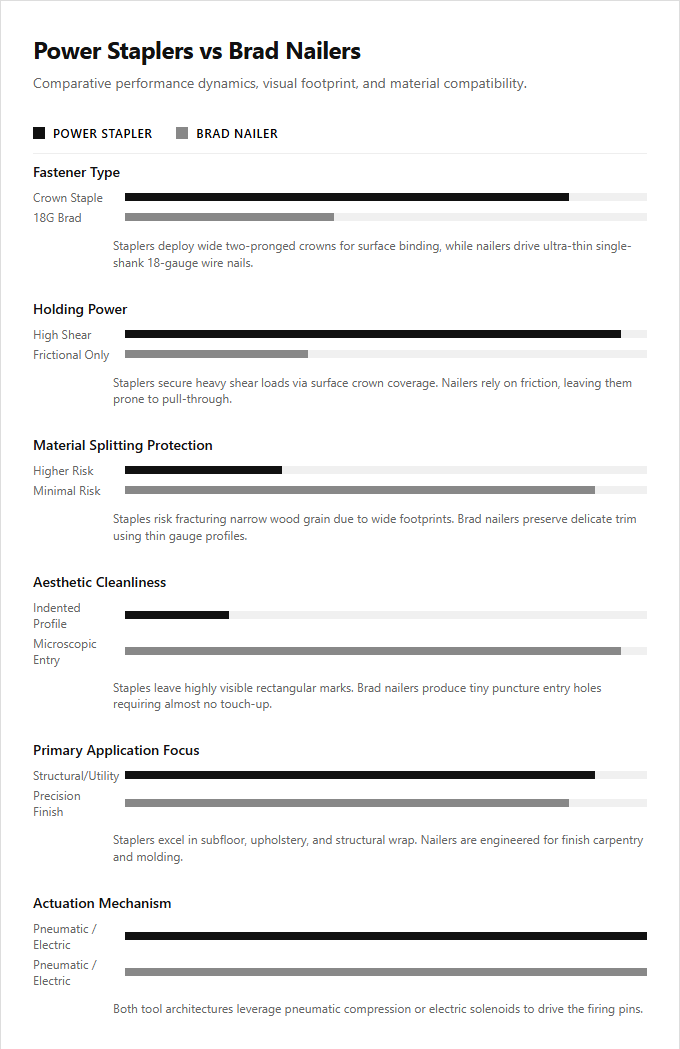
| Fastener Type | Power staplers utilize two-pronged crown staples to bind materials, whereas brad nailers drive thin, single-shank 18-gauge wire nails. |
| Holding Power | Power staplers offer superior shear strength due to the wider surface area of the crown, while brad nailers rely on friction and have limited resistance to pull-through. |
| Material Splitting | Brad nailers minimize the risk of splitting delicate wood because of their ultra-thin gauge profile, whereas the wider footprint of a staple can fracture thin trim. |
| Primary Application | Power staplers are engineered for securing subflooring, upholstery, and house wrap, while brad nailers excel in precision finish carpentry and molding installation. |
| Aesthetic Finish | Brad nailers leave a microscopic entry hole that requires minimal wood filler, whereas power staplers leave a prominent rectangular indentation on the workpiece. |
| Actuation Mechanism | Both tools rely on either pneumatic air pressure or electric solenoids to propel the drive blade into the fastener. |
18-Gauge Brad Nailers for Delicate Trim Work
When choosing between power staplers and brad nailers, understanding their specific fastening mechanisms is essential for achieving professional results. Brad nailers utilize 18-gauge fasteners, leaving a minimal footprint that is ideal for delicate trim work, cabinetry, and detailed molding. This thin gauge prevents delicate wood from splitting, and the small entry holes require virtually no wood putty before finishing.
Power staplers deploy crown staples that distribute holding pressure over a larger surface area, making them highly effective for securing upholstery, backing materials, and thin sheathing. Power staplers are ideal for upholstery specialists and insulation installers requiring broad holding strength, whereas brad nailers are best suited for finish carpenters and detailed woodworkers who demand seamless aesthetics.
Why Narrow Crown Staplers Have Superior Holding Power
Power staplers and brad nailers serve distinct roles in woodworking and construction. While brad nailers excel at holding delicate trim with minimal visibility, narrow crown staplers offer superior holding power. This exceptional strength is a direct result of the staple's dual-leg design, which straddles the wood grain to secure materials firmly and prevent splitting under tension.
Staplers distribute mechanical stress across a wider surface area, making them ideal for securing thin materials, cabinet backs, and underlayment. Conversely, brad nailers rely on a single, thin wire that is easily concealed but offers less resistance to pulling forces. Finish carpenters undertaking detailed trim installation require the subtlety of brad nailers, whereas cabinetmakers and furniture builders benefit from the robust fastening capabilities of power staplers.
High Shear Strength 1/4-Inch Crown Staples
Power staplers and brad nailers serve distinct roles in woodworking and construction. While brad nailers excel at delicate trim work by leaving minimal, easily filled holes, power staplers offer superior holding power for structural attachments. Specifically, the standard 1/4-inch crown width of a narrow crown stapler provides high shear strength, making it the ideal choice for securing cabinet backing and subfloor underlayment where lateral force resistance is critical.
In contrast, brad nailers utilize thin, 18-gauge wire nails designed for temporary holding power and seamless concealment in finish carpentry. Professional cabinetmakers and floor installers rely on power staplers for heavy-duty, structural fastening, whereas detailed trim carpenters and DIY hobbyists are better suited for the precise, cosmetic finishing capabilities of a brad nailer.
Brad Nailers with Tool-Free Depth Adjustment
When selecting between a power stapler and a brad nailer, understanding their distinct mechanical advantages is essential for achieving professional results. Power staplers utilize crown staples to provide a broad surface area of holding power, making them highly effective for securing fabrics, underlayment, and thin sheathing where materials must be held firmly against a substrate without tearing.
Brad nailers are engineered for precision woodwork and delicate trim applications. Brad nailers feature a tool-free depth of drive adjustment to prevent marring thin workpieces, allowing operators to countersink fasteners perfectly without damaging fragile wood surfaces. Power staplers are best suited for upholstery specialists and flooring installers who require maximum surface retention, while brad nailers are ideal for finish carpenters and hobbyists focusing on detailed cabinetry and trim work.
How Power Staplers Prevent Plywood Pull-Through
When choosing between power staplers and brad nailers, the primary distinction lies in how each tool secures materials. Power staplers utilize a wide crown that spans across the material, distributing fastening pressure over a significantly larger surface area. This broad distribution of force prevents the fastener from pulling through delicate materials, making it highly effective for securing thin plywood substrates, underlayment, and fabric.
In contrast, brad nailers insert thin, virtually headless wire nails designed to disappear into wood for a clean aesthetic. While brad nailers offer excellent concealment for detailed trim and cabinetry, they lack the surface-gripping capability required for tension-bearing applications. Carpenters and finish woodworkers undertaking delicate molding installations benefit most from the discreet holding power of a brad nailer, whereas installers and upholstery specialists securing backing boards, house wrap, or thin sheeting require the reliable surface hold of a power stapler.
Pneumatic CFM vs. Cordless Flywheel Technology
Power staplers and brad nailers serve distinct fastening roles in construction and woodworking. When selecting a pneumatic model of either tool, compatibility with your air compressor is critical, as these units require a specific CFM (cubic feet per minute) rating to operate efficiently and maintain consistent driving depth.
In contrast, battery-powered cordless options utilize advanced flywheel technology. This design spins an internal motor to store kinetic energy, allowing for rapid actuation and instant firing without the ramp-up delay traditionally associated with cordless fastening tools.
Heavy-duty pneumatic systems are best suited for workshop-based professionals requiring continuous, high-volume production, while cordless tools are ideal for mobile contractors and DIY enthusiasts seeking maximum portability on diverse job sites.
Why Brads Prevent Thin Hardwood Splitting
When fastening delicate materials, selecting the correct power tool is essential for preserving wood integrity. Power staplers utilize flat crown staples that apply broad downward pressure, which is excellent for securing backing materials but poses a significant risk of splitting thin hardwoods along the grain. In contrast, brad nailers utilize thin, round wire fasteners. This circular profile allows brads to pierce the wood fibers cleanly without wedging them apart, virtually eliminating the risk of splitting fragile workpieces.
Choosing between these tools depends heavily on the specific demands of your project and your material thickness. Power staplers are ideal for upholstery professionals and carpenters installing cabinetry backs, while brad nailers are the preferred choice for detailed trim carpenters and hobbyists working with delicate furniture moldings.
Leave a comment