
For trade professionals and serious DIYers alike, few things disrupt a productive workflow like pausing a precise cut to hunt for a misplaced hex key. While standard, budget-conscious tool configurations historically relied on these manual tension systems as the baseline, modern project demands require greater operational agility.
Upgrading to a keyless, tool-free interface grants operators an immediate boost in job-site efficiency, virtually eliminating transition downtime during rapid-fire tasks like flush-cutting door jambs or detailed grout removal. However, optimizing your toolkit requires managing expectations: rapid blade swaps must be balanced against key stipulations regarding clamping force retention, tool weight, and initial acquisition costs.
This article will analyze the mechanics of both locking systems, compare their real-world productivity metrics, and help you determine which mechanism best streamlines your workflow.
| Factor | Summary |
|---|---|
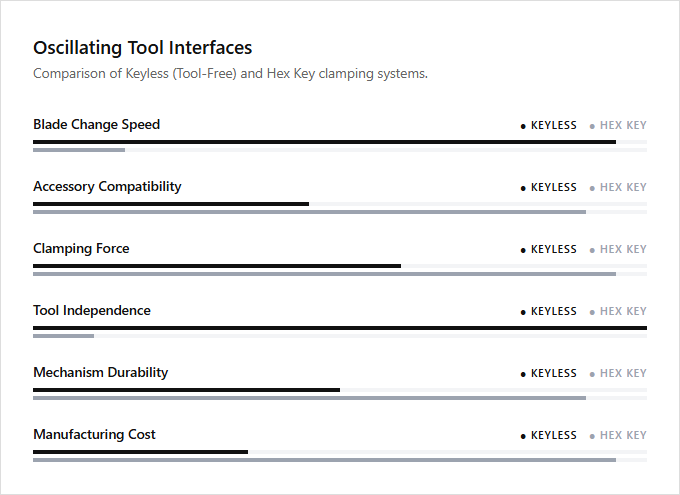
| Blade Change Speed | Keyless systems utilize a quick-release lever mechanism for rapid accessory swaps, whereas hex key systems require manually loosening a mandrel bolt with an Allen wrench. |
| Accessory Compatibility | Hex key systems accommodate a wider range of universal OIS (Oscillating Interface System) blades, while tool-free designs often require specialized interfaces like the Bosch-Fein Starlock system. |
| Clamping Force | Hex key mechanisms allow the operator to apply high mechanical torque directly to the arbor, whereas tool-free systems rely on internal spring tension to prevent accessory slippage. |
| Tool Reliance | Tool-free systems eliminate downtime caused by misplacing external hand tools, while hex key models depend entirely on a separate L-key to engage the socket head cap screw. |
| Mechanism Durability | The simple threaded spindle of a hex key system resists particulate contamination, whereas complex keyless tensioning linkages are more susceptible to mechanical failure from fine drywall dust ingress. |
| Manufacturing Cost | Hex key configurations feature lower production costs due to fewer moving parts, making the power tool more affordable compared to complex, precision-engineered tool-less clamping assemblies. |
Starlock interface mechanical coupling speed
Oscillating multi-tools rely heavily on their accessory change mechanisms for operational efficiency. While traditional hex key systems require manual fastening, modern keyless designs streamline this process. The pinnacle of this technology is the Starlock interface, a highly efficient mechanical coupling system. Utilizing a snap-on design, Starlock allows users to change blades in under three seconds, significantly outperforming the slower manual screw-down process of hex-key alternatives.
Although hex key mechanisms provide a secure hold, they are prone to lost tools and reduced productivity. Keyless systems ensure maximum torque transfer and rapid transition speeds during complex tasks. Standard hex key models are best suited for occasional DIYers prioritizing affordability, while advanced keyless and Starlock-compatible tools are indispensable for trade professionals demanding rapid, high-frequency accessory changes.
Spring-loaded clamping force consistency
Keyless, tool-free oscillating multi-tools utilize integrated, spring-loaded clamping mechanisms engineered to deliver uniform tension. This internal spring system ensures a consistent clamping force with every accessory change, mitigating the risk of blade slippage during high-vibration applications. Because the mechanism operates under factory-preset tension, it eliminates the user variability that often leads to under-tightening or component-damaging over-tightening.
Conversely, hex key systems rely entirely on manual torque, making clamping consistency dependent on operator physical effort. While hex key interfaces provide a highly robust, positive lock, the retention force fluctuates based on how tightly the bolt is fastened. Rapid-paced commercial contractors benefit most from the predictable tension and speed of spring-loaded keyless designs, while budget-conscious hobbyists performing infrequent tasks are well-served by the simplicity of a hex key configuration.
Flange screw and hex wrench loss prevention
Traditional oscillating multi-tools utilize a hex key and flange screw system to secure accessories. While this mechanism provides a reliable, high-torque clamp, it introduces the persistent risk of misplacing the wrench or dropping the loose flange screw during blade changes. Losing these critical components immediately halts operation, requiring operators to source replacements before work can resume.
Keyless, tool-free mechanisms eliminate this vulnerability by integrating the clamping lever directly into the tool housing. This captive design ensures that no fastening parts can be dropped or lost on busy job sites. Fast-paced professionals requiring rapid accessory transitions and maximum efficiency benefit most from keyless designs, whereas DIY hobbyists performing infrequent, stationary tasks may prefer the cost-effective simplicity of the hex key system.
Abrasive dust ingress in tool-free internal linkages
When selecting an oscillating multi-tool, the mechanism for blade changes significantly impacts long-term durability. Tool-free, keyless systems offer rapid accessory swaps through internal spring-loaded linkages. However, these complex internal cavities are highly vulnerable to abrasive dust ingress from sanding and drywall applications. Over time, fine particulate matter penetrates the tool casing, degrading internal lubricants and causing the quick-release mechanism to bind or fail.
Traditional hex key systems rely on a simple, external threaded bolt. Lacking intricate internal components, this design remains virtually impervious to dust accumulation, ensuring consistent clamping force in harsh environments. Tradespeople engaged in heavy-duty demolition and masonry benefit from the rugged reliability of the hex key system, whereas finish carpenters requiring frequent, rapid blade transitions prefer the convenience of the tool-free mechanism.
Accessory transition time during high-duty-cycle operations
During high-duty-cycle operations, accessory transition time directly impacts project efficiency and operator fatigue. Keyless, tool-free systems enable rapid blade changes in under five seconds, maintaining workflow momentum and preventing tool cool-down during intensive tasks. Hex key mechanisms require manual screw adjustment with an external wrench, which increases transition times and introduces potential downtime if the wrench is misplaced.
While the hex key system provides a robust, highly secure interface that resists heavy vibration, the time penalty during frequent accessory swaps accumulates over a workday. High-volume commercial contractors who prioritize speed and efficiency are best suited for keyless systems, whereas budget-conscious DIYers or workshop hobbyists with low-frequency change needs find the dependable hex key design highly adequate.
Arbor interface wear and deformation mitigation
The choice between keyless and hex key oscillating tool interfaces directly impacts the longevity of the arbor and accessory mount. Hex key systems utilize a manual threaded bolt to secure accessories, distributing high clamping forces that prevent slipping during demanding cuts. While highly secure, manual tightening is susceptible to human error, where undertightening causes abrasive slippage and overtightening risks stripping the threads or deforming the interface pins.
Keyless systems mitigate these risks by employing internal, spring-loaded tensioning levers that deliver consistent, factory-calibrated clamping pressure. This uniform force prevents localized metal fatigue and minimizes wear on the arbor interface over repeated changes. High-volume trade professionals requiring rapid blade transitions benefit most from the efficiency of keyless mechanisms, whereas DIY hobbyists and precision woodworkers performing occasional, high-torque tasks are well-suited for the stable, cost-effective rigidity of hex key systems.
Oscillating Interface System compatibility limitations
When selecting an oscillating multi-tool, interface compatibility is a critical distinction between keyless and hex key clamping systems. Keyless, tool-free mechanisms often employ proprietary designs, such as the Starlock interface, which restrict users to specific, matching blade shapes and limit the use of generic, open-back accessories without adapters. Conversely, traditional hex key systems utilize a highly adaptable, flat arbor setup. While slower to operate, this mechanical screw-and-washer design secures a much broader range of third-party and legacy universal oscillating interface system (OIS) blades.
This interface limitation directly dictates accessory availability and job site efficiency. High-volume contractors prioritizing rapid, frequent blade changes benefit most from keyless systems, while budget-conscious DIYers or restoration specialists requiring maximum blade compatibility are better suited for hex key models.
Leave a comment