
Achieving a flawless plunge cut or clean sand with an oscillating multi-tool can be surprisingly frustrating. Many trade professionals frequently battle with scorched workpieces, excessive hand vibration, or sluggish cutting speeds, struggling to find the sweet spot between efficiency and control.
While standard equipment funding sources-such as shop capital budgets-typically focus on raw motor amperage, tool kinematics are what truly dictate performance. Mastering the interplay between oscillation angle and oscillations per minute (OPM) grants operators the ability to drastically reduce project cycle times. However, this optimization carries the strict stipulation that accessory quality must match the tool's output capability.
For instance, high-end millwork shops regularly adjust these parameters to achieve clean, splinter-free cuts in delicate hardwoods. This article will analyze the mechanical differences between wide and narrow oscillation angles, explore how to optimize OPM for speed versus precision, and outline the ideal settings for various applications.
| Factor | Summary |
|---|---|
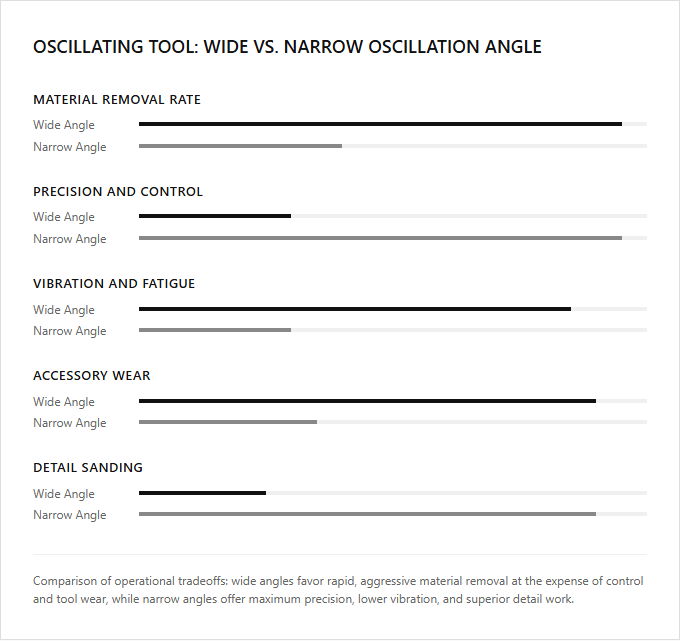
| Material Removal Rate | A wide oscillation angle increases the aggressive cutting speed for rapid material removal, whereas a narrow angle provides slower, more controlled stock removal. |
| Precision and Control | Narrow oscillation angles minimize kerf width and tool drift, offering superior precision for delicate plunge cuts compared to the aggressive movement of wide angles. |
| Vibration and Fatigue | Tools with a wide oscillation angle generate higher vibratory feedback, while narrow angles significantly reduce hand-arm vibration during prolonged operation. |
| Accessory Wear | Wide oscillation angles accelerate blade friction and thermal stress, leading to faster degradation of bi-metal or carbide-tipped accessories compared to narrow angles. |
| Detail Sanding | Narrow oscillation angles are highly efficient for detail sanding applications because they prevent surface swirling and heat-induced paint melting. |
Wide Angles and High OPM for Rapid Demolition
The oscillation angle of a multi-tool significantly influences its cutting speed and control. Wide oscillation angles, typically between 3.6 and 4.5 degrees, paired with high oscillations per minute (OPM) maximize the material removal rate for rapid demolition. This powerful combination enables aggressive, fast cutting through tough materials where speed and volume are the primary objectives.
A narrow oscillation angle, usually ranging from 1.5 to 2.0 degrees, limits blade travel to provide superior precision, cleaner finishes, and minimized vibration. Wide-angle tools are ideal for demolition contractors and heavy-duty renovators requiring rapid, high-volume material removal, while narrow-angle models are best suited for detail woodworkers and tile installers who demand meticulous control and delicate, splinter-free cuts.
Narrow Oscillation Angles for High-Precision Cuts
Oscillating multi-tools rely heavily on their oscillation angle to determine cutting behavior. A narrow oscillation angle, typically between 1.4 and 2.8 degrees, offers superior control by reducing the kerf width. This minimal blade movement allows for highly precise, intricate cuts in delicate materials without causing excessive tear-out or damage to surrounding surfaces.
A wide oscillation angle, ranging from 3.2 to 4.5 degrees, prioritizes aggressive material removal and faster cutting speeds. While this wider sweep increases productivity during demolition, it sacrifices the surgical accuracy of narrower configurations. Precision woodworkers and detail-oriented renovators benefit most from narrow-angle tools, whereas general contractors and demolition specialists require the rapid performance of wide-angle models.
High OPM and Wide Angles Increase Vibration and Deflection
Oscillating multi-tools rely on the critical relationship between oscillation angle and speed to determine cutting efficiency and control. A wide oscillation angle, typically between 3.6 and 4.2 degrees, aggressively removes material by sweeping a broader arc. However, pairing a high OPM with a wide angle increases accessory deflection and hand-arm vibration, which can compromise cutting precision and accelerate operator fatigue.
A narrow oscillation angle of 1.4 to 2.8 degrees minimizes tool deviation, providing superior control for delicate tasks. Heavy-duty contractors requiring rapid material removal and demolition favor wide-angle tools, while detail-oriented woodworkers and finish carpenters performing intricate plunge cuts are best suited for narrow-angle models.
Narrow Angles Extend Accessory Life in Plunge Cutting
The selection of an oscillating multi-tool's arc angle directly impacts cutting speed, control, and thermal management. A narrow oscillation angle, typically between 1.4 and 2.8 degrees, excels in precision applications. By limiting the distance the blade travels, narrow angles minimize frictional heat buildup. This thermal reduction is particularly beneficial during deep plunge cutting, where trapped heat rapidly dulls teeth, thereby significantly extending accessory life.
A wide oscillation angle, ranging from 3.2 to 5.0 degrees, prioritizes aggressive material removal and faster cutting speeds through a broader sweep. High-production contractors tackling rapid demolition and rough framing benefit most from wide-angle tools, whereas flooring installers and cabinet makers requiring precise plunge cuts and maximum accessory life are better suited for narrow-angle models.
Higher Torque Prevents Wide-Angle Tool Stalling
The oscillation angle of a multi-tool determines its cutting speed and performance. A wide oscillation angle, typically around 3.6 to 4 degrees, removes material rapidly but demands substantial operating power. To prevent the tool from stalling under heavy loads, a wide-angle design requires a high-torque motor to sustain consistent blade movement through dense materials.
A narrow oscillation angle, often between 2.8 and 3.2 degrees, delivers less aggressive action with superior detail control. This smaller arc reduces motor strain, ensuring smooth operation even with lower torque. Heavy-duty contractors requiring rapid material removal benefit most from high-torque, wide-angle models, while precision-focused woodworkers and hobbyists prefer the control of narrow-angle tools.
Prevent Delamination With Low OPM and Narrow Angles
The oscillation angle of a multi-tool significantly influences both cutting speed and material integrity. A narrow oscillation angle offers superior control and minimizes aggressive tool vibration. Operating a narrow-angle tool at lower oscillations per minute (OPM) settings prevents delamination and splintering when cutting fragile workpieces, such as veneered plywood or laminates. This configuration reduces mechanical stress and heat buildup on delicate material layers during intricate tasks.
A wide oscillation angle delivers aggressive material removal and faster cutting speeds. Demolition specialists and general contractors performing rapid rough cuts benefit most from high-angle tools, while finish carpenters and detail-oriented woodworkers requiring splinter-free precision are ideal candidates for narrow-angle models.
Oscillation Arc: Aggressive Cut vs. Controlled Finish
An oscillating multi-tool's performance is fundamentally defined by its oscillation angle. A wider oscillation angle, typically between 3.6 and 4.2 degrees, delivers a highly aggressive cutting action. This broader arc of movement removes material rapidly, making it exceptionally efficient for heavy demolition, rough-cutting timber, and fast plunge cuts where speed is prioritized over a flawless surface finish.
A narrower oscillation angle, usually between 1.4 and 2.8 degrees, prioritizes control and precision over sheer speed. The smaller arc minimizes tool vibration and reduces the risk of splintering or damaging delicate workpieces. This characteristic allows for cleaner, highly controlled cuts in confined spaces and intricate sanding applications.
Demolition contractors and framing carpenters thrive with wide-angle tools, whereas cabinetmakers, tilers, and restoration specialists achieve optimal results using narrow-angle models.
Wide oscillation angles maximize the Material Removal Rate (MRR)
The oscillation angle of an oscillating multi-tool significantly influences its cutting efficiency and control. A wider oscillation angle, typically between 3.6 and 4.2 degrees, increases the lateral speed of the accessory, directly maximizing the Material Removal Rate (MRR). This broader sweep allows the blade to aggressively slice through thick materials, making it highly efficient for rapid demolition, plunge cuts, and fast rough-cutting tasks.
A narrower oscillation angle, usually around 2.8 to 3.2 degrees, reduces aggressive movement to deliver superior precision and lower operating vibration. This smaller arc ensures cleaner cuts in delicate materials and minimizes the risk of workpiece damage. High-angle models are ideal for heavy-duty contractors prioritizing rapid material removal, while low-angle tools suit detail-oriented woodworkers and tile installers requiring meticulous accuracy.
Narrow oscillation angles optimize kerf control for high-precision jointing
Oscillating multi-tools vary significantly in performance based on their oscillation angle, which typically ranges from 2.8 to 4.5 degrees. A wide oscillation angle delivers aggressive material removal and faster cutting speeds, making it highly efficient for bulk cutting tasks. In contrast, a narrow oscillation angle restricts blade movement to a smaller arc, which minimizes tool vibration and maximizes user control.
This localized movement is essential for detailed woodwork, as narrow oscillation angles optimize kerf control for high-precision jointing. The tighter arc prevents the blade from wandering, ensuring clean, splinter-free cuts in delicate workpieces. Heavy-duty demolition contractors rely on wide-angle tools for rapid material tear-outs, whereas finish carpenters and instrument makers require narrow-angle tools for intricate fitting and detailed restoration work.
High OPM paired with narrow angles reduces hand-arm vibration levels
The oscillation angle of a multi-tool significantly influences both cutting speed and operator comfort. Wide oscillation angles, typically between 3.2 and 4 degrees, aggressively remove material but generate higher kickback. Tools engineered with a narrow oscillation angle, usually between 1.4 and 2.0 degrees, prioritize precision and control. When a narrow angle is paired with high oscillations per minute (OPM), the tool delivers smooth, rapid cuts while substantially reducing hand-arm vibration levels, protecting the operator during extended use.
The choice between these configurations depends entirely on the specific application. Wide-angle models excel in heavy-duty demolition and rapid rough cutting, whereas narrow-angle, high-OPM models are ideal for detailed woodworking, flush cutting, and grout removal. Demolition contractors requiring fast material removal prefer wide-angle tools, while detail-oriented finish carpenters and tile installers benefit most from the controlled, low-vibration performance of narrow-angle designs.
Lower OPM thresholds prevent thermal degradation on temperature-sensitive materials
Oscillating multi-tools vary significantly in performance based on their oscillation angle. Wide oscillation angles, typically between 3.2 and 4 degrees, deliver aggressive material removal and faster cutting speeds. Conversely, narrow oscillation angles of 1.4 to 2.8 degrees offer superior control, precision, and reduced tool vibration during intricate tasks.
When working with temperature-sensitive materials like plastics, PVC, or delicate laminates, thermal management is critical. Utilizing a narrow oscillation angle in conjunction with lower OPM thresholds prevents friction-induced heat buildup and subsequent thermal degradation. This low-speed, low-angle configuration ensures clean cuts without melting or scorching the workpiece.
Wide-angle tools are ideal for construction professionals requiring rapid demolition and bulk material removal, while narrow-angle models suit fine woodworkers and restorers who prioritize precision and material preservation.
Wide Angles Accelerate Blade Speed and Wear
The oscillation angle of a multi-tool significantly influences its cutting efficiency and durability. Wide-angle configurations, typically ranging from 3.6 to 4.2 degrees, deliver aggressive material removal by increasing the linear blade tip speed. This rapid movement generates higher friction and heat, accelerating mechanical wear on both the accessory and the tool's internal motor components.
Narrow-angle configurations, usually between 1.4 and 3.2 degrees, offer enhanced precision and reduced vibration. This smaller arc minimizes stress on the blade, extending tool lifespan while allowing for cleaner, highly controlled cuts in delicate materials. High-angle models suit heavy-duty contractors prioritizing rapid demolition, while low-angle tools are ideal for detail woodworkers and remodelers requiring meticulous accuracy.
Prevent Motor Stall by Matching Torque and OPM
Oscillating multi-tools rely on the critical relationship between oscillation angle, speed, and torque to maintain performance under load. A wide oscillation angle (typically 3.2° to 4.5°) delivers aggressive cutting but demands higher motor power. To prevent motor stalling under heavy load, manufacturers match robust, high-torque motors with an optimal OPM range, ensuring the blade maintains momentum through dense materials.
A narrow oscillation angle (around 1.4° to 2.8°) offers greater control and detail but requires higher OPM to compensate for the smaller stroke. Because the resistance per stroke is lower, these tools resist stalling during intricate tasks even with moderate torque. Wide-angle tools are ideal for heavy-duty contractors prioritizing rapid demolition, whereas narrow-angle models suit fine woodworkers requiring precise, clean finishes.
Oscillation Arc Controls Cutting-to-Sanding Transition
The oscillation angle of a multi-tool dictates its primary mechanical action, governing the transition between aggressive shear cutting and controlled abrasive sanding. A wider oscillation arc, typically between 3.6 and 4.5 degrees, increases blade tip speed and travel distance, maximizing aggression for rapid wood cutting and plunge cuts. Conversely, a narrower arc of 1.5 to 2.8 degrees reduces aggressive movement, providing the stable, high-frequency agitation required for delicate surface preparation and intricate detail sanding.
Matching the correct angle to the task ensures optimal accessory life and prevents material scorching. Professionals engaged in heavy demolition, framing, or rapid pipe cutting benefit most from wide-angle tools, while cabinetmakers, restorers, and precision detailers require the controlled finesse of a narrow-angle model.
Leave a comment