
Achieving a flawless profile in abrasive blasting is notoriously challenging, often plagued by sputtering media, inconsistent pressure, and hours of wasted labor. To resolve these inefficiencies, operators typically look to standard equipment budgets and traditional hardware procurement channels to upgrade their setups.
However, selecting the correct abrasive delivery method-pressure pot versus siphon-grants operators unparalleled control over velocity and media flow. This optimization holds true, with the critical stipulation that your compressor's CFM output must align perfectly with the chosen system's operational demands. For instance, while stripping heavy rust from a structural steel trailer requires high-velocity impact, delicate tasks like etching automotive glass demand precise, low-pressure modulation.
In this guide, we provide a comprehensive, objective comparison of pressure pot and siphon blasters. We will analyze their mechanical differences, media capacities, and overall cost-efficiency to help you determine the ideal tool for your workshop's specific blasting requirements.
| Factor | Summary |
|---|---|
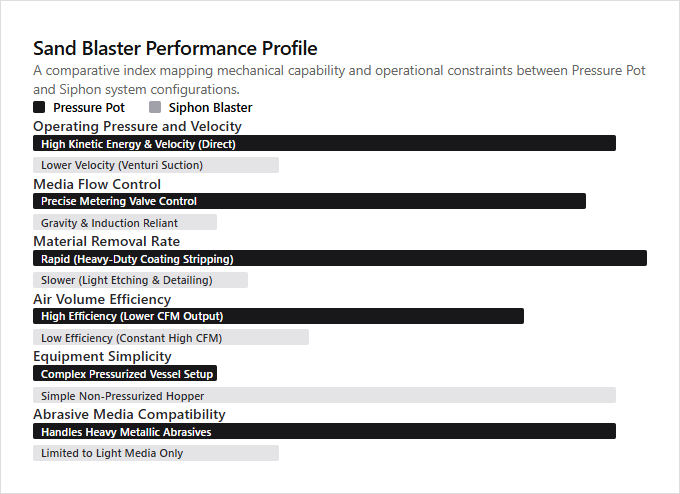
| Operating Pressure and Velocity | Pressure pots expel abrasive media at a much higher kinetic energy and velocity by pressurizing the entire vessel, whereas siphon blasters rely on the Venturi effect to draw media into the airflow. |
| Media Flow Control | Pressure pots utilize a dedicated metering valve at the base of the tank to regulate the air-to-media ratio, while siphon blasters depend on gravity and suction through a feed hose. |
| Material Removal Rate | The direct-pressure design of pressure pots yields a significantly faster material removal rate for heavy-duty coatings, whereas siphon blasters operate at a slower pace suitable for light etching. |
| Air Volume Requirements | Siphon blasters require a continuous high volumetric flow rate measured in cubic feet per minute (CFM) to maintain suction, while pressure pots can operate efficiently at lower CFM ranges depending on nozzle size. |
| Equipment Complexity | Pressure pots require an ASME-certified pressurized vessel and specialized safety relief valves, whereas siphon systems feature a simpler, non-pressurized hopper and induction gun configuration. |
| Abrasive Media Compatibility | Pressure pots can easily propel heavy, high-density metallic abrasives, whereas siphon blasters are generally limited to lighter media because of the physical constraints of suction-lift capacity. |
Pressure differential versus Venturi effect suction delivery
When selecting a sand blaster, the primary distinction lies in the media delivery method. Siphon blasters operate on the Venturi effect, where high-velocity compressed air passes over a suction inlet, creating a negative pressure vacuum that draws the abrasive media up from an unpressurized container. This system is mechanically simple but inherently loses energy during the suction process.
Pressure pot systems utilize a pressure differential. The media vessel itself is pressurized to match the air line pressure, forcing the abrasive down into the mixing valve and air stream. This direct push delivers significantly higher kinetic energy, resulting in faster and more consistent material removal. Siphon blasters are ideal for DIY hobbyists performing light-duty restoration, while pressure pots are best suited for industrial professionals requiring rapid, heavy-duty surface preparation.
Abrasive velocity and kinetic energy impact force
Pressure pot sandblasters utilize a pressurized vessel to force abrasive media through the nozzle, achieving exceptional velocity. This direct-pressure design delivers maximum kinetic energy impact force, allowing the media to fracture tough industrial coatings and heavy corrosion rapidly.
Siphon blasters employ the Venturi effect to draw media into the air stream, a process that inherently reduces exit velocity. This lower kinetic energy impact force provides a gentler, more controlled abrasion that minimizes the risk of warping delicate substrates. Pressure pots are best suited for industrial contractors requiring rapid, high-production stripping, whereas siphon blasters are ideal for hobbyists seeking a cost-effective tool for light-duty maintenance.
Volumetric flow rate and CFM compressor requirements
When selecting a sand blaster, understanding the distinction between pressure pot and siphon systems is crucial for matching the tool to your air compressor's capabilities. Pressure pot blasters utilize a pressurized vessel to force abrasive media through the nozzle, delivering a high volumetric flow rate. This high-velocity output demands a robust air supply, typically requiring a compressor capable of producing at least 10 to 20 CFM at 90 PSI to prevent pressure drops during extended use.
Siphon blasters utilize the Venturi effect to draw media into the airflow, resulting in a lower volumetric flow rate and reduced efficiency. This design operates effectively with smaller, more common compressors, requiring only 4 to 10 CFM. Pressure pots are suited for industrial operators needing rapid, heavy-duty coating removal, while siphon blasters are ideal for hobbyists performing light, intermittent restoration work.
Abrasive metering valve regulation of media-to-air ratio
Pressure pot sandblasters utilize a pressurized vessel to force media into the air stream, where an abrasive metering valve at the tank base precisely regulates the media-to-air ratio. This configuration enables a dense, highly consistent mixture that maximizes velocity and impact force, allowing operators to fine-tune the abrasive flow for specific surfaces.
In contrast, siphon blasters rely on the Venturi effect, utilizing high-velocity air to pull media up from an unpressurized container. Because the media-to-air ratio is governed by suction rather than mechanical pressure, the mixture is inherently leaner and less consistent, resulting in lower stripping efficiency.
Pressure pots are ideal for industrial contractors requiring rapid, high-production paint and rust removal, whereas siphon blasters are best suited for hobbyists performing light-duty etching or occasional workshop maintenance.
Nozzle orifice size and system backpressure tolerance
Pressure pot sandblasters utilize a pressurized vessel to push abrasive media through the hose, allowing them to maintain high velocity even with smaller nozzle orifice sizes. This design exhibits superior tolerance to system backpressure, ensuring consistent media flow through longer hoses or restrictive nozzles. Conversely, siphon blasters rely on the Venturi effect to pull media into the air stream. They require larger nozzle orifices to generate sufficient vacuum and are highly sensitive to backpressure, which can easily disrupt the suction mechanism.
Pressure pots are ideal for industrial contractors requiring high-efficiency, heavy-duty paint stripping, while siphon blasters are best suited for hobbyists performing occasional, localized surface etching.
Abrasive media bulk density and fluidization capacity
Pressure pot sandblasters excel with high bulk density abrasive media due to their direct pressurization design. By pressurizing the entire vessel, these systems effectively fluidize heavy materials like steel grit or aluminum oxide, forcing them through the nozzle with high, consistent velocity. This positive pressure ensures that dense media flows smoothly without clogging.
Siphon blasters rely on the Venturi effect to draw media from an open hopper. This configuration offers lower fluidization capacity, making it less efficient with heavy media that resists suction. Pressure pots are ideal for industrial contractors requiring rapid, heavy-duty surface preparation, while siphon blasters are best suited for DIY hobbyists performing light-duty etching or spot cleaning.
Continuous duty cycle and square-footage productivity rates
Pressure pot sandblasters deliver a superior continuous duty cycle and significantly higher square-footage productivity rates compared to siphon models. By utilizing a pressurized vessel to push abrasive media directly through the nozzle, pressure pots achieve up to four times the velocity and coverage speed of their counterparts. Siphon systems instead rely on the Venturi effect to draw media up to the gun, a process that limits overall output and increases the likelihood of flow interruptions during extended operation.
For high-volume applications, pressure pots maximize efficiency by stripping large surface areas rapidly without performance degradation. Siphon blasters offer a simpler, low-maintenance design that requires less air volume for intermittent tasks. Industrial contractors requiring rapid, high-production surface preparation will benefit most from a pressure pot, whereas DIY hobbyists performing localized rust removal or etching are better suited for a siphon blaster.
Leave a comment