
Achieving flawless perpendicularity on a drill press is notoriously difficult when sub-standard work surfaces flex under heavy spindle pressure, leading to ruined workpieces and wasted shop hours. While operators typically look to standard equipment funding sources-such as annual capital expenditure budgets or small-business tool grants-to acquire machinery, the material composition of the table itself is what ultimately dictates the machine's true return on investment.
Selecting the right interface grants operators the structural rigidity required for high-vibration metalworking, under the stipulation that one must balance physical weight against shop portability. For instance, heavy-duty industrial fabrication shops consistently rely on cast iron to dampen harmonics during high-torque boring operations.
In this guide, we will analyze the physical properties, deflection rates, and long-term durability of cast iron versus aluminum tables to help you secure the ideal foundation for your drilling applications.
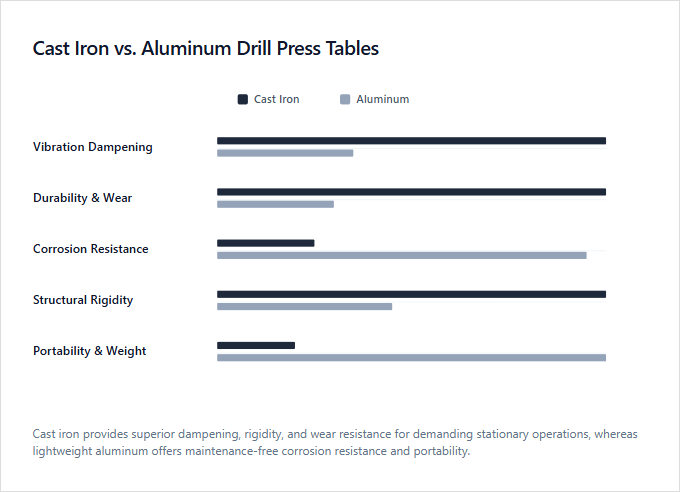
| Factor | Summary |
|---|---|
| Vibration Dampening | Cast iron tables feature superior mass and dampening capacity to absorb motor oscillations, whereas lightweight aluminum tables propagate more structural vibration. |
| Durability and Wear | Cast iron provides exceptional tensile strength and resistance to abrasive wear, while softer aluminum is more susceptible to surface gouging and deformation. |
| Corrosion Resistance | Aluminum tables naturally develop a protective passivation layer to resist rust, whereas cast iron requires regular lubrication to prevent surface oxidation. |
| Structural Rigidity | Cast iron maintains strict flatness tolerances under heavy workpieces, while aluminum tables can experience deflection or warping when subjected to high clamping forces. |
| Weight and Portability | Aluminum significantly reduces the tool's gross weight for easier height adjustment and transport, whereas heavy cast iron anchors stationary floor-model drill presses. |
Gray Cast Iron Dampens Drilling Vibrations
When selecting a drill press, the composition of the support table significantly influences machining accuracy and operational stability. Heavy-duty models typically feature gray cast iron tables, which are highly valued for their structural mass. Crucially, gray cast iron exhibits a high internal damping capacity that actively suppresses harmonic vibrations generated during high-speed drilling. This material absorbs mechanical energy, securing the workpiece and ensuring cleaner, more precise holes.
Aluminum tables offer a lightweight, corrosion-resistant alternative that enhances the portability of benchtop drill presses. While aluminum lacks the superior vibration-dampening mass of cast iron, it provides sufficient stability for light-duty tasks and remains easy to adjust. Heavy cast iron tables are ideal for professional machinists and woodworkers requiring maximum precision, whereas lightweight aluminum tables are best suited for DIY hobbyists and mobile contractors prioritizing portability.
Cast Iron's Modulus Prevents Spindle Thrust Deflection
When selecting a drill press, the table material directly impacts machining accuracy. Cast iron tables offer superior rigidity due to the material's high Young's modulus, which prevents structural deflection under high spindle thrust loads. This robust resistance to bending ensures the workpiece remains perfectly perpendicular to the spindle, maintaining precise hole alignment during heavy-duty drilling operations.
Conversely, aluminum tables are lightweight and corrosion-resistant but exhibit greater deflection under intense force. Professional metalworkers requiring extreme precision and heavy feed pressures should opt for the stability of cast iron, whereas DIY hobbyists and mobile tradespeople will find aluminum tables more suitable for light-duty, portable applications.
High-Hardness Cast Iron Resists Wear and Galling
When selecting a drill press, the choice between a cast iron and an aluminum table significantly impacts machine durability. Cast iron features superior Brinell hardness to resist surface galling and wear from heavy, abrasive workpieces. This heavy material also provides excellent vibration dampening, which ensures greater precision during high-torque drilling operations.
Aluminum tables offer a lightweight, corrosion-resistant alternative that simplifies machine transport and table height adjustments, though they remain more susceptible to scratching and denting under heavy loads. Cast iron tables are best suited for professional machinists and industrial workshops requiring maximum stability and wear resistance, while lightweight aluminum tables are ideal for hobbyists and mobile tradespeople who prioritize portability.
Cast Iron's Density Stabilizes Machine Bases
When selecting a drill press, the composition of the support table significantly influences overall machining performance. Cast iron tables offer a distinct advantage due to their superior material density. This greater material density provides the essential inertial mass required to stabilize the machine base, effectively dampening motor vibrations and ensuring highly accurate drilling depth and placement.
Aluminum tables prioritize portability and resistance to corrosion. Their lightweight design makes the machinery easier to adjust and transport, though they lack the substantial vibration-dampening qualities of heavier metals. Heavy cast iron tables are ideal for professional machinists requiring maximum stability for high-precision metalworking, whereas lightweight aluminum tables are best suited for hobbyists and mobile contractors who prioritize portability for light-duty tasks.
Aluminum Thermal Expansion and Heat Distortion
When selecting a drill press, the composition of the worktable significantly influences machining precision and long-term reliability. Cast iron tables offer exceptional mass and vibration dampening, maintaining a flat, rigid surface under heavy loads. Conversely, aluminum tables are lightweight and highly resistant to corrosion, but they introduce thermal stability concerns. Aluminum possesses a substantially higher coefficient of thermal expansion compared to cast iron. Under the heat generated by prolonged drilling or heavy friction, this thermal sensitivity can cause the aluminum table to expand unevenly, leading to dimensional distortion and compromised drilling alignment.
Cast iron remains structurally unaffected by these temperature fluctuations, ensuring consistent perpendicularity during demanding operations. Heavy-duty fabricators and machinists requiring maximum precision benefit most from the stability of cast iron, while hobbyists and mobile tradespeople prioritizing portability find aluminum tables highly suitable.
Cast Iron Resists Clamping Deformation Better Than Aluminum
When selecting a drill press, the material of the support table significantly influences the machine's long-term accuracy and structural integrity. Cast iron tables offer superior mass and rigidity, which helps absorb motor vibrations during heavy operation. Most notably, cast iron resists plastic deformation under heavy clamping forces much better than extruded aluminum alloys. When securing dense workpieces with high-tension clamps, aluminum tables are prone to flexing or experiencing permanent bowing, whereas cast iron maintains its flat, true surface over years of use.
Aluminum tables provide the benefits of corrosion resistance and lightweight portability for easier height adjustments. Professional metalworkers and production shops requiring absolute precision under heavy clamping loads should invest in cast iron, while hobbyists and mobile contractors prioritizing transportability will find aluminum tables more suitable.
Cast Iron's Superior Dimensional Stability and Warp Resistance
When selecting a drill press, the construction of the table is a critical factor influencing machining accuracy and tool longevity. Cast iron tables excel in demanding environments due to their density and material properties. This heavy-duty material maintains superior long-term dimensional stability and resistance to warping under cyclic loading, ensuring the work surface remains perfectly square to the spindle over years of rigorous use.
In contrast, aluminum tables offer a lightweight, corrosion-resistant alternative that facilitates easier height adjustments and machine portability. While aluminum may exhibit more deflection under extreme stress, it provides sufficient rigidity for everyday tasks. Cast iron tables are ideal for industrial machinists requiring uncompromising precision under heavy loads, whereas aluminum tables are best suited for hobbyists and mobile tradespeople prioritizing portability.
Leave a comment