
Sheet metal fabricators and contractors frequently struggle with premature tool burnout and rapid battery drain during demanding continuous cutting cycles, which directly halts workshop productivity. While procurement departments typically leverage standard capital equipment budgets or operational funding sources to absorb these recurring tool replacement costs, optimizing your active hand-tool fleet is a far more sustainable strategy.
Investing in a tool platform that grants superior motor efficiency not only extends daily runtime but also dramatically reduces long-term maintenance overhead. It must be stipulated, however, that achieving peak efficiency is heavily contingent upon matching the tool's specific duty cycle with your material gauge. For instance, transitioning to advanced solutions like the Makita 18V LXT Brushless Straight Shear has consistently demonstrated a reduction in thermal overload under heavy loads.
To help you optimize your tool investments, this article will compare brushed and brushless shears, analyzing mechanical power delivery, battery life, and overall return on investment.
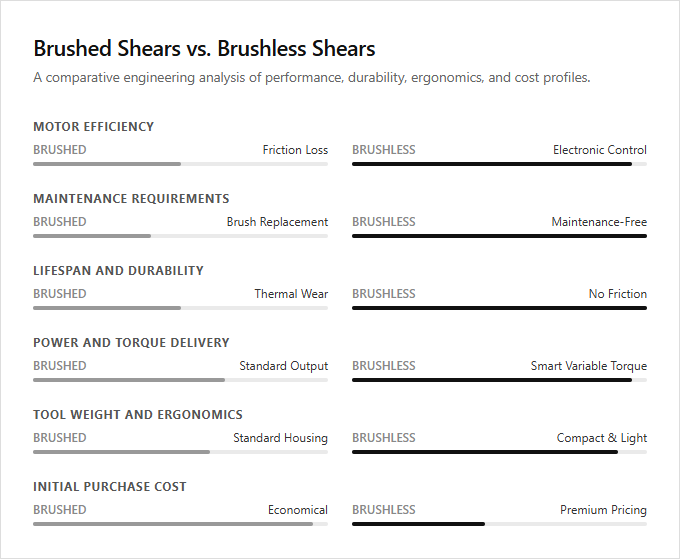
| Factor | Summary |
|---|---|
| Motor Efficiency | Brushless shears achieve superior energy efficiency by utilizing electronic controllers instead of physical brushes, minimizing power loss due to friction. |
| Maintenance Requirements | Brushed shears require periodic replacement of worn carbon brushes, whereas brushless shears are virtually maintenance-free due to their solid-state design. |
| Lifespan and Durability | The absence of mechanical friction in brushless shears drastically reduces thermal degradation, resulting in a significantly longer tool life. |
| Power and Torque Delivery | Brushless shears feature intelligent electronic speed control that dynamically adjusts torque output to maintain cutting power under variable workloads. |
| Tool Weight and Ergonomics | Brushless shears offer a superior power-to-weight ratio, allowing for a more compact, lightweight motor housing that reduces operator fatigue. |
| Initial Purchase Cost | Brushed shears are less expensive upfront due to their simpler commutator-based manufacturing process, while brushless models command a premium price. |
Brushless Shears: Eliminating Friction for Higher Efficiency
When selecting shear power tools, the distinction between brushed and brushless motor technologies represents a significant engineering choice. Brushless shears eliminate mechanical commutation and friction losses from carbon brushes, resulting in higher thermodynamic efficiency. By removing physical contact points, these tools minimize internal heat generation and energy waste, delivering superior battery runtime and consistent cutting power under load.
Traditional brushed shears rely on physical carbon brushes to transfer electrical current, which creates friction and requires periodic maintenance. Budget-conscious DIY enthusiasts typically benefit from the simplicity and lower initial cost of brushed shears, whereas high-volume professional contractors require the durability and efficiency of brushless models for demanding daily production environments.
Brushless Shears: Maximizing Battery Runtime
When selecting power shears, the primary distinction lies in motor efficiency and technology. Traditional brushed shears rely on physical carbon brushes to transfer energy, which generates friction and heat. In contrast, brushless shears utilize an electronic speed controller to optimize current delivery based on load, maximizing battery runtime and extending the overall lifespan of the tool.
While brushed models offer a lower initial cost, they require regular maintenance as the brushes wear down over time. Casual DIY enthusiasts or occasional hobbyists often find budget-friendly brushed shears sufficient for quick, light tasks, whereas high-volume professional contractors requiring continuous daily performance and maximum battery efficiency are best suited for brushless shears.
Thermal Performance: Brushed vs. Brushless Shears
When selecting electric shears, motor design plays a critical role in tool longevity and performance. Traditional brushed shears rely on carbon brushes to deliver current to the rotating armature. This mechanical contact generates friction, leading to significant heat buildup in the armature windings during prolonged use, which can degrade internal components over time.
In contrast, brushless models utilize an electronic controller to manage power, eliminating physical brushes. This design features superior thermal dissipation as the heat-generating coils are positioned on the stationary outer ring, allowing heat to escape more efficiently. Lightweight, budget-friendly brushed shears are ideal for occasional DIY hobbyists, while highly efficient brushless models are best suited for high-volume fabrication professionals requiring continuous-duty operation.
How Brushless Motors Optimize Sheet Metal Shears
When selecting sheet metal shears, the choice between brushed and brushless motors significantly impacts on-job performance. Brushless motors deliver a superior torque-to-weight ratio, which allows the shears to maintain a consistent RPM even under heavy cutting resistance. By eliminating mechanical brushes, these advanced models minimize energy loss and heat buildup, preventing the tool from stalling when navigating thick-gauge metal materials.
In contrast, traditional brushed shears rely on physical contact carbon brushes that wear down over time, leading to decreased cutting speed under load. While brushed shears are highly suitable for budget-conscious DIY enthusiasts undertaking occasional home workshop tasks, brushless models are the ideal choice for industrial fabrication professionals who require continuous, high-volume cutting power on demanding jobsites.
Brushed vs. Brushless Shears: The Maintenance Difference
Brushed power shears rely on internal carbon brushes to deliver electrical current to the motor. Over time, the mechanical friction generated during operation leads to the physical degradation of these components, requiring users to perform periodic maintenance and part replacements to sustain optimal tool performance.
Brushless shears utilize an electronic sensor controller instead of physical brushes, resulting in a maintenance-free system that eliminates downtime. This advanced design also increases energy efficiency and extends the overall operational lifespan of the tool. Budget-conscious DIY enthusiasts often prefer traditional brushed shears for occasional home projects, whereas high-volume contractors and industrial professionals benefit most from the continuous reliability of brushless models.
Brushless Shears: Eliminating Voltage Drop for Higher Efficiency
When selecting power shears, understanding the motor technology is key to optimizing performance. Traditional brushed shears rely on physical carbon brushes contacting a spinning commutator, which inherently creates friction and electrical resistance. In contrast, brushless shears eliminate this physical contact entirely. By preventing the voltage drop typically lost across the commutator-brush interface, brushless models achieve significantly higher electrical efficiency and extended battery runtime.
This lack of mechanical wear also translates to reduced heat buildup and a longer overall tool lifespan. While brushed alternatives remain a budget-friendly option, they require periodic maintenance to replace worn brushes. Budget-conscious DIYers and occasional hobbyists will find brushed shears perfectly adequate for light tasks, whereas high-volume industrial fabricators and professional contractors requiring maximum daily productivity are best suited for brushless shears.
The Magnetic Mechanism of Brushless Shears
Selecting the right metal shear power tool depends on understanding the underlying motor technology. Traditional brushed shears rely on physical carbon brushes to deliver electrical current, which creates friction, heat, and gradual wear over time. While these tools remain a cost-effective and reliable standard, they do require periodic maintenance and brush replacement to sustain optimal performance.
In contrast, brushless shears use rare-earth permanent magnets on the rotor to generate electromagnetic force without electrical contact. By eliminating the friction associated with carbon brushes, this design maximizes energy efficiency, minimizes heat buildup, and significantly extends the overall lifespan of the tool. This electronic control system delivers more consistent torque and power under heavy cutting loads.
Budget-conscious DIY enthusiasts or occasional users will find brushed shears highly practical for light, intermittent projects, whereas high-volume contractors and industrial fabricators require the continuous power and maintenance-free durability of brushless shears.
Leave a comment