
Selecting a power saw that consistently delivers high torque under load is a persistent challenge for trade professionals. Too often, demanding projects are stalled by motors that overheat, lag, or bog down mid-cut. Historically, operators bridged this performance gap by relying on standard mains power or budgeting for frequent replacement of entry-level tools. However, transitioning to modern brushless technology grants users unprecedented torque efficiency, cooler operating temperatures, and up to twice the operational lifespan of traditional tools.
Crucially, certain stipulations apply: realizing these performance gains requires a higher upfront financial investment and pairing the tool with compatible high-output battery platforms. For example, when pushing a heavy-duty circular saw through dense, wet-treated 4x4 lumber, the difference in continuous torque retention becomes immediately apparent.
This guide compares the internal mechanics of brushed and brushless motors, evaluates their torque-to-weight ratios under load, and outlines the key factors to help you select the optimal power saw for your job site requirements.
| Factor | Summary |
|---|---|
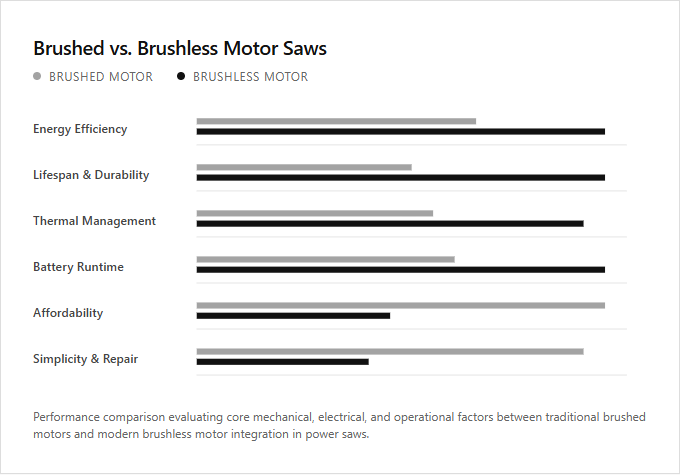
| Operating Principle | Brushed motors rely on physical carbon brushes to transfer current, whereas brushless saws utilize an electronic controller to manage power delivery via electromagnetic induction. |
| Energy Efficiency | Brushless motor saws achieve higher efficiency by eliminating the friction and voltage drop associated with a mechanical commutator. |
| Maintenance and Lifespan | Brushed saws require periodic maintenance to replace worn carbon brushes, while brushless saws experience virtually no mechanical wear on internal electrical components. |
| Thermal Management | Brushless saws generate significantly less heat during operation, reducing the risk of thermal overload and protecting the tool's armature. |
| Battery Runtime | Cordless brushless saws optimize battery life by using microprocessors to dynamically adjust power consumption based on cutting resistance. |
| Cost and Complexity | Brushed saws are simpler and less expensive to manufacture, whereas brushless saws require complex integrated circuitry that increases the initial retail price. |
Electronic speed controller (ESC) dynamic power regulation
Brushless saw motors utilize an electronic speed controller (ESC) to continuously monitor resistance and dynamically adjust power delivery. Unlike brushed motors that draw a constant current regardless of the workload, the ESC in a brushless saw regulates current in real-time. This sophisticated closed-loop feedback loop optimizes energy efficiency and maintains consistent blade speed under heavy loads.
Brushed motors lack this intelligent electronic regulation, relying instead on physical carbon brushes that deliver fixed voltage levels and generate friction loss. The absence of an ESC in brushed saws results in significant speed drops during tough cuts, whereas brushless models maintain peak torque by channeling exact current demands. Casual DIY enthusiasts seeking cost-effective tools for occasional light projects benefit from traditional brushed saws, while high-volume professional contractors requiring maximum duty cycles and precise power delivery are better served by brushless technology.
Neodymium permanent magnets maximizing magnetic flux density
When selecting saw power tools, the choice between brushed and brushless motors hinges on efficiency and power delivery. Brushless motor saws represent a significant technological advancement, primarily due to their integration of neodymium permanent magnets. These rare-earth magnets maximize magnetic flux density within the motor, allowing for a compact design that delivers superior torque and sustained cutting speed under heavy loads without the friction-induced energy loss common in traditional brushed motors.
While brushed saws rely on physical carbon brushes that wear out over time, the high magnetic flux density of brushless systems ensures optimal energy conversion, extending both runtime and overall tool lifespan. Traditional brushed saws remain a dependable, cost-effective choice for DIY enthusiasts undertaking occasional home projects, whereas high-performance brushless saws are ideal for trade professionals requiring maximum daily productivity and endurance on demanding jobsites.
Carbon brush friction and associated voltage drop
Brushed motor saws utilize physical carbon brushes that press against a rotating commutator. This mechanical contact creates continuous friction, generating significant heat and causing a measurable voltage drop across the interface, which reduces overall tool efficiency. In contrast, brushless saws employ electronic circuitry instead of physical brushes, bypassing these mechanical limitations entirely.
By eliminating brush-related friction and the associated voltage drop, brushless motors deliver more battery power directly to the cutting blade, ensuring longer runtimes and sustained torque under heavy loads. Brushed models remain ideal for budget-conscious DIYers and occasional home hobbyists, whereas brushless saws are best suited for demanding professionals who require maximum daily performance and minimal tool maintenance.
Torque-to-weight ratio optimization in brushless configurations
In the selection of power saws, the transition from brushed to brushless motor technology represents a significant advancement in tool efficiency. Brushless configurations eliminate physical brushes, allowing electronic controllers to optimize energy delivery directly to the stator. This engineering shift dramatically enhances the torque-to-weight ratio, enabling lighter saws to deliver high rotational force without the heat buildup and mechanical drag associated with traditional carbon brushes.
By utilizing permanent magnets and precise electronic commutation, brushless saws maintain consistent torque under heavy loads while reducing overall tool mass. High-demand construction professionals requiring maximum runtime and power on intense framing jobs benefit most from brushless saws, while budget-conscious DIY enthusiasts find traditional brushed models highly suitable for occasional, lighter-duty workshop cutting.
Closed-loop feedback sensor integration for load compensation
Brushless motor saws leverage advanced electronics, integrating closed-loop feedback sensors to continuously monitor and compensate for varying workloads. When cutting through dense knots or hardwoods, these internal sensors instantly detect drops in blade RPM and signal the controller to increase current, maintaining a constant speed under load. In contrast, traditional brushed motor saws lack this active electronic feedback loop, meaning their speed decreases linearly as mechanical resistance increases.
This difference in load compensation directly affects efficiency, run-time, and tool longevity. While traditional brushed saws are highly suitable for budget-conscious DIYers undertaking occasional light utility cuts, brushless saws with closed-loop sensor technology are the superior choice for high-volume trade professionals who demand consistent torque and absolute precision on demanding job sites.
Thermal dissipation efficiency preventing motor demagnetization
In power saws, thermal dissipation is a critical factor in maintaining motor longevity and preventing permanent magnet demagnetization. Brushed motors generate significant friction and heat internally at the commutator and brush interface, making heat dissipation difficult. This internal heat buildup can reach temperatures that degrade the magnetic strength of the permanent magnets, leading to a permanent loss of torque and efficiency.
Brushless motors position their heat-generating copper coils on the outer stator, allowing heat to escape directly through the tool housing. This efficient thermal pathway keeps the internal permanent magnets cooler during demanding cutting applications, preventing demagnetization and maintaining consistent power output. Brushed saws remain a cost-effective choice for DIY hobbyists with light, intermittent projects, whereas brushless models are essential for trade professionals requiring sustained, heavy-duty cutting performance.
Commutator-free design eliminating electrical arcing
When selecting a saw power tool, the choice between brushed and brushless motors significantly impacts performance and longevity. Traditional brushed motors rely on physical carbon brushes and a commutator to deliver current, which inevitably generates friction and electrical arcing. In contrast, brushless motors utilize an innovative commutator-free design controlled by an electronic circuit. By eliminating physical contact, these advanced motors eradicate electrical arcing entirely, resulting in cooler operation, minimal thermal stress, and a substantially longer tool lifespan.
This seamless energy transfer also yields higher efficiency and greater torque-to-weight ratios during demanding cutting tasks. Maintenance is virtually eliminated, as there are no carbon brushes to wear down or replace over time. Brushed motor saws remain ideal for budget-conscious DIYers undertaking occasional home projects, whereas brushless motor saws are best suited for professionals and heavy-duty users who require maximum reliability and daily runtime.
Leave a comment