
Industrial system engineers frequently struggle with soaring energy costs and premature equipment wear caused by running regenerative blowers at continuous, unoptimized speeds. While traditional capital expenditure budgets often stall necessary hardware upgrades, leveraging local utility energy-efficiency grants can dramatically offset modernization costs, granting facilities immediate access to high-efficiency control technologies.
However, an important stipulation remains: variable-frequency drive (VFD) integration requires meticulous motor insulation matching to prevent premature winding failure from harmonic voltage spikes. In municipal and packaging plants adhering to rigorous ISO 50001 energy management standards, this balanced approach has proven highly successful in stabilizing system pressure while reducing consumption.
This article provides a comprehensive comparison of fixed-speed versus variable-frequency drive regenerative blowers. We will examine operational performance curves, analyze real-world energy consumption profiles, and outline key integration strategies to help you maximize airflow efficiency in your ring compressor systems.
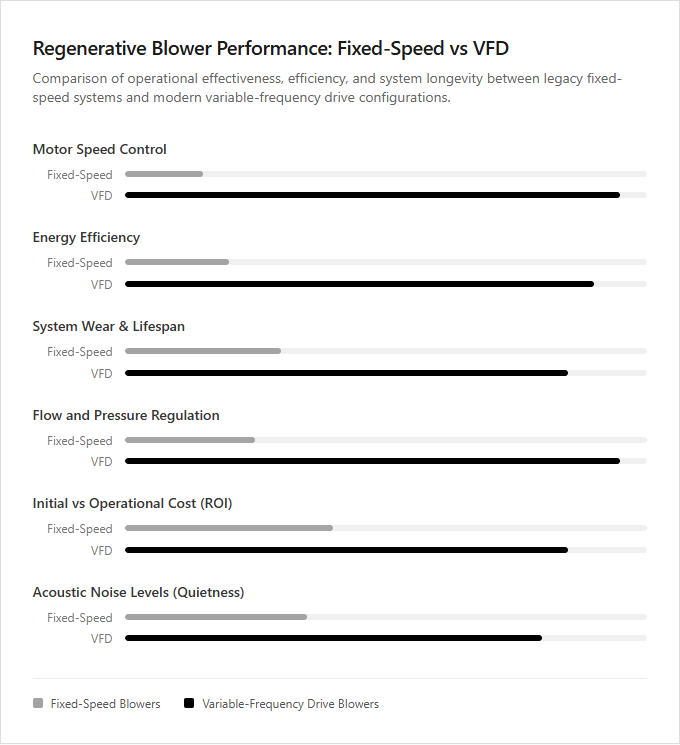
| Factor | Summary |
|---|---|
| Motor Speed Control | Fixed-speed blowers operate at a constant synchronous speed dictated by grid frequency, whereas VFD blowers dynamically alter the input hertz to regulate rotational velocity. |
| Energy Efficiency | VFD blowers leverage the affinity laws to drastically reduce power consumption during partial-load conditions, unlike fixed-speed models that run continuously at maximum power. |
| System Wear & Lifespan | Fixed-speed blowers suffer from high inrush current and mechanical shock during startup, while VFD blowers utilize a soft-start sequence to mitigate thermal stress. |
| Flow and Pressure Regulation | Fixed-speed configurations require restrictive throttling valves to adjust volumetric flow rate, whereas VFD systems directly modulate discharge pressure by adjusting motor speed. |
| Initial vs Operational Cost | While fixed-speed blowers require lower initial capital expenditure, VFD blowers deliver a superior return on investment through long-term utility savings. |
| Acoustic Noise Levels | VFD blowers significantly decrease decibel levels at lower operating frequencies by minimizing the rotational velocity and impeller tip speed. |
Affinity Laws: Cubic Power Savings in VFD Blowers
Regenerative blowers are essential for high-volume, low-pressure air applications, available in fixed-speed and variable-frequency drive (VFD) configurations. While fixed-speed blowers operate continuously at a constant velocity, VFD-equipped models offer precise control over motor speed to match fluctuating system demands. This speed modulation yields massive energy savings due to the Affinity laws, which dictate that a blower's power consumption decreases cubically with any reduction in rotational speed. Operating a VFD blower at just 80% speed reduces power draw by nearly 50%, significantly lowering operating costs.
Choosing between these technologies depends entirely on your operational profile. Fixed-speed blowers are ideal for operators running steady-state, continuous-duty processes with constant airflow requirements, whereas VFD models suit energy-conscious facilities managing variable demands and fluctuating production cycles.
Inefficient Pressure Regulation in Fixed-Speed Blowers
Regenerative blowers are vital for industrial air moving, but the choice between fixed-speed and variable-frequency drive (VFD) systems heavily impacts operational efficiency. Fixed-speed blowers run continuously at maximum velocity, relying on inefficient bypass valves or physical throttling to regulate system pressure. This mechanical restriction fails to reduce motor power consumption, wasting significant kinetic energy as heat and noise.
Variable-frequency drives adjust the motor speed directly to match the precise demand of the application. By modulating the electrical frequency, VFD systems eliminate the need for artificial throttling, drastically reducing energy waste and mechanical wear. Fixed-speed models suit operators with constant, uninterrupted airflow demands, while VFD units are ideal for facility managers requiring precise, fluctuating pressure control.
Why Low-Speed VFDs Require Inverter-Duty Motors
Regenerative blowers operate as either fixed-speed or variable-frequency drive (VFD) systems to meet industrial airflow requirements. While VFDs offer excellent energy efficiency by adjusting motor speed to demand, low-speed operation introduces severe thermal risks. Because standard integrated cooling fans slow down at reduced speeds, heat dissipation decreases significantly. To prevent thermal breakdown, VFD blowers require specialized inverter-duty motors designed with enhanced insulation and independent cooling to withstand these high-temperature conditions.
Fixed-speed blowers run consistently at a single velocity, maintaining steady cooling and reliable, straightforward operation. Fixed-speed models are ideal for operators requiring constant, predictable airflow on a limited budget, whereas VFD systems suit facility engineers managing complex, variable-demand processes who prioritize precise control and long-term energy optimization.
Optimizing Blower Turndown and Efficiency via Frequency Control
Regenerative blowers are vital assets in industrial air-handling, with the choice between fixed-speed and variable-frequency drive (VFD) configurations significantly impacting operational efficiency. VFD blowers offer superior adaptability by dynamically modulating motor speed to match real-time system demands. Adjusting frequency optimizes the blower's turndown ratio while maintaining stable volumetric efficiency under varying loads, preventing unnecessary energy consumption during fluctuating demand cycles.
Fixed-speed blowers operate at a constant velocity, delivering a continuous flow rate and relying on bypass valves to manage excess pressure. While highly reliable and structurally simple, they lack the energy-saving adaptability of variable systems. Fixed-speed units are best suited for operators running continuous, uninterrupted processes with stable pressure demands, while VFD models are ideal for facilities requiring precise process control and energy optimization under shifting workloads.
VFDs Dynamically Match Blowers to Compressor Curves
Regenerative blowers, also known as ring compressors, traditionally operate at a fixed speed, which can limit efficiency when system demands fluctuate. Integrating a Variable-Frequency Drive (VFD) resolves this by dynamically matching the blower's operating point to the shifting system curve. By modulating motor frequency in real time, the VFD adjusts airflow and pressure output, ensuring the compressor runs efficiently even as downstream resistance changes.
Fixed-speed models run continuously at maximum capacity, which simplifies operation but can lead to energy waste during low-demand periods. VFD-driven blowers mitigate this waste and reduce mechanical wear by avoiding unnecessary high-pressure operation. Fixed-speed blowers are ideal for facility managers with stable, unchanging airflow requirements, whereas VFD systems are highly suitable for operators managing dynamic processes who require precise control and energy savings.
PWM in VFDs Eliminates High Inrush Current
When selecting regenerative blowers, the choice between fixed-speed and variable-frequency drive (VFD) systems heavily impacts system longevity and electrical infrastructure. Conventional fixed-speed blowers rely on direct-on-line starting, which draws a massive inrush current that stresses both the motor and the power grid. In contrast, VFD blowers utilize pulse-width modulation to precisely control voltage and frequency. By gradually ramping up the motor, pulse-width modulation completely eliminates this high inrush current, ensuring a soft start that reduces mechanical wear and thermal stress.
This controlled acceleration prevents facility voltage drops and optimizes energy consumption. Fixed-speed blowers are suitable for operators requiring simple, continuous constant-flow processes, while VFD models are ideal for engineers seeking precise flow control, energy efficiency, and minimized electrical demand.
Mitigating VFD Harmonics with Line Reactors and Filters
Regenerative blowers are essential in industrial air applications, available in either fixed-speed or variable-frequency drive (VFD) configurations. While fixed-speed systems operate at a constant velocity directly from the main power source, VFD systems allow for precise flow control by adjusting motor speed. This VFD integration introduces non-linear loads that create harmonic distortion within the electrical supply. The resulting electrical interference necessitates the installation of line reactors or harmonic filters to protect sensitive upstream equipment and maintain power quality.
Choosing between these technologies depends on operational demands and infrastructure capabilities. Fixed-speed blowers are ideal for operators requiring straightforward, continuous displacement with minimal electrical complexity, whereas VFD blowers are suited for engineers needing precise process modulation who have the technical capacity to mitigate electrical harmonics.
Leave a comment