
Professional tradespeople and industrial operators frequently struggle with the frustration of adhesive cooling mid-application due to sudden voltage drops in cordless hot melt tools. While relying on standard, off-the-shelf alkaline batteries offers an accessible and familiar starting point for powering these devices, this traditional energy source often fails to maintain the intense, consistent thermal output required for heavy-duty bonding.
Selecting the correct battery chemistry grants operators uninterrupted thermal regulation and rapid recovery times. However, as an essential educational stipulation, users must balance initial procurement costs against the specific duty-cycle demands of their projects-whether executing high-volume packaging sealing or precise product assembly.
This article provides an objective comparison of Lithium-Ion versus Alkaline power sources, evaluating run-time efficiency, thermal stability, and long-term cost-of-ownership to help you select the optimal power source for your cordless adhesive applicators.
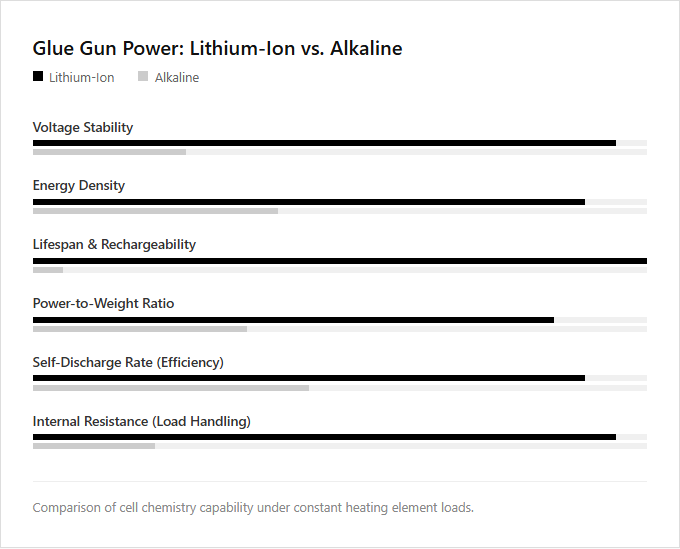
| Factor | Summary |
|---|---|
| Voltage Stability | Lithium-ion batteries maintain a flat discharge curve to deliver consistent heating power to the glue gun, whereas alkaline batteries suffer from continuous voltage drop that degrades thermal performance. |
| Energy Density | Lithium-ion chemistry offers a significantly higher energy density than alkaline cells, allowing the power tool to run much longer on a single charge cycle. |
| Lifespan and Rechargeability | Lithium-ion batteries support hundreds of charge-discharge cycles, whereas disposable alkaline batteries are limited to single-use applications and generate substantial electronic waste. |
| Power-to-Weight Ratio | Lithium-ion cells provide a superior power-to-weight ratio, ensuring the glue gun remains lightweight and ergonomic during prolonged operation. |
| Self-Discharge Rate | Lithium-ion batteries exhibit an extremely low self-discharge rate during storage, whereas alkaline batteries are prone to capacity loss and corrosive electrolyte leakage over time. |
| Internal Resistance | Lithium-ion packs have low internal resistance to easily handle the high current draw required by the heating element, while alkaline batteries suffer from high internal resistance that causes voltage sag under load. |
Lithium-Ion Extends Heating Element Runtime
When selecting a cordless glue gun, the power source determines overall performance. Heating elements are high-draw components requiring consistent, high-wattage output. Lithium-ion batteries excel in this application due to their superior energy density, which delivers sustained power and significantly longer runtimes compared to alkaline alternatives under heavy thermal loads.
Alkaline batteries experience rapid voltage drops under high-drain conditions, leading to fluctuating nozzle temperatures. Lithium-ion cells maintain a steady voltage output until depletion, ensuring consistent adhesive flow. Busy professionals and high-volume crafters benefit most from the reliable, sustained heat of lithium-ion models, while occasional DIYers performing quick, minor repairs may find the simplicity of alkaline-powered guns sufficient.
Consistent Lithium-Ion Discharge Prevents Extrusion Temperature Drops
When selecting a cordless hot glue gun, the choice of power source directly impacts thermal performance. Lithium-ion batteries provide a distinct engineering advantage through their flat discharge curve, delivering a steady voltage output until the cell is nearly depleted. This consistent power delivery prevents the heating element from experiencing temperature drops, ensuring a stable melt rate and smooth adhesive flow during continuous extrusion.
Alkaline batteries experience a progressive voltage drop from the moment they are activated. This decline leads to gradual thermal loss in the glue gun, resulting in sluggish extrusion and inconsistent bonding. High-capacity lithium-ion models are ideal for professional contractors and heavy crafters requiring prolonged, dependable heat, whereas alkaline-powered units are best suited for infrequent, quick household repairs by casual DIY users.
Low-Resistance Li-ion Enables Rapid Warm-Up
Cordless glue guns rely heavily on their power source to reach operating temperatures quickly. Lithium-ion batteries offer a distinct technical advantage over traditional alkaline cells due to their significantly lower internal resistance. This characteristic allows lithium-ion chemistry to efficiently deliver the high peak currents required by the heating element during the initial warm-up phase, resulting in rapid deployment times and consistent thermal performance.
In contrast, alkaline batteries suffer from higher internal resistance, causing voltage drops under heavy thermal loads and leading to sluggish heating cycles. This limitation makes alkaline-powered models less efficient for demanding applications that require sustained heat. Lithium-ion tools are ideal for professional contractors and frequent crafters who require rapid, reliable performance, while alkaline-powered glue guns are best suited for occasional DIY users performing light, quick repairs.
Rechargeable Lithium-Ion Eliminates Disposable Battery Costs
When selecting a cordless glue gun, the choice of power source significantly impacts both long-term operational costs and overall tool performance. Lithium-ion batteries offer an exceptional rechargeable cycle life, allowing the tool to be recharged hundreds of times before capacity degrades. This capability directly eliminates the high recurring expense of purchasing disposable alkaline primary cells, which deplete rapidly under the constant, high-thermal demands of glue gun heating elements.
Beyond cost efficiency, lithium-ion technology maintains a stable voltage output, ensuring consistent heating temperatures throughout the job. Lithium-ion models are highly recommended for professional tradespeople and heavy crafters who require frequent, reliable heating, while alkaline-powered glue guns remain suitable for occasional DIYers needing a simple tool for infrequent, light repairs.
BMS Prevents Thermal Runaway in Lithium-Ion Tools
When selecting cordless glue guns, the choice of power source significantly impacts safety and sustained performance. Lithium-ion models offer a major technological advantage through integrated battery management systems. During prolonged operations, this specialized circuitry actively monitors cell temperature and voltage, preventing thermal runaway and ensuring consistent heat output under demanding conditions.
Alkaline-powered glue guns rely on simple chemical reactions without protective electronic safeguards. While suitable for short tasks, they lack active thermal monitoring and suffer from rapid voltage drops under heavy loads. Professional crafters and contractors requiring continuous, high-heat output benefit most from advanced lithium-ion systems, whereas casual hobbyists performing quick, occasional repairs may find the simplicity of alkaline batteries sufficient.
Lithium Glue Guns Stay Charged During Storage
When selecting a cordless glue gun, the battery chemistry dictates the tool's reliability and long-term performance. Lithium-ion technology offers a distinct advantage over alkaline alternatives due to its exceptionally low self-discharge rate. While alkaline batteries steadily lose power during inactivity, lithium-ion cells retain their charge over extended periods of storage. This characteristic ensures the glue gun remains fully operational and ready for immediate deployment without pre-use charging delays.
Alkaline-powered options offer a lower initial cost but suffer from rapid voltage drops and require frequent battery replacements. Lithium-ion models deliver consistent thermal output throughout the entire discharge cycle to maintain optimal adhesive temperatures. Lithium-ion units are best suited for professionals and active hobbyists requiring instant readiness and sustained performance, whereas alkaline models are appropriate for occasional users seeking a budget-friendly tool for minor, infrequent household repairs.
High-Voltage Cells Enable Compact, Lightweight Battery Packs
When selecting a cordless glue gun, the choice between lithium-ion and alkaline battery technology significantly impacts tool ergonomics and thermal performance. Lithium-ion chemistry delivers a higher nominal voltage per cell compared to traditional alkaline alternatives. This inherent electrical efficiency allows manufacturers to design lightweight, compact battery pack configurations that reduce hand fatigue and improve maneuverability during intricate tasks.
In contrast, alkaline-powered glue guns require multiple individual cells to achieve comparable voltage levels, resulting in bulkier designs and rapidly declining heat output. High-volume crafters and tradespeople requiring consistent heating cycles are best suited for lithium-ion models, whereas casual hobbyists performing infrequent, quick repairs may find the simplicity of alkaline-powered options sufficient.
Leave a comment